
Mori · licensed hairdresser, 8 years in Tokyo & Shanghai, specialising in Japanese straightening.
Matching a product to a hair type was the job. That is what this article is.
Both of these are sold to people with dry hair. They solve different problems.
Tsubaki repairs. &Honey moisturises. Those sound like the same thing and they are not, and picking the wrong one is why people end up saying a well-reviewed shampoo “did nothing.”
Here is how to tell which problem you actually have.
⏱️ In a hurry?
Damaged — bleached, coloured, heat-worn → Tsubaki Premium EX Damage Care & Repair (gold)
Dry and coarse, thick or curly, but not damaged → &Honey Deep Moist
Dry but fine to medium → Tsubaki Premium Moist & Repair (red)
Quick Comparison
| Tsubaki Premium EX Damage Care & Repair | &Honey Deep Moist | |
|---|---|---|
| What it does | Repairs structure | Adds moisture |
| Formula weight | Heavy (the heaviest Tsubaki) | Heavy |
| Mechanism | Camellia oil, arginine-derived conditioner, phytosteryl esters, macadamia fatty acids | Three honeys, plant keratin, argan oil |
| Best for | Damaged, coloured, heat-styled | Coarse, thick, very dry, curly |
| Wash frequency | Daily is fine | 3–4× weekly maximum |
| Fine hair | Too heavy unless badly damaged | Will go limp |
| Scent | Floral, strong | Sweet honey, stronger |
| Size | 400ml + 400ml set | 440ml |
| Price band | $$$ | $$$ |
| Where to buy | Check Price on Amazon | Check Price on Amazon |
Price bands: $$ mid-range · $$$ premium. Amazon pricing moves — check the live listing.
Damage and Dryness Are Not the Same Thing
This is the distinction that decides your purchase, and almost nobody outside a salon makes it.

Damage is structural. The cuticle has lifted or broken and protein has been lost. It comes from bleach, colour, perms, straightening, or years of heat. Damaged hair snaps, splits, tangles, and feels rough when you run your fingers up the strand. You cannot moisturise it back. You can fill the gaps and smooth the cuticle — that is what repair formulas do.
Dryness is a moisture deficit. The hair is intact but thirsty. It comes from coarse texture, dry climate, hard water, indoor heating, or simply not conditioning enough. Dry hair feels rough and looks dull, but it does not snap easily and it does not split much. This one moisture actually fixes.
How to tell which you have
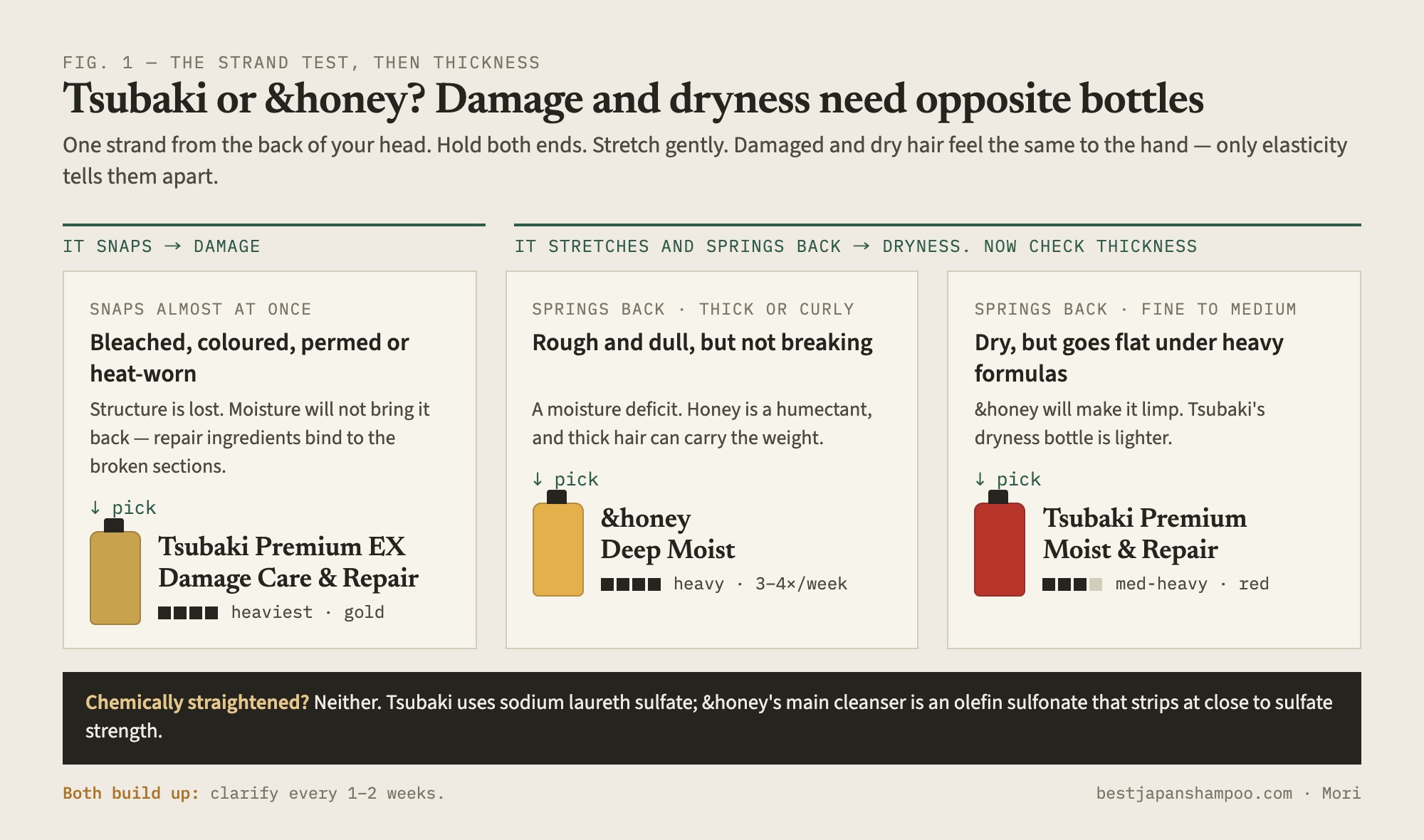
Take one strand and stretch it gently.
- It snaps almost immediately → damage. You want Tsubaki EX
- It stretches, then returns → dryness. You want &Honey if your hair is thick or curly, or the lighter Tsubaki Moist & Repair if it is fine to medium
Another check: run your fingers from the ends up towards the roots. If it feels rough in that direction but smooth going down, the cuticle is lifted — that is damage.
If you have both — and plenty of people do — treat the damage first. Moisture sits better on hair that has been repaired than repair works on hair that is parched.
Tsubaki Premium EX Damage Care & Repair — The Repair One
Best for: Coloured, bleached, permed, or heat-damaged hair
Tsubaki Premium EX Damage Care & Repair (the gold bottle) is the repair formula in the range. On top of the camellia oil base it adds an arginine-derived conditioning agent, phytosteryl esters and macadamia fatty acids — ingredients that bind to the damaged, negatively charged sections of the fibre rather than just coating the outside.
September 2026 correction: this article used to recommend the red Premium Moist & Repair for damage. That bottle is Tsubaki’s dryness formula, not its repair formula — the name misleads almost everyone. For damage it is EX; red Moist & Repair appears below as the pick for dry hair that is too fine for &honey.
Not sure which Tsubaki bottle is which? The range was renamed — see which Tsubaki shampoo to buy for the red / white / gold breakdown.
It is heavy — heavier than the rest of the Tsubaki range — and it works best with its matching EX conditioning treatment, which does more of the repair than the shampoo. On healthy hair it is too much.
Pros – Genuine repair on chemically processed hair – The matching EX treatment does real work on bleached ends – Thick creamy lather, luxurious for a drugstore price – Fine for daily use – Easy to find and replace
Cons – Buildup after 2–4 weeks is the dominant complaint, and it needs a clarifying wash to reset – Contains sulfates, which matters if your hair is chemically treated — see below – Strong sweet-floral fragrance that lingers – Too heavy for fine or oily hair
👉 Buy Tsubaki Premium EX Damage Care & Repair →
One caveat. Tsubaki contains sulfates. If your hair is chemically straightened or freshly coloured, sulfates accelerate the fade of the treatment you paid for. In that case a sulfate-free repair formula is the better call — our straightening aftercare guide covers what to use instead.
&Honey Deep Moist — The Moisture One
Best for: Coarse, thick, curly, or genuinely dry hair
&honey has one serious rival in the same botanical, sulfate-free-labelled corner of the Japanese drugstore, and it works in the opposite direction — the BOTANIST vs &honey comparison is the one to read if your hair is fine or your scalp does not like a heavy finish.
&Honey uses three honeys — Manuka, Acacia, and Japanese raw honey — layered so they absorb at different rates, plus plant-derived keratin and argan oil.
Honey is a humectant: it pulls water into the hair shaft and holds it. That is a different mechanism from repair, and on hair that is dry rather than damaged it works better than any protein formula will.
It is the heaviest shampoo in the Japanese drugstore range. That is the point, and also the limit.
Pros – The most moisture available at this price – Transforms coarse, dry, frizzy lengths in one wash – Excellent in winter and in dry climates – Rich enough that a small amount goes far – The best of the two for curly and coiled hair
Cons – Far too heavy for fine hair — it will go limp – Builds up above 3–4 washes weekly – Most expensive per millilitre of the two – The sweet honey scent divides people – Labelled sulfate-free, but the main cleanser is sodium C14-16 olefin sulfonate, which strips at close to sulfate strength
Both Have the Same Weakness
Neither of these clarifies. Both build up, and buildup is the reason most people abandon either one.
The pattern is identical: two good weeks, a waxy scalp by week three, limp and dull hair by week four. That is residue, not the shampoo failing.
The fix is a clarifying wash every week or two. A light clarifying formula clears it without undoing the work — our Ichikami vs Tsubaki comparison covers the cheapest way to do that, and the sulfate-free guide has a clarifier that does not reintroduce sulfates.
This single habit prevents more complaints about both products than any other change.
Which One by Hair Type
Bleached or heavily coloured → Tsubaki EX. Structural damage needs repair, not moisture.

Coarse and thick, undamaged → &Honey. Nothing else here delivers that much moisture.
Curly or coiled → &Honey. Textured hair is dry by structure, and weight is what defines curls. Our curly hair guide goes further, including the conditioner pairing that matters more than the shampoo.
Fine hair → dry and fine: Tsubaki Moist & Repair; fine and flat by afternoon: Tsubaki Volume & Repair. &Honey will flatten fine hair completely.
Dry winters, normal hair the rest of the year → both, seasonally. &Honey through winter, Tsubaki the rest of the year.
Chemically straightened → neither. Tsubaki uses sodium laureth sulfate and &honey an olefin sulfonate; both shorten the life of the treatment. See the aftercare guide.
No idea → Tsubaki Moist & Repair (red). It sits in the middle — lighter than &honey, gentler on healthy hair than EX — so its failure mode is milder.
FAQ
Is &Honey better than Tsubaki? For dry, coarse, or curly hair, yes. For damaged hair, no — moisture does not repair structure. The two are not competing at the same job.
Can I use both? Yes, and seasonal rotation is the most sensible way: &Honey in winter and dry months, Tsubaki the rest of the year. Some people also use &Honey once weekly as a treatment and Tsubaki as the everyday shampoo.
Which is better for frizz? Depends on the cause. Frizz from dryness responds to &Honey. Frizz from cuticle damage responds better to Tsubaki EX. If your hair is curly, weight matters more than either — see the curly guide.
Are either of them sulfate-free? Not in practice. Tsubaki lists sodium laureth sulfate second. &honey is labelled sulfate-free, but its main cleanser, sodium C14-16 olefin sulfonate, cleans at close to sulfate strength. If sulfate-free is a requirement — and it is if your hair is chemically treated — see our sulfate-free guide.
My hair went limp after two weeks. Which one was it? Most likely &Honey, and most likely your hair is finer than you thought. Either that or it is buildup — try a clarifying wash before switching products.
How do these compare to salon brands? Both are drugstore tier. Milbon sits above them and repairs more thoroughly at a higher price per bottle, though far less per wash. Our Milbon vs Shiseido comparison covers whether that upgrade is worth it.
The Bottom Line
Damage — bleached, coloured, snapping, splitting → Tsubaki Premium EX Damage Care & Repair 👉 Check Price on Amazon →
Dryness — coarse, thick, curly, rough but not breaking → &Honey Deep Moist 👉 Check Price on Amazon →
Do the strand test before you buy. Hair that snaps needs repair; hair that stretches needs moisture. Getting that one thing right matters more than which brand you choose.
And whichever you pick, clarify every week or two. Both of these build up, and buildup is what makes people think a good shampoo stopped working.
For the wider range, see our full Japanese shampoo comparison.
About the author
Mori spent eight years as a licensed hairdresser — two in Shanghai at the Isetan salon, six in Tokyo — specialising in Japanese hair straightening (shukumo kyosei). He no longer works behind a chair but still holds the licence, and lives in Japan.
This article is based on professional knowledge of hair and formulation, plus aggregated customer reviews. It does not claim personal testing of every product. More about how this site works →