
Mori · licensed hairdresser, 8 years in Tokyo & Shanghai, specialising in Japanese straightening.
Matching a product to a hair type was the job. That is what this article is.
Search this question and you will be told every answer between two months and twelve. That range is not a disagreement about hair. It is a sign that most of the pages answering it have never done the treatment.
Here is the part that resolves it: the hair that was straightened does not revert. Ever. The bonds were broken, reshaped and reformed, and they stay that way until that hair is cut off.

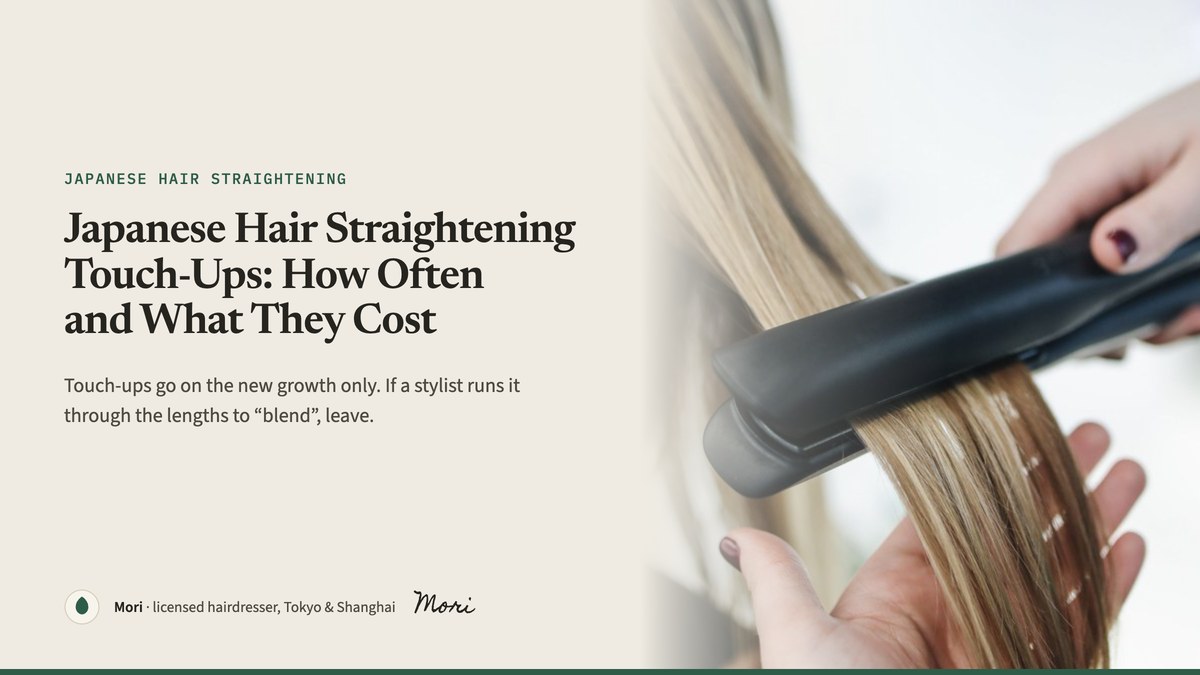
So a touch-up is not a repeat of the treatment. It is a completely different service performed on a strip of new growth at your scalp, and everything about timing and cost follows from that one fact.
The Short Answer
Most people: 6 to 12 months. The standard salon guidance is a touch-up at around four inches of new growth, which for average hair is roughly eight months.
But averages are not what you have. The real answer is three variables, and you can work yours out in about a minute.
Had the treatment done in the last three days? Stop here and read The First 72 Hours first — the rules in that window are stricter than most people are told, and mistakes made now are the ones that show up later.
The cheapest way to stretch your interval: regrowth arrives on schedule, but tired-looking lengths make it look worse and send people to the salon months early. Keeping the treated hair glossy buys you real time — Milbon Moisture Replenishing against a $300–850 service is a rounding error. Check Price on Amazon →
Work Out Your Own Interval
1. Your growth rate. Hair grows about half an inch a month — roughly six inches a year, per the American Academy of Dermatology. Some people run faster, some slower.
2. Your natural texture. This is the variable that actually decides it. The touch-up is not driven by the length of the new growth but by how visible it is. Two inches of loose wave against straightened lengths is barely noticeable. Two inches of tight curl is a visible ridge.
3. Your length. On long hair, four inches of regrowth is a fifth of the visible length. On a chin-length bob it is most of what people see. Short hair reaches “obvious” much sooner.
Roughly, by texture
| Your natural texture | Regrowth before it shows | Typical interval |
|---|---|---|
| Loose wave | 3–4 inches | 10–12 months |
| Wavy to curly | 2–3 inches | 6–9 months |
| Curly | 1.5–2 inches | 4–6 months |
| Coily / very tight | 1 inch | 3–5 months |
If you are on the shorter end of these, that is your hair, not a problem with your treatment.
The Technical Reason You Cannot Just “Redo It”
This is the part that no one outside a salon explains, and it is the reason a touch-up is a genuinely different job.
The straightening solution has to go only on the new growth. Not near it. On it.
Where new growth meets previously treated hair, there is a boundary — the demarcation line. That boundary is the weakest point on your entire head. It is where two different structures meet, and it snaps more easily than any other part of the strand.
Now consider what happens if the stylist is careless with the boundary. Hair that was already processed gets processed a second time. It is chemically broken down, reshaped and heat-pressed all over again, on top of a structure that has already been through it once. That is the classic cause of straightening breakage — not the treatment itself, but overlap.
Done properly, the stylist leaves a fraction of a millimetre of unprocessed hair rather than risk overlapping by a fraction of a millimetre. That is why a touch-up can take nearly as long as a full treatment despite using a quarter of the product. You are paying for precision, not chemicals.
A salon that rushes will run the solution down the lengths “to refresh it.” There is nothing to refresh. That hair is already straight and cannot become straighter — it can only become weaker.
The Question to Ask Before You Book
Call and ask:

“For a touch-up, do you apply to the new growth only, or do you run it through the lengths as well?”
“New growth only” — good. That is the correct answer and a stylist who does this work properly will answer immediately.
“We run it through the ends to blend it” — book somewhere else. Full-strength solution on already-straightened hair is how hair snaps at the demarcation line.
There is a middle answer worth knowing: some stylists do a short pass with a much weaker solution on the lengths to smooth the transition. That is a real technique and it is not the same as re-treating. If you hear it, ask whether it is the same strength as the root application. It should not be.
Cost
Full Japanese straightening in the US runs roughly $300 to $850, and can exceed $1,000 in major cities or at specialist salons.
For a city-by-city breakdown of what salons are charging in 2026, why the quote moves with length and history, and how to spot a salon that is too cheap, see the Japanese hair straightening cost guide.
Touch-ups are priced lower, but I am not going to invent a number for you — this is one place where the internet’s confident figures are mostly guesses. Salons price touch-ups very differently, some by the percentage of the head treated, some as a flat rate, some by time. What is consistent:
- A root touch-up costs meaningfully less than a full treatment, because it is a fraction of the product and less time on the lengths
- It is not proportionally cheap. The precision work at the demarcation line means the labour does not scale down the way the product does
- Many salons offer a partial touch-up — the front and face-framing sections only, at a lower price. Worth asking about, because the front is usually what bothers people first
Ask for the touch-up price specifically when you book, not the treatment price. They are separate line items.
When You Cut Your Hair, the Maths Changes
Here is something almost never mentioned: if you trim regularly, you are removing treated hair.
Six inches of growth a year, trimmed every eight weeks, means a chin-length bob can be almost entirely new growth within a year or so. At that point the calculation flips — there is very little previously treated hair left, so a full treatment is both appropriate and lower-risk than it would be otherwise.
If you are growing your hair out, the opposite is true: you carry treated lengths for years, and every touch-up has to protect them.
Tell your stylist how often you cut. It changes what they should be doing.
What Actually Extends the Interval
Let me be straight about this, because a lot of pages are not: no shampoo slows down hair growth. Nothing you buy affects when your roots come in.
What products do affect is whether you want to go in early — and that is most of the reason people book before they need to.
Here is the pattern. The regrowth arrives on schedule. But if the treated lengths have gone dull, dry and slightly frizzy, the contrast between them and the new growth looks far worse than it is, and the whole head reads as “the treatment has failed.” It has not. The lengths have just been dried out — usually by sulfates.
Keep the treated lengths glossy and the same regrowth is much less obvious. People with well-maintained lengths routinely stretch to the far end of their interval. People whose lengths look tired come in months early and pay for it.
That is the whole mechanism, and it is worth real money — a couple of months of extra interval against a $300–850 service.
Your dryer matters here too. Straightened lengths get blow-dried several times a week for years, and the difference between a harsh dryer and a moisture-retaining one compounds over that time. See Japanese Hair Dryers on Amazon: Nanocare vs the US Models.
What to use in between
| Product | Best for | Price | Where to buy |
|---|---|---|---|
| Milbon Moisture Replenishing | The safe default — salon tier | $$$$ | Check Price on Amazon |
| BOTANIST Botanical (Damage Care) | Everyday washing, sensible budget | $$ | Check Price on Amazon |
| &Honey Deep Moist | Lengths that have already gone dry | $$$ | Check Price on Amazon |
| ONSENSOU Scalp Care Shampoo | A tight, dry scalp after treatment | $$ | Check Price on Amazon |
Price bands: $$ mid-range · $$$ premium · $$$$ salon tier. Amazon pricing moves — check the live listing.
All four are sulfate-free, which is the entry requirement rather than a feature. Our full aftercare guide covers why, and what to avoid.
One warning that matters more as you approach a touch-up: do not use clarifying shampoos on treated lengths. That includes Ichikami, which is excellent and completely wrong for this. Clarifiers strip the hair shaft, which is the opposite of what you need. See our sulfate-free guide for gentler options.
Going Too Early, and Waiting Too Long
Too early is the more common mistake and the more expensive one. Under about an inch of regrowth, there is barely enough new hair to apply to, and the risk of overlapping onto treated hair goes up sharply — the margin for error shrinks with the target. A good stylist will tell you to come back. If a salon books you at six weeks without comment, that tells you something about the salon.
Too long is less dangerous than people assume. The treated hair is not deteriorating while you wait. What happens is cosmetic — a pronounced ridge where the textures meet, and hair that is harder to style. The one real risk is mechanical: that demarcation line is fragile, so aggressive brushing or tight ponytails at the boundary can cause snapping. Be gentle with it and waiting an extra month or two costs you nothing.
FAQ
How often do I need a Japanese straightening touch-up? Six to twelve months for most people. Tighter natural texture and shorter hair mean shorter intervals — three to five months at the tight-curl end. Standard salon guidance is around four inches of new growth.
Does the straightened hair ever go back to curly? No. Those bonds were reformed and stay reformed until the hair is cut off. If your straightened lengths look wavy again, that is damage and dryness changing how they behave, not the treatment reverting.
Is a touch-up cheaper than a full treatment? Yes, but not proportionally. Less product, similar precision. Ask for the touch-up price specifically — it is a separate service, and some salons also offer a cheaper front-only partial.
Can I get a touch-up at a different salon? You can, and you should tell them exactly what was used and when. A stylist working on someone else’s chemistry blind is more likely to misjudge the boundary. Bring the date and, if you have it, the product name.
Can I colour my hair between touch-ups? Ask your stylist about timing, not the internet — the answers online conflict badly, and the right gap depends on your hair’s condition and what was used. What is not negotiable is that both services stress the same hair, so they should not be close together.
What if I only want my bangs done? Many salons will do a partial. The front grows into visibility first because you see it in the mirror all day, so this is a common and reasonable request.
Will a good shampoo make my touch-up last longer? It will not change your regrowth. It changes whether you can comfortably wait — and that is worth a couple of months. See what to use.
The Bottom Line
- The treated hair is permanent. You are only ever treating new growth
- Most people land at 6 to 12 months; tight texture and short hair, sooner
- Ask whether the salon applies to new growth only. The answer tells you whether your hair is safe there
- Ask for the touch-up price as a separate item, and about a front-only partial
- Going early is riskier than going late
- You cannot slow regrowth — but keeping the treated lengths in good condition genuinely buys you months
If you have just had the treatment done, start here instead: Shampoo After Japanese Hair Straightening — the first 72 hours matter more than anything in this article.
About the author
Mori spent eight years as a licensed hairdresser — two in Shanghai at the Isetan salon, six in Tokyo — specialising in Japanese hair straightening (shukumo kyosei). He no longer works behind a chair but still holds the licence, and lives in Japan.
This article is based on professional knowledge of hair and formulation, plus aggregated customer reviews. It does not claim personal testing of every product. More about how this site works →