
Mori · licensed hairdresser, 8 years in Tokyo & Shanghai, specialising in Japanese straightening.
Matching a product to a hair type was the job. That is what this article is.
Rewritten September 2026. The earlier version of this page ranked five shampoos. This one checks the ingredient list of every Japanese “sulfate-free” shampoo this site recommends — and three of them turned out not to be as gentle as the label suggests.
“Sulfate-free” is the most useful phrase on a shampoo bottle and the most misleading one. It tells you what is not in the formula: sodium lauryl sulfate and sodium laureth sulfate. It tells you nothing about what replaced them. A shampoo can drop the sulfates, add a cleanser that strips almost as hard, and print “sulfate-free” on the front quite legally. There is no certification behind the phrase. It is a claim the brand makes about itself.
That matters most to the people who buy sulfate-free for a reason — chemically straightened, keratin-treated, bleached or coloured hair, or a scalp that reacts. So instead of a top-five list, this is an ingredient check. I read the full ingredient list of eight Japanese shampoos, sorted them by what actually does the cleaning, and put the result in one diagram. Then I tell you which to buy.
⏱️ In a hurry?
Genuinely sulfate-free and mild, easy to buy in the US → Margaret Josefin Japanese Hotel Shampoo — amino-acid cleansers
Genuinely mild, the brand you have heard of → BOTANIST Bouncy Volume set — taurate cleanser, fine or oily-root hair
Oily, itchy scalp and untreated hair → ONSENSOU Scalp Care — sulfate-free by the letter, cleans hard
A clarifying wash once a week → DEMIKI — sulfate-free by the letter, keep it off straightened lengths
In Japan → pick up BOTANIST or Ichikami at any drugstore; details below
Outside the US? YesStyle ships most of these worldwide — the link sits next to each Amazon button.
Quick Comparison
| Line | Weight | Built for | Price | Check Price on Amazon |
|---|---|---|---|---|
| Margaret Josefin Japanese Hotel Shampoo · glutamate ✅ | Light | Treated hair, sensitive scalp, daily use | $$ | Check Price on Amazon |
| BOTANIST Bouncy Volume set · taurate ✅ | Light | Fine hair, oily roots, treated hair | $$ | Check Price on Amazon |
| BOTANIST Damage Care 490 mL (import) · taurate ✅ | Medium | Coloured or heat-damaged hair | $$$$ | Check Price on Amazon |
| ONSENSOU Scalp Care · olefin sulfonate ⚠️ | Light | Oily, itchy scalp; untreated hair | $$ | Check Price on Amazon |
| DEMIKI · olefin sulfonate ⚠️ | Light | Weekly clarifying, product build-up | $$ | Check Price on Amazon |
| &honey Deep Moist 1.0 shampoo · olefin sulfonate ⚠️ | Heavy | Thick, dry, untreated hair | $$ | Check Price on Amazon |
✅ genuinely mild cleanser · ⚠️ sulfate-free by the letter, strong in practice. Price bands: $$ mid-range · $$$$ imported, well above Japanese shelf price. Check the live listing.
What “Sulfate-Free” Means, and What It Does Not
Sulfates are detergents. Sodium lauryl sulfate (SLS) and sodium laureth sulfate (SLES) are cheap, foam well and remove oil very efficiently. They are not poison. On an oily, untreated scalp they are fine.
The problem is chemical treatments. A sulfate wash speeds up colour fade and shortens the life of Japanese straightening and keratin, which is why every aftercare sheet tells you to avoid it — the aftercare guide for straightened hair and the Japanese straightening vs keratin comparison explain why for each treatment.
“Sulfate-free” only promises that SLS and SLES are absent. What replaced them falls into three groups:
- Amino-acid and taurate cleansers — glutamates, alaninates, sarcosinates, methyl taurates. Mild, low foam, gentle on treatments. This is what people picture when they buy sulfate-free.
- Sodium C14-16 olefin sulfonate — a sulfonate, not a sulfate, so the label is technically true. It is a strong, high-foaming cleanser. My professional judgement: on treated hair I treat it like a sulfate, because in the salon a shampoo built on it fades a treatment the way a sulfate shampoo does.
- Mild ether carboxylates and betaines — often used alongside one of the above to soften it. They do not tell you much on their own.
So the question is never “does it say sulfate-free?” It is “what is the second ingredient?“
The Ingredient Check: Eight Japanese Shampoos
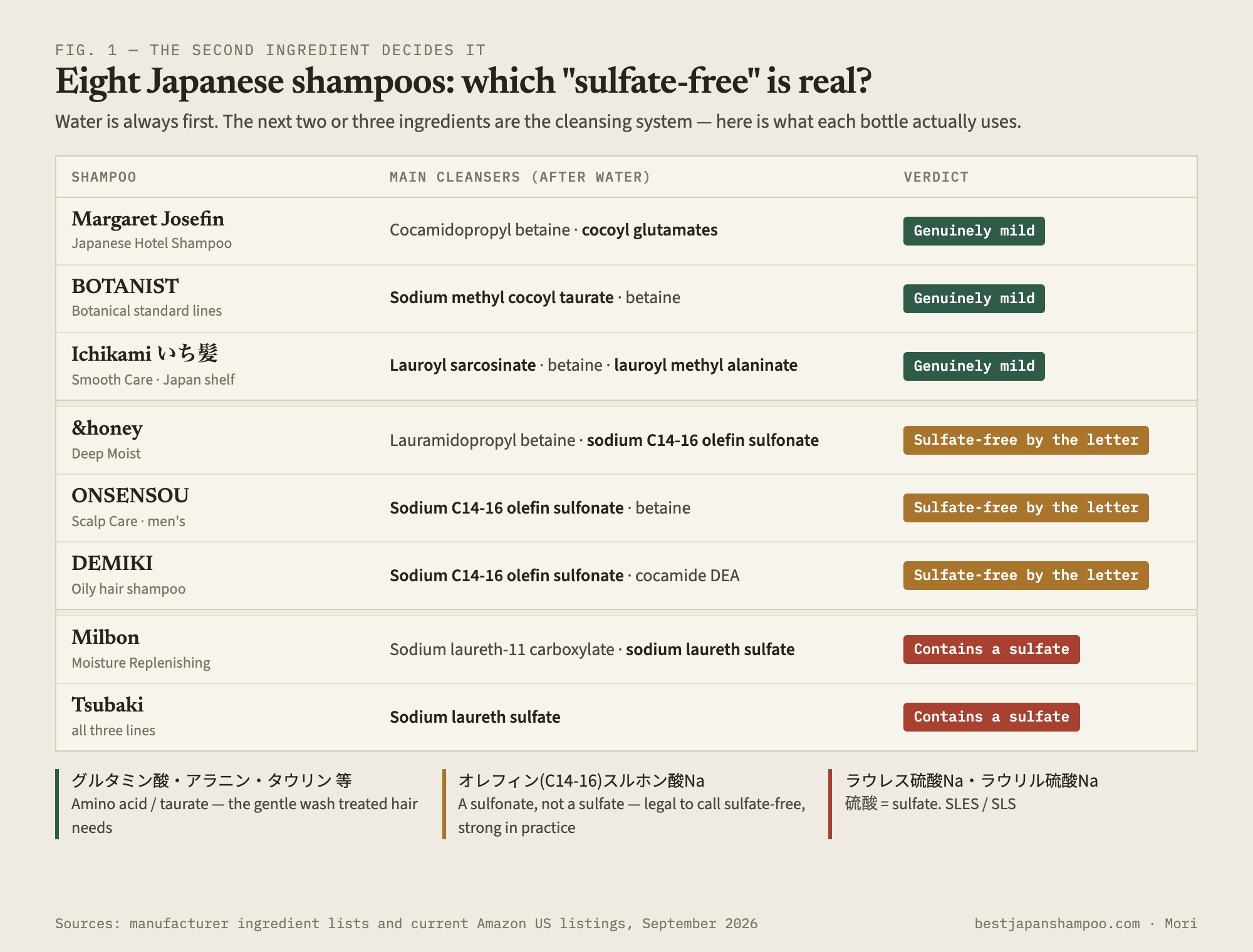
These are the cleansers at the top of each full ingredient list, taken from the manufacturer’s own list or the current Amazon US listing in September 2026. Water is always first. The next two or three ingredients are the cleansing system.
Genuinely mild — amino acid or taurate first. Margaret Josefin Japanese Hotel Shampoo cleans with cocamidopropyl betaine plus two cocoyl glutamates. BOTANIST’s standard Botanical lines use sodium methyl cocoyl taurate with a betaine. Ichikami Smooth Care, the Japan-shelf version reformulated in 2026, uses a lauroyl sarcosinate and a lauroyl methyl alaninate.
Sulfate-free by the letter — olefin sulfonate as the main cleanser. &honey Deep Moist lists sodium C14-16 olefin sulfonate second, after a betaine. ONSENSOU Scalp Care and the ONSENSOU men’s shampoo list it straight after water. DEMIKI lists it straight after water too, followed by cocamide DEA. I checked DEMIKI’s full list for this rewrite; it belongs here, not beside the gentle shampoos.
Contains a sulfate. Milbon Moisture Replenishing, a salon brand people often assume is sulfate-free, lists sodium laureth sulfate third. This site made the same assumption until September 2026 and has corrected it in every article. Tsubaki uses SLES in all three lines and never claimed otherwise — the Which Tsubaki guide covers who it still suits.
Genuinely Sulfate-Free: The Two to Buy in the US
Margaret Josefin Japanese Hotel Shampoo — Best Overall
Cleanser: cocamidopropyl betaine + TEA-cocoyl glutamate + disodium cocoyl glutamate · Size: 500 mL · Scent: green tea
Margaret Josefin is the one I recommend first now, for a plain reason: it is a true amino-acid shampoo, it is sold at a normal price on Amazon US, and it has stayed in stock. The US bottle matches the formula of the brand’s Japanese Organic Josefin line on the maker’s own ingredient list. It lathers less than you expect. That is the glutamate working as designed.
Who it is for
- Japanese-straightened, keratin-treated, coloured or bleached hair
- A sensitive scalp that tightens after washing
- Anyone who wants a daily shampoo and does not want to think about it again
Who should skip it
- Very oily scalps with heavy styling product — pair it with a weekly clarifying wash
- Anyone who wants a strong scent
Pair it with: a clarifying wash every one to two weeks if you use oils or silicones.
👉 Check Price on Amazon → · YesStyle (ships worldwide) →
BOTANIST — The Brand Name, With a Stock Problem
Cleanser: sodium methyl cocoyl taurate + cocamidopropyl betaine · Lines on Amazon US: Bouncy Volume set (brand store), Damage Care 490 mL (import)
BOTANIST is genuinely sulfate-free across its standard range, and the taurate cleanser is one of the mildest on a drugstore shelf. The catch is availability. As of September 2026 BOTANIST’s own Amazon US store has most lines out of stock. The one sold at a normal price is the Bouncy Volume shampoo and conditioner set, with a low stock count. The Japanese Damage Care 490 mL is in stock through an importer at several times its Tokyo price. The BOTANIST vs &honey comparison puts the BOTANIST and &honey ingredient panels side by side.
Who it is for
- Fine or flat hair, oily roots, a sensitive scalp (Bouncy Volume)
- Coloured or heat-damaged hair, if you accept the import price (Damage Care)
Who should skip it
- Anyone on a budget in the US — Margaret Josefin does the same job
- Anyone who dislikes a noticeable fragrance
Pair it with: the matching conditioner in the set; BOTANIST’s formulas are built as pairs.
Sulfate-Free by the Letter: Good Shampoos, Wrong for Treated Hair
These three are not bad products. They are strong cleansers with a gentle label, which makes them right for some hair and wrong for the hair most people buy sulfate-free for.
ONSENSOU Scalp Care — For an Oily, Itchy Scalp
Cleanser: sodium C14-16 olefin sulfonate straight after water · Built around: hot-spring algae and yeast extracts
ONSENSOU is a scalp shampoo. An olefin sulfonate is why it settles an oily, itchy scalp, and it is also why I keep it off straightened lengths. The men’s version uses the same cleanser with menthol. Buy whichever is cheaper.
Who it is for: oily or flaking scalps; untreated hair; wash the roots and let the rinse do the lengths. Who should skip it: anyone within the first months after a straightening or keratin treatment.
DEMIKI — A Clarifier, Not a Daily Wash
Cleanser: sodium C14-16 olefin sulfonate + cocamide DEA · Also contains: hydrolysed keratin, a small amount of taurate
DEMIKI is sold as a sulfate-free shampoo for oily hair, and it cleans like one. That makes it a useful weekly reset for build-up on untreated hair. It is not the gentle daily shampoo it looks like.
Who it is for: oily roots, dry-shampoo and styling-product build-up, once a week. Who should skip it: straightened, keratin-treated or bleached lengths.
&honey Deep Moist — Heavy Moisture on a Strong Base
Cleanser: lauramidopropyl betaine, then sodium C14-16 olefin sulfonate · Finish: heavy, oily conditioning film
&honey strips with an olefin sulfonate and then coats the hair heavily to compensate. On thick, dry, untreated hair that feels wonderful. On a treatment, the coating hides the fade until it has happened. The Tsubaki vs &honey comparison covers who it suits.
Who it is for: thick, coarse, dry hair with no chemical treatment. Who should skip it: fine hair, oily scalps, and any treated hair.
👉 Check Price on Amazon → · Stylevana (ships worldwide) →
If You’re in Japan: How to Find Real Sulfate-Free at a Drugstore
Japanese law requires every cosmetic to list its full ingredients (全成分) in order of amount, so the back of the bottle is reliable. The front is not: ノンシリコン (silicone-free) and ボタニカル (botanical) say nothing about the cleanser.
- Turn the bottle over and find 全成分. 水 (water) is first.
- Read the next two or three. ラウレス硫酸Na or ラウリル硫酸Na — the 硫酸 means sulfate. Put it back if your hair is treated.
- オレフィン(C14-16)スルホン酸Na is the olefin sulfonate: sulfate-free by the letter, strong in practice.
- ココイルグルタミン酸, ラウロイルメチルアラニンNa, ラウロイルサルコシンTEA or ココイルメチルタウリンNa near the top means an amino-acid or taurate shampoo. That is the shelf you want.
My professional judgement. In Japan, do not order this category online. BOTANIST and Ichikami (いち髪) are at every Matsukiyo, Welcia and Sundrug, both pass the check above, and both cost a fraction of the imported bottle in the US. If you live in Japan, sulphate-free shampoo in Japan: what to look for on a Japanese label walks through the back of the bottle, including why medicated (薬用) labels break the second-ingredient rule.
Buying These in Japan: What Is Actually on Amazon.co.jp
If you are reading this from Japan, the drugstore advice above still holds — but the online shelf is not the one I linked for US readers. Prices are Amazon.co.jp in November 2026, tax included, and move — check before you buy.
One thing to know before you click anything. Amazon.co.jp has moved on from the 490 ml bottle this article pictures. BOTANIST’s current single is 460 ml at ¥1,310, and the old 490 ml is listed only as 旧品 — old stock — at ¥2,000. Alongside the bottle it pushes the 詰め替え (refill pouch) and the shampoo-plus-conditioner ボトルセット. That is not a quirk of the listings: in Japan you buy the pump once and then buy pouches, which is why the refill is cheaper per millilitre than anything on Amazon US.
ONSENSOU Scalp Care — ¥2,178 for 300 ml (温泉薻配合 頭皮ケアシャンプー). Same bottle, no import markup, and it is the one on this list I would reach for if your scalp is oily or itchy.
👉 ONSENSOU を Amazon.co.jp で見る →
&honey Deep Moist 1.0 — ¥1,595 for the 440 ml bottle. Read the caveat above before you buy it: it is sulfate-free by the letter, but the base is strong for chemically treated hair.
👉 &honey Deep Moist 1.0 を Amazon.co.jp で見る →
BOTANIST — the sensible buy here is the 大容量詰め替え at ¥3,080, which I-ne sells as three ordinary refills in one pouch. No stock problem, no third-party importer, and about a third of what the US listings ask per millilitre.
👉 BOTANIST ダメージケア 詰め替え大容量 を Amazon.co.jp で見る →
⚠️ Two of my picks you cannot simply buy here. DEMIKI returns nothing at all on Amazon.co.jp — the brand is not listed. And Margaret Josefin, my best-overall pick for the US, appears only as a 4-litre salon jug (about ¥3,300), not as the hotel-size bottle. For those two, a Japanese address is the worse address, which is the opposite of what you would expect.
Do You Actually Need Sulfate-Free?
Yes, if your hair is chemically straightened, keratin-treated, coloured or bleached — a treatment that cost several hundred dollars (the straightening cost guide has the numbers) is not worth shortening with a sulfate wash. Also yes if your scalp itches or tightens within a day of washing.
Probably not, if your scalp is oily and your hair is untreated. A mild cleanser on that scalp often means flat roots and more washing. Expect build-up either way: gentle cleansers leave silicones and styling product behind, so plan a clarifying wash every week or two.
If You Still Cannot Decide
Treated hair, any type → Margaret Josefin.
Fine hair or oily roots, treated or not → BOTANIST Bouncy Volume.
Oily, itchy scalp, untreated hair → ONSENSOU Scalp Care.
Weekly build-up reset → DEMIKI, once a week.
You are standing in a Japanese drugstore → BOTANIST or Ichikami, after a look at the 全成分.
What Are the Best Sulfate-Free Shampoo Options for Daily Use in Japan?
Daily use is a different question from “which is best”, because the thing that matters daily is not how well a shampoo cleans — it is how little it takes away each time. Over seven washes a week, a cleanser that is slightly too strong compounds.
For every day, in Japan, with the panels verified: BOTANIST Botanical (taurate and betaine, in every drugstore, around ¥1,000) and Margaret Josefin (cocoyl glutamate, the shortest exclusion list here). Both are genuinely mild enough that nothing builds up and nothing strips.
Not for every day, even though they are sold as sulfate-free: ONSENSOU and &honey, because both lead with sodium C14-16 olefin sulfonate. Two or three times a week is fine. Seven is not. And DEMIKI is a clarifier by design — that one is a weekly reset, not a daily wash.
One note for readers in the UK, Australia, New Zealand and Singapore, since the spelling throws people: sulphate-free and sulfate-free mean the same thing. Japanese bottles print neither — they print the ingredient itself, so what you are scanning for on the back of the bottle is 硫酸 (sulfate) in the first few lines. If it is there, put it back.
FAQ
Are Japanese shampoos sulfate-free?
Some are and many are not. BOTANIST, Ichikami and Margaret Josefin clean with amino-acid or taurate cleansers. Tsubaki uses SLES. &honey, ONSENSOU and DEMIKI are sulfate-free on paper but use sodium C14-16 olefin sulfonate, which cleans almost as hard.
Is sodium C14-16 olefin sulfonate a sulfate?
No. It is a sulfonate, so a shampoo built on it can legally say sulfate-free. It is a strong, high-foaming cleanser, and on chemically treated hair I treat it as if it were a sulfate.
Is Milbon shampoo sulfate-free?
Milbon Moisture Replenishing is not: sodium laureth sulfate is its third ingredient. It is a good salon shampoo for untreated or lightly coloured hair, but not for the first months after a straightening or keratin treatment.
Which sulfate-free shampoo is best after Japanese straightening?
An amino-acid or taurate shampoo: Margaret Josefin or BOTANIST in the US, BOTANIST or Ichikami in Japan. Avoid olefin sulfonate formulas on the lengths until the treatment has settled.
How do I read a Japanese ingredient list?
Find 全成分, skip 水, and read the next two or three ingredients. 硫酸 means sulfate. スルホン酸 is a sulfonate, usually olefin sulfonate. グルタミン酸, アラニン, サルコシン and タウリン near the top mean a mild amino-acid or taurate cleanser.
Why does my sulfate-free shampoo barely lather?
Amino-acid cleansers foam less. Lather is not cleaning power. If a “sulfate-free” shampoo foams as much as your old one, check the second ingredient — it is often an olefin sulfonate.
Is “sulfate-free” certified?
No. It is the manufacturer’s own claim, and formulas change between batches and markets. Check the current label if it matters for your hair.
Bottom Line
“Sulfate-free” tells you what is missing, not what is doing the cleaning. Read the second ingredient. Of the eight Japanese shampoos checked here, only the amino-acid and taurate ones — Margaret Josefin, BOTANIST, Ichikami — are the gentle wash people are paying for.
Treated hair, in the US → Margaret Josefin Japanese Hotel Shampoo Fine hair or oily roots → BOTANIST Bouncy Volume set Oily, itchy scalp, untreated → ONSENSOU Scalp Care In Japan → BOTANIST or Ichikami from any drugstore
Prices, stock and formulas on Amazon change. Check the live listing and the ingredient panel before buying.