
Mori · licensed hairdresser, 8 years in Tokyo & Shanghai, specialising in Japanese straightening.
Matching a product to a hair type was the job. That is what this article is.
You live in Japan, or you have just landed, and you are standing in the shampoo aisle of a Matsukiyo or a Welcia. There are sixty bottles, the front of half of them says something botanical, and almost none of it is in English. You want a sulphate-free shampoo — because your hair is coloured, straightened or keratin-treated, or because your scalp itches after an ordinary wash.
The good news: Japan is one of the easiest countries in the world to do this in. Every bottle has to list its ingredients, the gentle shampoos are cheap and everywhere, and you only need to recognise a handful of words. This guide is those words, how the back of a Japanese bottle is laid out, and the four shampoos I would actually pick up.
⏱️ In a hurry?
Turn the bottle over → find 全成分 (full ingredients) or, on a medicated bottle, その他の成分
Put it back → 硫酸 (sulphate) anywhere near the top: ラウレス硫酸Na, ラウリル硫酸Na
Treat with caution → オレフィン(C14-16)スルホン酸Na — “sulphate-free” on paper, strong in practice
Pick it up → グルタミン酸, アラニン, タウリン or サルコシン in the first few ingredients
Easiest safe pick in any drugstore → BOTANIST Botanical or Ichikami
Buy the refill → つめかえ用 is the same formula for noticeably less per millilitre
Outside the US? These ship worldwide — the link sits next to each Amazon button.
The Four I Would Pick Up
| Line | Weight | Built for | Price | Check Price on Amazon |
|---|---|---|---|---|
| BOTANIST Botanical · taurate ✅ | Light to medium | Most hair types, coloured or straightened hair | $$ | Check Price on Amazon |
| Ichikami (いち髪) · sarcosinate ✅ | Medium | Dry, frizzy or straightened hair on a budget | $ | Check Price on Amazon |
| YOLU Relax Night Repair (Japan) · alaninate ✅ · Amazon US: treatment only | Medium | Thick, dry hair that tangles overnight | $$ | Check Price on Amazon |
| Margaret Josefin Hotel Shampoo · glutamate ✅ | Light | Fine hair and sensitive scalps, once you have left Japan | $$ | Check Price on Amazon |
✅ the main cleanser is an amino-acid or taurate type. Price bands: $ budget · $$ mid-range. In a Japanese drugstore all four are cheaper than on Amazon; the buttons are for delivery or for readers outside Japan.
Why the Front of a Japanese Bottle Tells You So Little
Japanese shampoo fronts are written in marketing katakana. The four phrases you will see most:
- サルフェートフリー (sarufēto furī) — sulphate-free. Sometimes written out as 硫酸系界面活性剤不使用, “no sulphate-type surfactants.” True, but it says nothing about what replaced them.
- アミノ酸系 (amino-san kei) — amino-acid type. Usually a good sign, but it can mean one amino-acid cleanser sitting behind a stronger one.
- ノンシリコン (non-shirikon) — silicone-free. Nothing to do with sulphates. A non-silicone shampoo can be built on sodium laureth sulphate.
- ボタニカル (botanikaru) — botanical. A mood, not a formula.
The same trap exists in English: “sulphate-free” is a claim the brand makes about itself, with no certification behind it. I went through that problem product by product in which Japanese sulphate-free labels are real. The difference in Japan is that the back of the bottle is laid out in a way you can learn in five minutes.
The Back of the Bottle: Cosmetic or Medicated?
This is the part most English guides miss. A Japanese shampoo is sold under one of two legal categories, and they list ingredients differently.
Cosmetic (化粧品). Look for the heading 全成分 (zen-seibun, full ingredients). Ingredients are listed in order of amount, largest first; only those at 1% or less may be listed in any order. So the rule from the English-language guides works: skip 水 (water), and the next two or three names are the cleansing system.
Medicated (医薬部外品, often marked 薬用 on the front). Japan’s “quasi-drug” category — common for anti-dandruff, anti-itch and scalp-care shampoos. The label lists 有効成分 (active ingredients) first, then その他の成分 (other ingredients), and the other ingredients do not have to be in order of amount. The “read the second ingredient” rule does not work here. You have to scan the whole その他 list for the words below.
Fig. 1 shows the whole check as one flow.
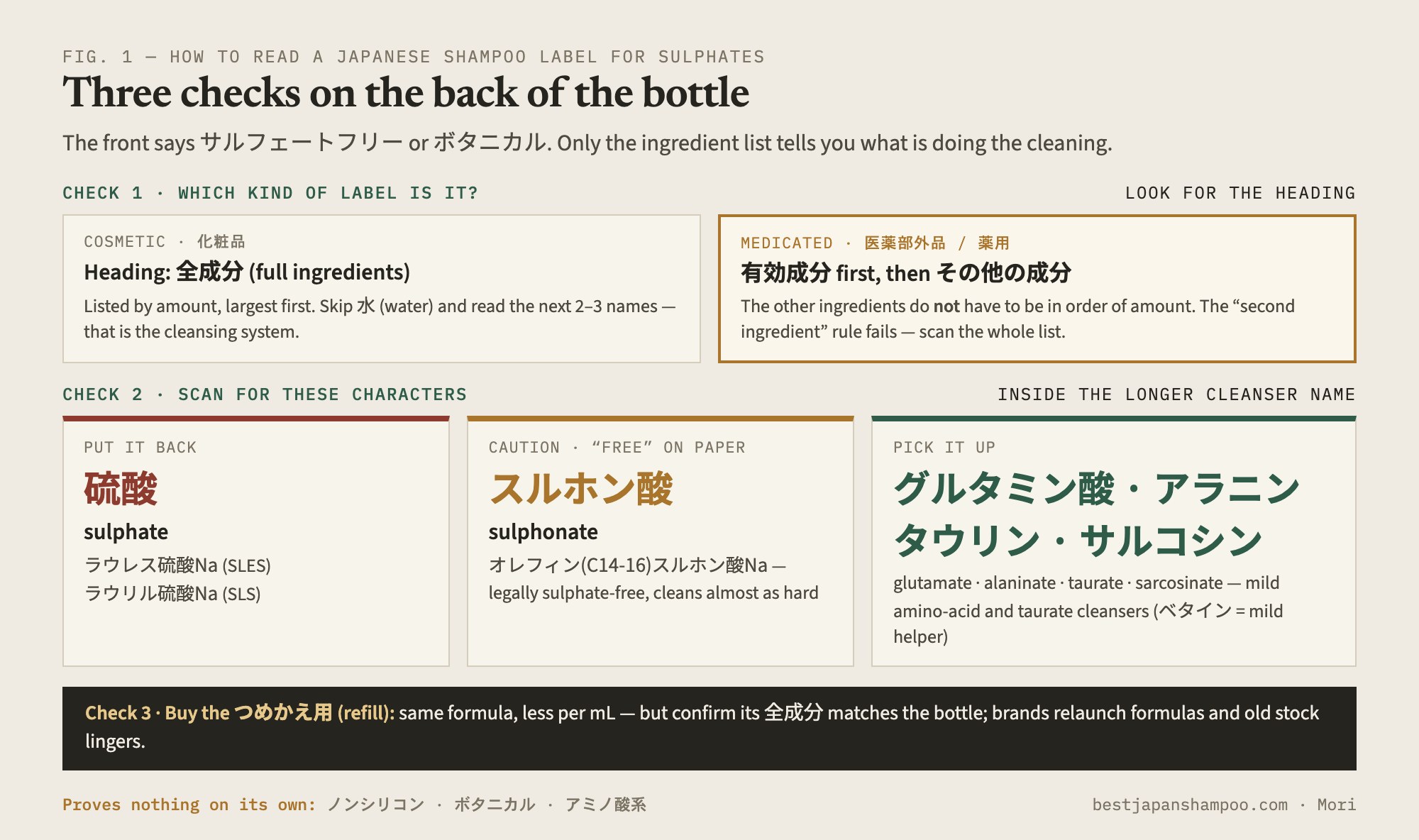
My professional judgement. People tend to read 薬用 as “gentler,” and it is not a promise of that. A medicated label tells you the active ingredient is approved for a purpose — dandruff, itching — not that the wash is gentle. If your hair is treated, read a medicated bottle more carefully than a cosmetic one, not less.
The Words to Scan For
You do not need to read Japanese. You need to recognise a few characters inside a longer name.
Put it back — 硫酸 (ryūsan, sulphate):
- ラウレス硫酸Na — sodium laureth sulphate (SLES)
- ラウリル硫酸Na — sodium lauryl sulphate (SLS)
- Anything else with 硫酸 in it near the top of the list
On an untreated, oily scalp these are fine. On coloured, bleached, straightened or keratin-treated hair they speed up fading, which is why every aftercare sheet tells you to avoid them — the aftercare shampoo guide for straightened hair explains why.
Treat with caution — スルホン酸 (suruhon-san, sulphonate):
- オレフィン(C14-16)スルホン酸Na — sodium C14-16 olefin sulphonate
It is not a sulphate, so a bottle built on it can legally say サルフェートフリー. It is still a strong, high-foaming cleanser. In my experience, on treated hair it fades a result about the way a sulphate does.
Pick it up — the amino-acid and taurate cleansers:
- グルタミン酸 — glutamate (e.g. ココイルグルタミン酸TEA)
- アラニン — alaninate (e.g. ラウロイルメチルアラニンNa)
- タウリン — taurate (e.g. ココイルメチルタウリンNa)
- サルコシン — sarcosinate (e.g. ラウロイルサルコシンTEA)
- ベタイン — betaine; mild, usually there to soften the main cleanser
If two of those sit at the top of a cosmetic list, or there is no 硫酸 or スルホン酸 anywhere in a medicated list, you have found a genuinely gentle shampoo. Expect less lather. Lather is not cleaning power.
BOTANIST Botanical — The Safest Pick in Any Drugstore
Cleanser: cocamidopropyl betaine + sodium methyl cocoyl taurate + sodium lauroyl methyl alaninate · Weight: Light to medium, depending on the line
Turn over a bottle of BOTANIST Botanical Moist in a Japanese drugstore and the list reads water, glycerin, cocamidopropyl betaine, ココイルメチルタウリンNa, ラウロイルメチルアラニンNa. That is a textbook gentle wash, and it is stocked by nearly every chain in the country. Moist suits dry hair, Smooth suits frizz, Damage Care suits coloured or heat-damaged hair, and Bouncy Volume suits fine hair.
Outside Japan the picture is different: on Amazon US most BOTANIST lines come through importers at well above the Japanese shelf price. I compared it with its stablemate in YOLU vs BOTANIST.
Who it is for
- Coloured, straightened or keratin-treated hair that needs a daily gentle wash
- Anyone who wants one bottle that is easy to find again
Who should skip it
- Anyone sensitive to fragrance — BOTANIST is noticeably scented
Pair it with: the matching BOTANIST treatment on the lengths only; the lines are designed as pairs.
Ichikami (いち髪) — The Budget Amino-Acid Shampoo
Cleanser: TEA-lauroyl sarcosinate + sodium lauroyl methyl alaninate, with betaine · Weight: Medium
Kracie’s Ichikami is the quiet over-performer of the Japanese drugstore shelf. The brand states the whole range is サルフェートフリー, and the 2026 relaunch of Smooth Care lists ラウロイルサルコシンTEA and ラウロイルメチルアラニンNa as its cleansers. It sits on the lowest shelf, costs the least of the four, and on dry or frizzy hair it does more than its price suggests. The Moisturizing version on Amazon US also lists a glutamate and a taurate.
Who it is for
- Dry, frizzy or wavy hair, including straightened hair
- Students and anyone buying for a household
Who should skip it
- Very fine hair that goes flat easily — try BOTANIST Bouncy Volume
Pair it with: the Ichikami conditioner, and from the second bottle on, the refill pouch. Outside Japan, the Smoothing refill is the better value too. I set it against Tsubaki in Ichikami vs Tsubaki.
👉 Check Price on Amazon → · Stylevana (ships worldwide) →
YOLU Relax Night Repair — For Thick Hair, With One Caveat
Cleanser: sodium lauroyl methyl alaninate, then lauramidopropyl betaine and a taurate · Weight: Medium
In Japan, YOLU’s Relax, Deep and Mellow shampoos open with ラウロイルメチルアラニンNa straight after water — a genuinely mild alaninate wash, with enough conditioning for thick hair that tangles overnight. The caveat is the fourth line: YOLU Calm uses an olefin sulphonate. Same brand, same shelf, different cleanser. This is exactly why you read the back.
Also note that the YOLU sold by the brand in the US is a separate line with a different formula; the Amazon link here is the imported Japanese Relax refill.
Who it is for
- Thick, dry or coarse hair, long hair that knots
Who should skip it
- Fine hair or oily roots — it is too rich
- Anyone who picked up Calm by mistake
Pair it with: the matching Relax treatment on the mid-lengths and ends.
Buying from outside Japan: the imported Relax shampoo refill lost its Amazon US buy button (checked 2 November 2026), so the link below goes to the matching Relax treatment, which is in stock. In Japan, the shampoo is on the shelf at every big drugstore chain.
👉 Check Price on Amazon → · Stylevana (ships worldwide) →
Margaret Josefin Hotel Shampoo — For When You Have Left Japan
Cleanser: cocamidopropyl betaine + TEA-cocoyl glutamate + disodium cocoyl glutamate · Weight: Light
This one is for the day you move back to London, Sydney or Singapore and your drugstore no longer stocks BOTANIST at Japanese prices. It is a true glutamate shampoo with no sulphate and no olefin sulphonate, and it is sold by the brand’s own Amazon store rather than an importer.
Who it is for
- Fine hair, sensitive scalps, treated hair, outside Japan
Who should skip it
- Thick, very dry hair — it will not condition enough alone
Pair it with: a light conditioner on the ends, and a clarifying wash every week or two if you use oils.
👉 Check Price on Amazon → · YesStyle (ships worldwide) →
Put It Back: Popular Bottles That Fail the Check
None of these are bad shampoos. They are the wrong ones if you came looking for sulphate-free.
- &honey (Deep Moist, Melty) — the main cleanser is オレフィン(C14-16)スルホン酸Na, followed by a heavy conditioning film. Lovely on thick untreated hair, wrong for treatments. The details are in BOTANIST vs &honey.
- Tsubaki — uses ラウレス硫酸Na across the range and has never claimed otherwise. Which Tsubaki shampoo covers who it still suits.
- YOLU Calm — the olefin sulphonate exception in an otherwise gentle range.
- Korean bottles — the flag tells you nothing about strength. Ryo and Mise en Scène lead with sodium laureth sulfate (ラウレス硫酸Na), while Aromatica uses amino-acid cleansers. I put both countries side by side in Japanese vs Korean Shampoo.
- Medicated (薬用) scalp shampoos — some are gentle, many are not. Scan the whole その他の成分 list.
Buy the Refill: How Japanese Shampoo Is Meant to Be Bought
Next to almost every bottle on a Japanese shelf is a soft pouch marked つめかえ用 (tsumekae-yō, refill) or 詰替. It is the same formula, usually a slightly smaller volume, and noticeably cheaper per millilitre. Some brands sell a larger 2回分 (two-refill) pouch that is cheaper still.
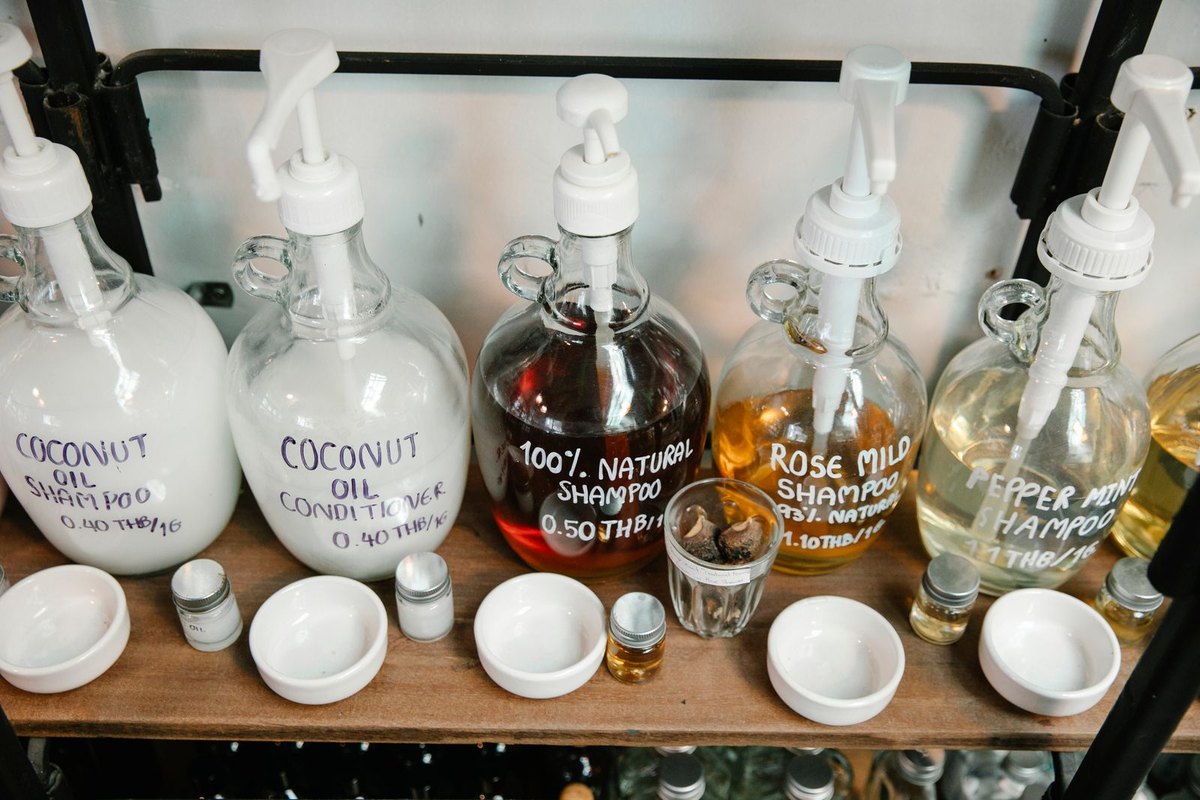
The normal way to do it here is to buy the pump bottle once and refill it from then on. Two practical notes: rinse and dry the bottle before you refill it, because water left inside is how a shampoo goes off; and check that the refill’s 全成分 matches the bottle, since brands relaunch formulas and old stock lingers.
Where to Buy It
The big drugstore chains — Matsumoto Kiyoshi, Welcia, Sundrug, Tsuruha — carry BOTANIST, Ichikami and YOLU almost everywhere. Don Quijote stocks them too and stays open late, though the haircare aisle is chaotic and prices are not always better. Supermarkets often carry Ichikami.
What you will not find in a drugstore is salon-only brands; those are sold through hair salons and professional suppliers. If you are curly and in Japan, the curly hair shampoo guide has a drugstore section written for you.
Buying It Online: The Amazon.co.jp Shelf
Everything above is written for the drugstore aisle, because that is where these bottles live. If you would rather have it delivered, here is what is actually listed. Prices are Amazon.co.jp in November 2026, tax included, and move — check before you buy.
And note what the listings tell you: alongside the single bottle, Amazon.co.jp pushes the 詰め替え and the ボトルセット, which is exactly the point made in the refill section above — the catalogue is built around buying the pump once.
BOTANIST Botanical — ¥3,080 for the large refill (three ordinary refills’ worth). The safest pick in any drugstore is also the cheapest per wash online.
👉 BOTANIST 詰め替え大容量 を Amazon.co.jp で見る →
Ichikami (いち髪) — ¥682 for the 640 ml 濃密W保渿ケア refill, which is two bottles’ worth. At that price the budget amino-acid shampoo stops being a compromise and becomes the obvious default.
👉 いち髪 濃密W保渿ケア 詰め替え を Amazon.co.jp で見る →
YOLU Relax Night Repair — ¥2,800 for the large refill. This is the domestic version, which is the one the caveat above is about.
👉 YOLU リラックスナイトリパア 詰め替え を Amazon.co.jp で見る →
⚠️ Margaret Josefin is the exception. I recommend it above for when you have left Japan, and that turns out to be literal: on Amazon.co.jp it is listed only as a 4-litre salon jug (about ¥3,300), not the hotel-size bottle. Inside Japan it is a salon-supply product, not a retail one.
If You Still Cannot Decide
Treated hair, any type → BOTANIST Botanical, in the line that matches your hair.
Dry or frizzy hair on a budget → Ichikami, then the refill.
Thick hair that knots → YOLU Relax Night Repair — not Calm.
You have left Japan → Margaret Josefin Hotel Shampoo.
The bottle says 薬用 → read every line of その他の成分 before you buy it.
FAQ
How do I say “sulphate-free” in a Japanese drugstore? サルフェートフリー (sarufēto furī), or 硫酸系界面活性剤不使用 on more technical labels. Staff will understand “sarufēto furī” — but the ingredient list is more reliable than the front label either way.
What is the Japanese word for sulphate on an ingredient list? 硫酸 (ryūsan). If you see it in a cleanser name such as ラウレス硫酸Na or ラウリル硫酸Na near the top of the list, the shampoo contains a sulphate.
Is sulfate-free the same as sulphate-free? Yes. Sulfate is the American spelling and sulphate the British one. Japanese bottles use neither — they print the ingredient itself, so look for 硫酸.
Why can’t I use the “second ingredient” rule on every Japanese bottle? Because medicated shampoos (医薬部外品, often marked 薬用) list active ingredients first and the rest without having to follow order of amount. On those, check the whole その他の成分 list.
Are Japanese drugstore shampoos sulphate-free? Many are not. BOTANIST, Ichikami and most of YOLU use amino-acid or taurate cleansers. Tsubaki uses a sulphate, and &honey and YOLU Calm use an olefin sulphonate.
Is it cheaper to buy Japanese shampoo in Japan? Yes, clearly — especially as refills. Imported Japanese shampoo on Amazon US or UK often costs several times the Japanese shelf price.
Which sulphate-free shampoo should I use after Japanese straightening? An amino-acid or taurate shampoo: BOTANIST or Ichikami in Japan, Margaret Josefin outside it. Start after the first 72 hours.
Bottom Line
In Japan, finding a real sulphate-free shampoo is a thirty-second job once you know where to look. Ignore the front. Turn the bottle over, check whether it is 化粧品 or 薬用, look for 硫酸 and スルホン酸, and look for グルタミン酸, アラニン, タウリン or サルコシン instead. Then buy the refill.
Treated hair → BOTANIST Botanical
Budget, dry or frizzy → Ichikami
Thick hair → YOLU Relax Night Repair
Outside Japan → Margaret Josefin Hotel Shampoo
Prices, stock and formulas change. Check the live listing and the ingredient panel before buying.