
Mori · licensed hairdresser, 8 years in Tokyo & Shanghai, specialising in Japanese straightening.
Matching a product to a hair type was the job. That is what this article is.
Why Your Curly Hair Deserves Better
If you have naturally curly or wavy hair, you know the struggle. The humid day when styled curls turn into a frizzy cloud. The afternoon slump when waves lose definition. The endless search for products that understand your hair type instead of treating it like it’s straight.
Traditional shampoos strip natural oils, leaving curls dry and angry. Silicone-heavy products promise smoothness but weigh curls down into a flat, lifeless mess.
Japanese beauty brands approach this differently: gentle cleansing, strategic hydration, and ingredients that respect your curl pattern instead of fighting it. Brands like Ichikami, Shiseido Tsubaki, &Honey, and Milbon have built cult followings among curly-haired shoppers for a reason.
This guide covers the four best Japanese shampoos for curly hair and frizz control on Amazon US, plus how to pair each with the right conditioner — because for curly hair, the conditioner matters as much as the shampoo.
⏱️ In a hurry? Our Top Pick: Tsubaki Premium Moist & Repair Shampoo — the most versatile option for curly hair. Enough protein to strengthen curls, enough moisture to define them, without the heaviness that flattens medium-textured curls. If you’re buying one bottle, buy this one. 👉 Check Price on Amazon →
Quick Comparison Table
| Product | Best For | Key Benefit | Weight | Price | Where to Buy |
|---|---|---|---|---|---|
| Tsubaki Premium Moist & Repair | Types 3A–3C, damaged curls | Repair & smoothness | Medium | $$ | Check Price on Amazon |
| Ichikami Smooth & Sleek | Types 2A–2C, fine waves | Lightweight frizz control | Light | $ | Check Price on Amazon |
| &Honey Deep Moist | Coarse, thick, tightly coiled | Deep hydration | Medium-Heavy | $$$ | Check Price on Amazon |
| Milbon Moisture Replenishing | Salon-level dryness treatment | Professional-grade moisture | Medium | $$$$ | Check Price on Amazon |
Price bands: $ budget · $$ mid-range · $$$ premium · $$$$ salon/professional. Amazon pricing fluctuates by seller and promotion — check the current listing before buying.
Who This Guide Is NOT For
Straight hair wearers. These formulas are built for curly, wavy, and textured hair. On straight hair they read as over-engineered — slightly heavy, overly moisturizing.
Sensitive scalps. Japanese formulations are generally gentler than Western equivalents, but most of these contain fragrance and botanical extracts. Patch-test first if you’re prone to irritation or dermatitis.
Severely damaged or chemically straightened hair. If you’ve had multiple bleaching sessions or chemical straightening, you need a protein-intensive reconstruction treatment before a maintenance shampoo will do anything. These are improvement tools, not repair miracles.
Fragrance-averse shoppers. Most Japanese shampoos carry a natural floral or fruity scent. There are no unscented options in this roundup.
Three Criteria That Actually Matter
1. Moisture Content & Humectants
Curly hair is drier than straight hair by structure. Scalp oils travel slowly down the spiral of a curl, so the ends stay thirsty no matter how oily your roots feel.
Look for humectants: glycerin, panthenol, and honey. These pull water into the hair shaft, plumping the cuticle and cutting frizz at the source. Japanese brands have been doing this with camellia oil, rice bran extract, and botanical honey for generations.
Avoid sulfates — sodium lauryl sulfate in particular. Sulfates strip aggressively and leave curls feeling like straw. If you want to go further on this, see our guide to Japanese sulfate-free shampoos.
2. Weight & Lather Profile
More lather does not mean better cleaning. Excessive lather usually signals harsh surfactants.
A good curly hair shampoo produces moderate, creamy lather — enough to cleanse without the aggressive bubble-fest. Your curls shouldn’t feel tight, squeaky, or rough afterward.
Japanese shampoos are typically less sudsy than Western brands. That takes adjustment, but it’s a sign of gentler chemistry, not weaker cleaning.
3. Protein — In Moderation
Curly hair benefits from hydrolyzed keratin, amino acids, and collagen. These fill microscopic gaps in the cuticle and reduce breakage.
But too much protein makes curls stiff and kills elasticity. The shampoo shouldn’t be protein-heavy — that’s what treatments are for. You want some amino acids, not a protein bomb.
Detailed Product Reviews
1. Tsubaki Premium Moist & Repair Shampoo — Best Overall for Curly Hair
Best For: Types 3A–3C, color-treated or heat-styled curls
Tsubaki is Shiseido’s premium line, and it shows. This is the formula for curls that have taken a beating — heat styling, chemical treatments, or years of environmental stress.
What it does: Combines camellia oil with glycerin, collagen, and amino acids. It’s more protein-forward than Ichikami, which makes it better at repair and structural strengthening. It penetrates the shaft, fills damage gaps, and restores elasticity.
Key Features: – Camellia oil, glycerin, collagen, amino acids – 490ml bottle – Creamy, satisfying lather – Richer botanical fragrance with sweet undertones
Pros: – Cuts frizz noticeably — especially wispy flyaways – Leaves curls softer and less prone to tangling – Works across the widest range of curl types – Genuinely good value for a premium formula
Cons: – Can feel slightly heavy on already-healthy curls – Fragrance is stronger than Ichikami – Not ideal if your curls are fine and limp
Who should buy this: Anyone with damaged or color-treated curls. If your curls feel dry, brittle, or prone to breakage — and especially if you only want to buy one bottle — this is the safe choice.
👉 Buy Tsubaki Premium Moist & Repair on Amazon →
2. Ichikami Smooth & Sleek Shampoo — Best for Lightweight Frizz Control
Best For: Types 2A–2C, fine waves, oily roots with dry ends
If you want frizz control without weighing curls down, Ichikami Smooth & Sleek is the answer. It’s a clarifying-meets-conditioning hybrid that walks the line between effective cleansing and moisture restoration.
What it does: Uses camellia oil and rice bran extract to smooth the cuticle and seal in moisture. Camellia oil is lightweight and penetrative — it delivers shine without a greasy finish.
Key Features: – Camellia oil, rice bran extract, amino acids – 480ml bottle – Impressive lather that doesn’t feel harsh – Light, clean floral fragrance
Pros: – Maintains curl definition while taming flyaways – Won’t weigh down fine or wavy hair – Most affordable option here – Removes buildup effectively
Cons: – Using it more than 2–3 times weekly causes dryness – Better as a weekly clarifying step than a daily cleanser – Not moisturizing enough for coarse or coiled hair
Who should buy this: People with medium-textured curls who don’t want a heavy product. Anyone prone to product buildup. Curls that are more “wavy” than tightly coiled.
👉 Buy Ichikami Smooth & Sleek on Amazon →
3. &Honey Deep Moist Shampoo — Best for Intense Hydration
Best For: Coarse, thick, or tightly coiled curls; dry climates and winter
&Honey is the hydration powerhouse of this list. If Ichikami is the lightweight option and Tsubaki is the repair specialist, &Honey is the one that leaves curls quenched and glowing.
What it does: Uses three honeys — Manuka from New Zealand, Acacia from Hungary, and Japanese raw honey — layered for hydration at different absorption speeds. Adds plant-derived keratin, argan oil, collagen, and amino acids. It’s essentially a conditioning treatment disguised as a shampoo.
Key Features: – Three-honey blend plus keratin, argan oil, collagen – 440ml bottle – Rich, viscous texture; moderate lather – Sweet honey-forward scent
Pros: – Transforms cotton-candy frizz into defined, bouncy waves – Deep moisture that actually holds through the day – Excellent for winter and dry climates – A little goes a long way
Cons: – Too heavy for fine or limp curls – Can cause buildup used more than 3–4 times weekly – Priciest per ounce of the mid-range options
Who should buy this: Anyone with dry, coarse, or very textured curls. People in Arizona, Colorado, or anywhere with dry winter heating. Not for fine curls.
👉 Buy &Honey Deep Moist on Amazon →
Torn between &Honey and Tsubaki? They solve different problems — &Honey adds moisture, Tsubaki repairs structure. There is a one-minute strand test that tells you which your hair actually needs. See Tsubaki vs &Honey.
4. Milbon Moisture Replenishing Shampoo — Best Professional Option
Best For: Persistent dryness that drugstore formulas haven’t fixed
Milbon is what Japanese salons actually stock. It’s the most expensive option here by a wide margin, and it’s aimed at a specific problem: curls that stay dry no matter what you put on them.
What it does: Salon-grade moisture delivery with a lighter feel than the price suggests. Where &Honey coats, Milbon absorbs.
Key Features: – Professional salon formulation – Noticeably lighter finish than drugstore moisture shampoos – Subtle, non-sweet fragrance
Pros: – Delivers moisture without the weight penalty – Consistent results across wash cycles – The fragrance won’t compete with your styling products
Cons: – Significantly more expensive – Overkill if your curls are only mildly dry – Availability on Amazon fluctuates
Who should buy this: People who’ve cycled through drugstore moisture shampoos without success. If you want the full comparison against Shiseido, read our Milbon vs Shiseido breakdown.
👉 Buy Milbon Moisture Replenishing on Amazon →
Japanese Shampoo and Conditioner for Curly Hair: Why Pairing Matters
For curly hair, the conditioner does more work than the shampoo. The shampoo cleans; the conditioner is what actually defines the curl, seals the cuticle, and determines whether you get frizz by noon.
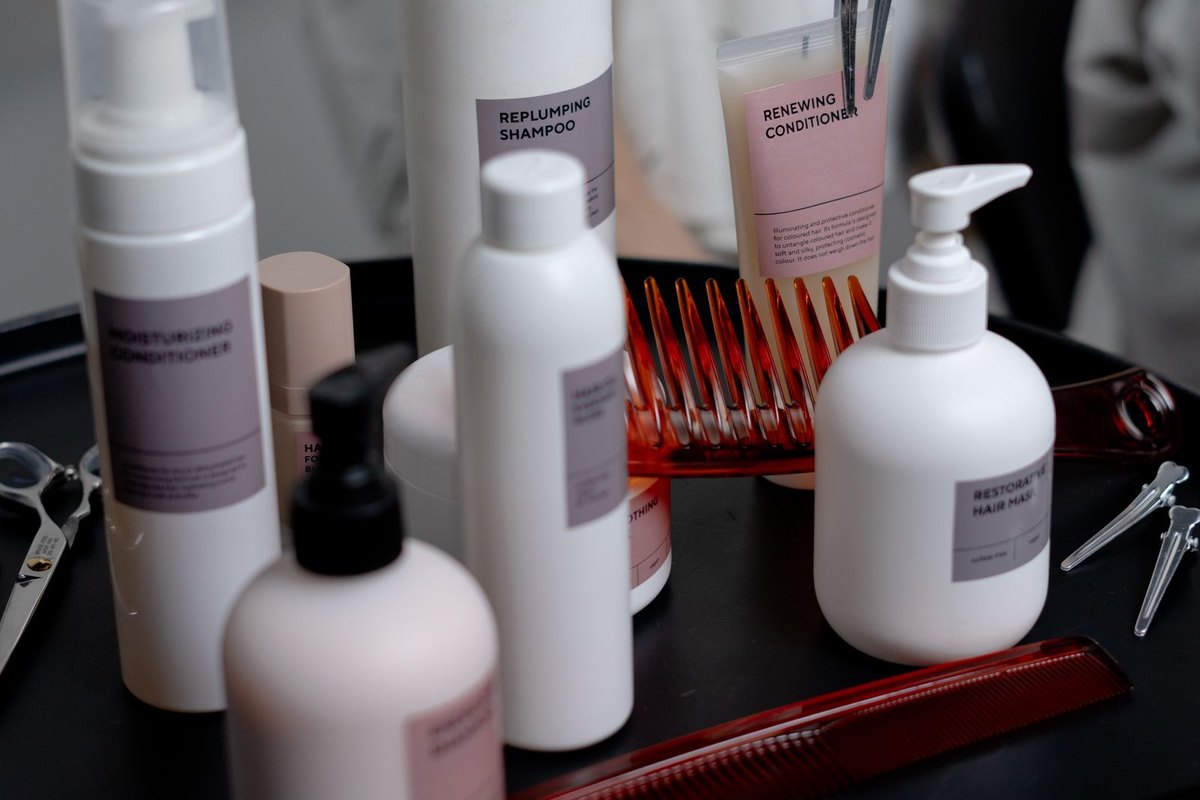
Japanese brands sell shampoo and conditioner as matched pairs, and they’re formulated to work together — the conditioner is designed to counterbalance exactly what the shampoo strips.
The rule for curly hair: never mix a light shampoo with a light conditioner. That combination leaves curls under-moisturized and frizzy by afternoon. Pair by weight.
| If you use this shampoo | Pair it with | Why |
|---|---|---|
| Ichikami Smooth & Sleek (light) | A heavier conditioner — not the matching one | The shampoo clarifies; the conditioner has to put moisture back |
| Tsubaki Premium Moist & Repair (medium) | Tsubaki Premium EX Intensive Repair Treatment | Matched protein levels — mixing lines can over-protein your curls |
| &Honey Deep Moist (heavy) | &Honey Deep Moist conditioner | The honey blend is built as a two-step system |
Application tip that matters more than the product: apply conditioner to soaking wet hair, not towel-dried hair. Curly hair seals better when the cuticle is still open and water is trapped underneath. Rake it through with your fingers, wait three minutes, then rinse with cool water.
The conditioner half deserves its own guide. Which one to buy is only part of it — where you apply it, how wet your hair should be, and how much to rinse out decide more than the bottle does. See Japanese Conditioner for Curly Hair: 4 That Actually Work.
How to Fix Frizz: What Actually Works for Curly Hair
Frizz isn’t a product problem. It’s a moisture-gradient problem — dry hair pulling humidity out of the air, which lifts the cuticle and breaks curl clumps apart.
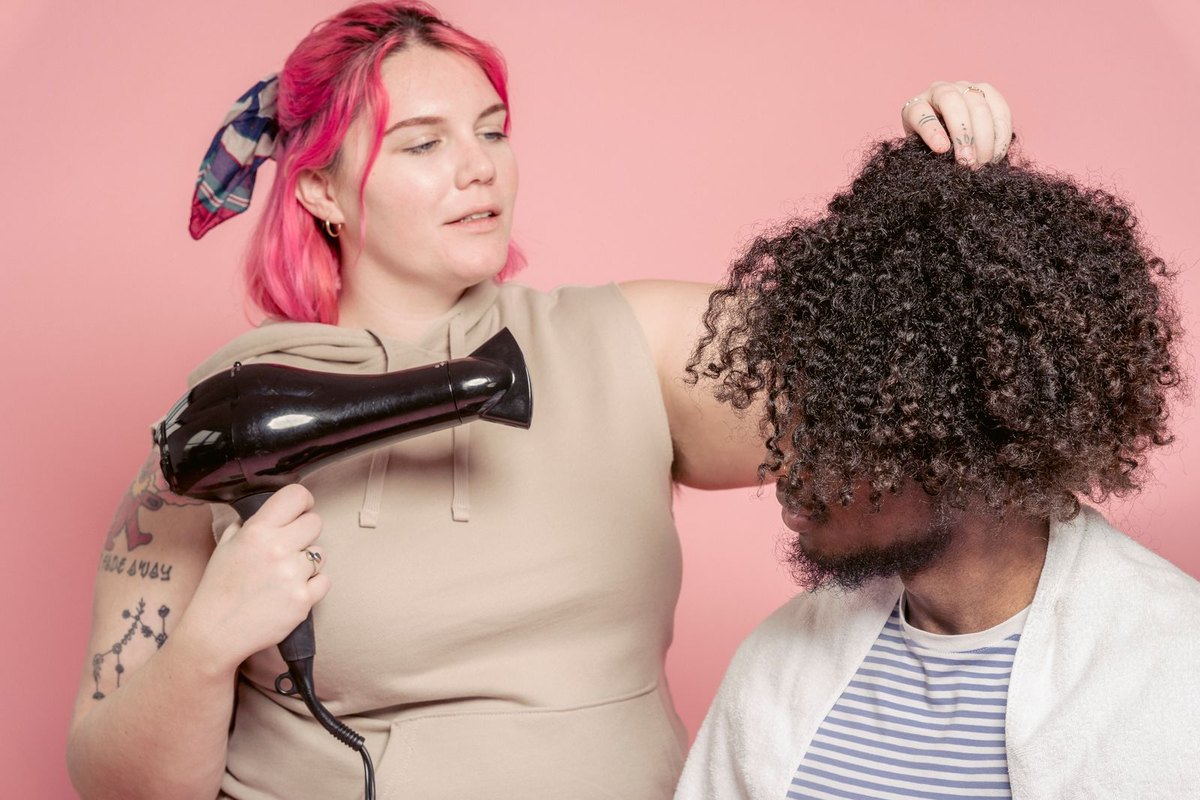
That means the fix has three parts, and only one of them is the shampoo.
1. Stop stripping moisture out. Sulfate-free formulas, cool-water rinses, and washing 2–3 times weekly instead of daily. Every one of the shampoos above is gentle enough for this.
2. Put moisture back and seal it in. This is the conditioner’s job — see the pairing table above. If you only change one thing about your routine, change this.
3. Stop breaking curl clumps after the shower. Terry cloth towels and aggressive drying destroy the curl pattern that the shampoo and conditioner just built. Use a microfiber towel or a cotton t-shirt, and squeeze rather than rub.
For severe frizz specifically: &Honey Deep Moist is the most effective option in this roundup. The three-honey humectant blend addresses the underlying dryness rather than coating the outside of the hair. Pair it with a leave-in and you’ll see the difference in one wash cycle.
If your frizz comes with flaking or an itchy scalp, the root cause may be barrier damage rather than dryness — we cover that in our guide to scalp barrier protection.
Thinking about a chemical treatment instead? If shampoo and technique are not enough, the choice comes down to two very different processes — one permanent, one that fades. Our specialist comparison of Japanese straightening vs keratin covers which one suits curly hair, and the risks that come with each.
Frizz has a second half nobody writes about. Everything above is what you wash with — but frizz is created in the ten minutes after the shower, not in it. The towel, the airflow direction and the diffuser decide more than the bottle does. See Best Japanese Shampoo for Frizzy Hair.
What Low Ratings Reveal: Real Complaints
These are good products, but they’re not universally good. Here’s what negative reviewers consistently say.
Dryness from Ichikami with frequent use. Several curly-haired reviewers loved it initially, then hit dry, straw-like curls after using it more than 2–3 times weekly. It works as a clarifying shampoo, not an everyday cleanser. Switching to bi-weekly fixed it for most of them.
Heaviness and buildup from &Honey. Reviewers with fine or thin curls reported limp hair and product buildup with regular use. The workaround: use it once weekly as a treatment-shampoo hybrid rather than an everyday cleanser.
Insufficient moisture for Type 4 hair. A few reviewers with tightly coiled Type 4 hair found these shampoos underpowered. These formulas are optimized for wavy to curly (Types 2–3C). Type 4 hair needs heavier layering with deep conditioners.
Fragrance sensitivity. A notable minority developed scalp irritation or headaches from the floral fragrances with prolonged use. These are real botanical fragrances, not synthetic dupes. Patch-test if you’re scent-sensitive.
Price and availability. These are imported specialty items. Pricing fluctuates and stock isn’t always reliable.
Recommendations by Hair Type
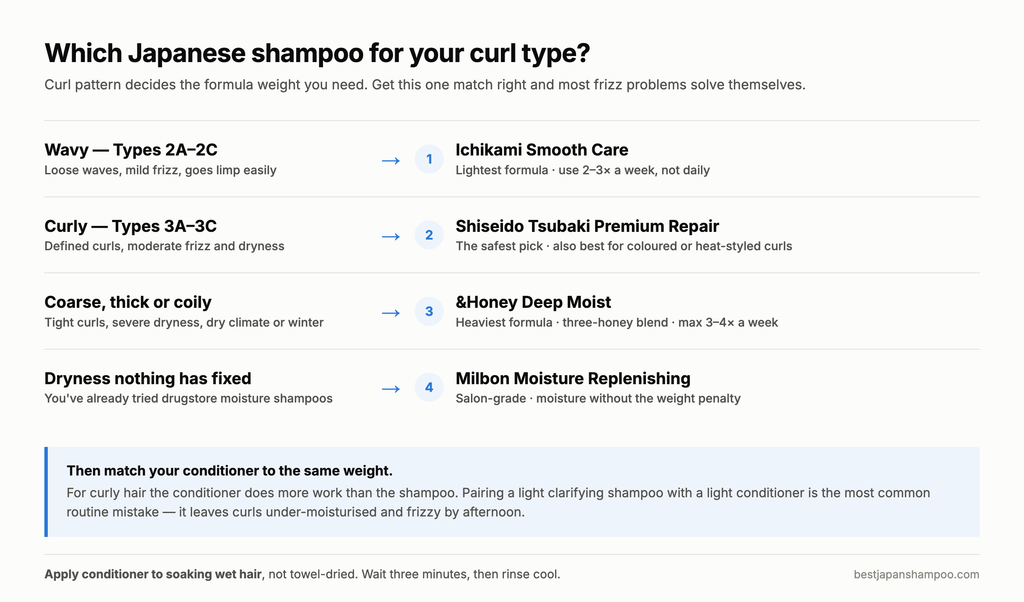
Wavy hair (2A–2C) with mild frizz → Ichikami Smooth & Sleek. Wavy hair needs lightweight formulas that enhance the wave without flattening it. Use 1–2 times weekly.
Curly hair (3A–3C) with moderate frizz and dryness → Tsubaki Premium Moist & Repair. This is the sweet spot for most people reading this guide.
Coarse, thick, or tightly coiled hair → &Honey Deep Moist. Thick cuticles need the honey-forward formula and heavier consistency.
Color-treated or heat-styled curls → Tsubaki Premium Moist & Repair. The protein content repairs the cuticle damage that coloring causes.
Persistent dryness nothing has fixed → Milbon Moisture Replenishing.
Oily roots, dry ends → Ichikami Smooth & Sleek. Clarifies roots without stripping the ends.
Seasonal rotation: &Honey in winter, Ichikami in spring and summer, Tsubaki whenever your hair feels stressed.
FAQ
Are Japanese shampoos good for curly hair? Yes, with a caveat. Japanese formulations are gentler and more moisture-focused than most Western drugstore brands, which suits curly hair well. But they’re optimized for wavy to curly textures (Types 2–3C). Type 4 hair generally needs heavier products than any of these.
Can I use Japanese shampoo every day on curly hair? Not these ones. Curly hair does better washed 2–3 times weekly regardless of product, and Ichikami specifically causes dryness with daily use. &Honey builds up. Two to three washes per week is the target.
Do I need the matching conditioner, or can I mix brands?
You can mix, but match the weight — pairing a light shampoo with a light conditioner is the most common mistake curly-haired shoppers make. Our conditioner guide has the full pairing table.
Are these sulfate-free? Most use gentler surfactants than sodium lauryl sulfate, but formulations vary and change. If sulfate-free is non-negotiable for you, check our dedicated sulfate-free guide where every product is verified.
How long does one bottle last? Roughly 5–8 weeks for medium-length hair washed 2–3 times weekly. &Honey lasts longer than its size suggests because the consistency is rich — you use less per wash.
Why don’t these lather as much as my old shampoo? Lower lather means gentler surfactants. It’s a feature, not a defect. Curly hair does better with less lather, not more.
Is Milbon worth four times the price of Ichikami? Only if you’ve already tried the cheaper options and they didn’t solve your dryness. For most people, Tsubaki delivers most of the benefit at a fraction of the cost. Our full comparison breaks down where the extra money actually goes.
Should I use Ichikami or Tsubaki?
They are the two most-compared Japanese drugstore shampoos and they suit opposite hair types — one is light and clarifying, the other medium-weight and repairing. See Ichikami vs Tsubaki.
The Bottom Line: Which One Should You Buy?
Buying one bottle and want the safe choice? Tsubaki Premium Moist & Repair. Most versatile, broadest range of curl types, visible results. 👉 Check Price on Amazon →
Want maximum frizz control with a lightweight feel? Ichikami Smooth & Sleek. Affordable, and the clarifying properties solve buildup instead of masking it. 👉 Check Price on Amazon →
Have seriously dry or thick curls? &Honey Deep Moist. The honey formulation is genuinely different from anything on a US drugstore shelf. 👉 Check Price on Amazon →
Pro tip: you don’t have to pick one forever. Many curly-haired people rotate — Ichikami as a weekly clarifier, Tsubaki as the everyday workhorse, &Honey as a weekly treatment. That rotation covers every failure mode at once.
And if you are building a routine from scratch, the shampoo is not where the biggest change comes from — a dryer with a diffuser matters more for curly hair than any bottle. See Japanese Curly Hair Products: What Actually Changes the Result.
Why Japanese Shampoos Are Worth It
The US curly hair market is dominated by specialty brands that have trained people to accept premium pricing as the baseline for textured hair care.
Japanese brands prove there’s another route. Camellia oil, rice extract, honey, and seaweed aren’t trend ingredients — they’re long-standing formulation staples with real evidence behind them, and the J-Beauty market has grown on that reputation rather than on marketing spend.
These four shampoos are the best of what J-Beauty offers for curly hair. They ship with Prime. They work. And you don’t need to hunt down a specialty importer to try one.
If you want to go wider than curly-specific picks, see our full breakdown of the best Japanese shampoos on Amazon.
Further reading on J-Beauty formulation and market trends: J-Beauty Products Market Report · Japanese Beauty Industry Trends 2026
Heat is the other half of the frizz problem. If you’re drying with a standard hot-air dryer, see our guide to Japanese hair dryers — moisture-emitting models reduce the damage that undoes your wash routine.
And if you straighten your curls some days, the iron matters too: the Japanese flat iron comparison (KINUJO vs Panasonic vs ReFa) explains why 160–180 °C and a loose section do more for your curls than any plate coating.