
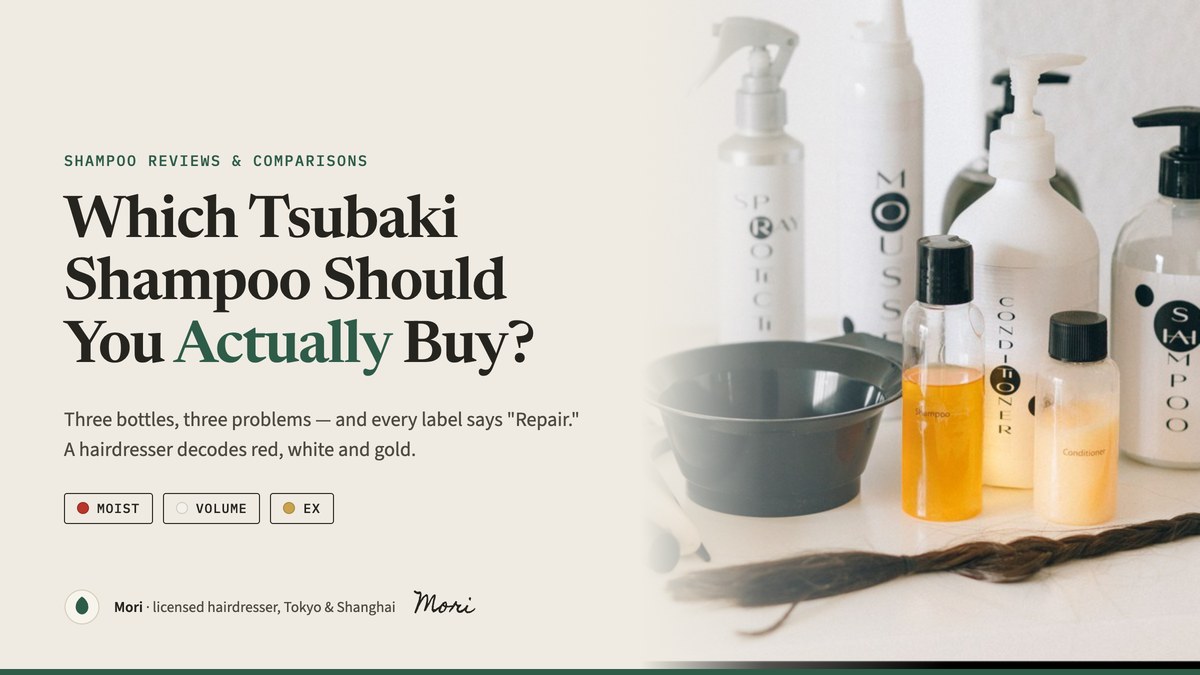
Mori · licensed hairdresser, 8 years in Tokyo & Shanghai, specialising in Japanese straightening.
Matching a product to a hair type was the job. That is what this article is.
Tsubaki is the Japanese shampoo people most often ask me about, and the question is almost never “is it good.” It is “which one?” — because the Amazon listings are a mess. Old bottle names, new bottle names, refills, bundles with hair ties, a blue one that appears every summer. Three different products all called “Premium … Repair.”
Here is the clean answer. Tsubaki currently makes three shampoo lines, and each one is built for a different hair problem. Pick by problem, not by which bottle has the most reviews.
⏱️ In a hurry?
Dry, frizzy, thick or wavy hair → Tsubaki Premium Moist & Repair (red)
Fine, flat, oily at the roots → Tsubaki Premium Volume & Repair (white)
Bleached, coloured, breaking → Tsubaki Premium EX Damage Care & Repair (gold)
Quick Comparison
| Line | Bottle | Weight | Built for | Price | Where to buy |
|---|---|---|---|---|---|
| Premium Moist & Repair | Red | Medium-heavy | Dryness and frizz | $$ | Check Price on Amazon |
| Premium Volume & Repair | White | Light | Fine hair that goes flat | $$ | Check Price on Amazon |
| Premium EX Damage Care & Repair | Gold | Heaviest | Chemical and heat damage | $$$ | Check Price on Amazon |
Price bands: $$ mid-range · $$$ premium. Amazon pricing moves — check the live listing.
All three contain sodium laureth sulfate. That matters for one group of readers and I will come back to it.
First, Decode the Bottles
Tsubaki is made by Fine Today (the brand was spun out of Shiseido in 2021), and the range has been renamed and reformulated over the last few years — most recently a full renewal in September 2024. The old names are still all over Amazon because sellers are clearing old stock. Here is the map:
- Premium Moist (old red) → now Premium Moist & Repair
- Premium Repair (old white) → now Premium Volume & Repair
- Premium EX Intensive Repair (gold) → now sold as Premium EX Damage Care & Repair. Same line, same positioning; you will see both names on the same product.
- Premium Cool (blue) → a summer limited edition with menthol. Not a fourth hair-type line. Skip it unless you specifically want a cold scalp.
So if you bought the old white “Premium Repair” bottle — the one we recommended in Tsubaki vs &Honey and Ichikami vs Tsubaki — its current equivalent is Volume & Repair, not EX. People assume “Repair” means the damage one. It does not. The damage one is gold.
Refills: Japanese brands sell foil refill pouches that are cheaper per millilitre than the pump bottle. On Amazon they are listed separately: Moist & Repair refill and EX refill. Buy the pump once, then refill.
The 10-Second Test That Picks Your Bottle
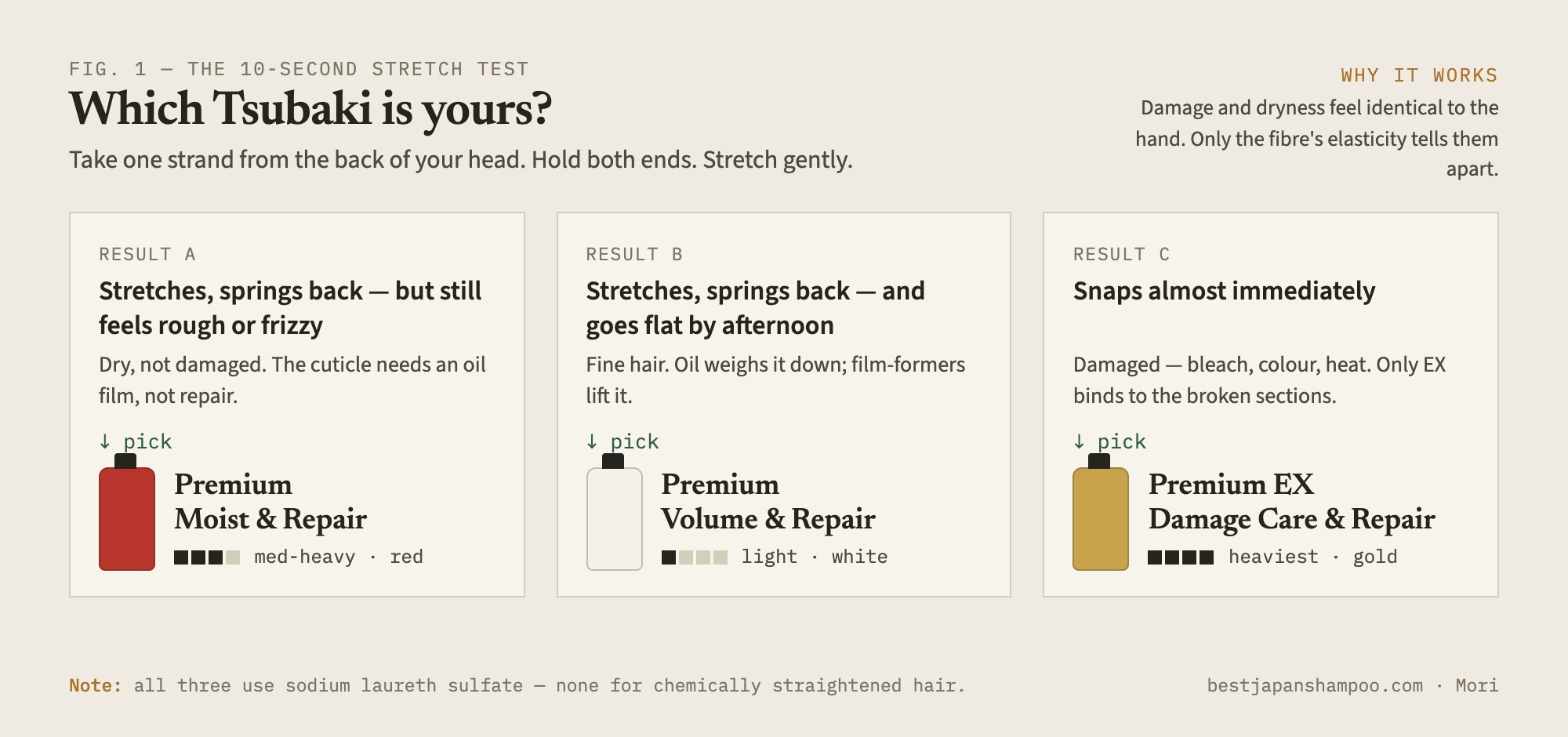
Before reading the reviews below, do this. Take one strand of hair from the back of your head, hold it at both ends, and stretch it gently.
- It snaps almost immediately → your hair is damaged. Go to EX.
- It stretches and springs back, but your hair still feels rough or frizzy → your hair is dry, not damaged. Go to Moist & Repair.
- It stretches and springs back, and your problem is that it goes flat by afternoon → your hair is fine. Go to Volume & Repair.
Damage and dryness feel identical to the hand and need opposite products. A Tsubaki bottle that “did nothing” for someone is almost always the wrong one of these three, not a bad shampoo.
Tsubaki Premium Moist & Repair — The Default
Bottle: Red · Weight: Medium-heavy · Built for: Dryness, frizz, thick or wavy hair
Premium Moist & Repair is the one most people mean when they say “Tsubaki.” The formula is built around what Fine Today calls Tsubaki Oil Force — camellia seed oil with squalane, a plant cholesterol analogue and a ceramide-like component — plus royal jelly and soy extracts, with a small amount of dimethiconol for slip.
What that means in practice: it cleans properly (it is a sulfate shampoo), then leaves a light oil film that holds moisture in the cuticle. On thick, coarse, or wavy hair that reads as “smooth and shiny.” On fine hair it reads as “why is my hair flat.”
Who it is for
- Hair that feels rough, dull, or frizzy but passes the stretch test
- Thick, coarse, or wavy hair — any texture with enough weight to carry an oil film
- Anyone in a dry climate or through winter
Who should skip it
- Fine, flat hair — see Volume & Repair
- Bleached or heavily coloured hair — it will feel nice but it is not repairing anything. Go to EX.
- Chemically straightened hair that you want to keep straight for as long as possible — sulfates accelerate fade. See the note below.
Pair it with: the matching Moist & Repair conditioner (it comes in the pump set). Once a week, the Tsubaki Premium Repair Mask if the ends are dry.
Tsubaki Premium Volume & Repair — For Fine Hair
Bottle: White · Weight: Light · Built for: Fine hair that loses body by afternoon
Premium Volume & Repair uses the same camellia oil base but swaps the heavy conditioning agents for what the brand calls a Volume Rich Complex — taurine, aspartic acid and polyquaternium-11. Those are film-formers that stiffen the hair shaft slightly rather than coating it in oil.
The result is the lightest finish in the range. Hair dries with lift at the root and does not collapse an hour later. If Moist & Repair makes your hair “greasy by the second day,” this is the one you should have bought.
This is also, in my experience, the best Tsubaki for straight fine East Asian hair — the hair type the range was originally designed around.
Who it is for
- Fine or thin hair, especially with an oily scalp
- Straight hair that goes flat
- Anyone who found Moist & Repair too heavy
Who should skip it
- Coarse, thick or curly hair — it will not give you enough slip, and you will fight tangles. Curly hair generally wants the opposite of “volumising”; the curly hair guide explains why weight matters more than anything else there.
- Damaged hair — “Repair” is in the name, but this is the lightest formula. It does not do the heavy lifting.
Tsubaki Premium EX Damage Care & Repair — For Damaged Hair
Bottle: Gold (sometimes listed as “Black Series”) · Weight: Heaviest · Built for: Bleach, colour, heat, and chemical damage
Premium EX is the top of the range and it is a genuinely different formula, not a relabel. On top of the camellia oil base it adds an arginine-derived conditioning agent, phytosteryl esters and macadamia fatty acids — the ingredients that bind to the damaged, negatively-charged sections of a hair fibre rather than just sitting on top of it.
Translated: it targets the hair that fails the stretch test. Ends that snap, mid-lengths that feel like straw after bleaching, hair that has had a flat iron on it every day for a year.
It is also the heaviest of the three. On healthy hair it is too much — you will get the “coated” feeling and think Tsubaki is greasy.
Who it is for
- Bleached, balayaged, or repeatedly coloured hair
- Heat-damaged hair (daily iron or hot dryer)
- Hair that snaps in the stretch test
- Anyone who bought Moist & Repair for damaged hair and found it “nice but didn’t fix anything”
Who should skip it
- Healthy hair of any type — waste of money and too heavy
- Fine hair, unless it is also badly damaged, and even then use a small amount
Pair it with: the matching EX conditioning treatment. This is the one Tsubaki line where the conditioner is doing more than the shampoo — do not buy the shampoo alone.
The Sulfate Question
All three Tsubaki shampoos list sodium laureth sulfate second on the ingredients, right after water. That is not a scandal — it is why they clean well and lather properly, and for most people it is fine.
It matters for exactly two groups:
- Chemically straightened or keratin-treated hair. Sulfates shorten the life of the treatment you paid $300–850 for. If that is you, Tsubaki is the wrong brand for daily use, whichever bottle. The straightening aftercare guide has the sulfate-free options.
- Very dry or sensitive scalps. Tsubaki Moist & Repair is moisturising for the hair; the cleanser is still a sulfate. If your scalp itches with regular shampoos, go to the Japanese sulfate-free guide instead.
Everyone else: ignore this section.
If You Still Cannot Decide
Thick, wavy, frizzy → Moist & Repair. This is the majority of people asking.
Fine, straight, flat by 3pm → Volume & Repair.
Bleached or breaking → EX, with its own conditioner.
Curly → Moist & Repair of the three, but Tsubaki is not the best Japanese brand for curls. The curly conditioner guide has better options.
Straightened → none for daily use. See the sulfate section.
No idea → Moist & Repair. Its failure mode — slightly heavy on fine hair — is the mildest of the three, and it is the cheapest way to find out whether you like the brand at all.
FAQ
Is Tsubaki Premium Repair the same as Premium EX? No. The old “Premium Repair” (white) is now called Volume & Repair and is the lightest formula. EX (gold) is the damage line and the heaviest. The word “Repair” is on all three bottles, which is the whole problem.
What is the difference between the red and white Tsubaki? Red (Moist & Repair) leaves an oil film for dry, frizzy or thick hair. White (Volume & Repair) uses film-formers instead of oil for fine hair that goes flat. Same cleanser, opposite finish.
Is Tsubaki sulfate-free? No. All three lines use sodium laureth sulfate as the main cleanser. If you need sulfate-free — chemically straightened hair, sensitive scalp — see the sulfate-free guide.
Is Tsubaki good for curly hair? Moist & Repair is usable on loose curls and waves. For tighter curls the conditioner matters far more than the shampoo, and there are better Japanese options — see the curly conditioner guide.
Which Tsubaki is best for damaged hair? Premium EX, used with its own conditioner. Moist & Repair will make damaged hair feel softer without repairing it; EX is the only one formulated to bind to damaged sections of the fibre.
Tsubaki or &Honey — which is better for dry hair? Depends whether the hair is dry or damaged, which feel the same. The Tsubaki vs &Honey comparison walks through the test.
Is Tsubaki still made by Shiseido? The brand moved to Fine Today in 2021, a company spun out of Shiseido’s personal-care division. The whole range was reformulated in September 2024. Amazon listings still say “Shiseido Tsubaki” on older stock.
Bottom Line
Three lines, three problems. Dry → red. Flat → white. Damaged → gold. Do the stretch test before you buy, and ignore the word “Repair” on the label — it is on all of them.
Dryness and frizz → Tsubaki Premium Moist & Repair Fine, flat hair → Tsubaki Premium Volume & Repair Bleached, coloured, breaking → Tsubaki Premium EX Damage Care & Repair
Prices and availability on Amazon change. Check the live listing before buying.