
Mori · licensed hairdresser, 8 years in Tokyo & Shanghai, specialising in Japanese straightening.
Matching a product to a hair type was the job. That is what this article is.
Almost every comparison of these two is written by a salon that sells one of them. That is worth knowing before you read anything, including this.
I did Japanese straightening for six years in Tokyo. I do not sell either treatment now, and I have no booking page. So here is the version I would have given a client across the chair, including the parts that talked people out of the treatment I was being paid for.
Updated September 2026 with the current FDA position on formaldehyde, the state-level ban that is already in force, and 2026 salon pricing for both treatments.
⏱️ In a hurry?
You want your curl gone, permanently → Japanese straightening
You want your frizz gone but your movement kept → keratin
Your hair is bleached or heavily highlighted → keratin, and expect a strand test
You are not sure you will like it → keratin, because it fades and leaves no line
You live in California → formaldehyde-based keratin is already banned there; ask what they use instead
The One Question That Decides It
Everything else is detail.
Do you want your curl gone, or your frizz gone?
- Curl gone. You want pin-straight hair that stays straight in humidity, out of the shower, with no effort → Japanese straightening
- Frizz gone, movement kept. You want your hair to still be your hair — with body and some wave — just smooth and manageable → keratin
The people who regret Japanese straightening are almost always people who wanted the second thing and were sold the first. It is genuinely, completely straight. It will not hold a curl. If I still want some volume is anywhere in your head, that is a keratin brief.
Quick Comparison
| Japanese Straightening | Keratin Treatment | |
|---|---|---|
| What it changes | The internal structure | The outer surface |
| The finish | Pin-straight, flat, high shine | Smoothed and frizz-free, still has movement |
| How long it lasts | Permanent on the hair it treated | Fades over 3–5 months |
| How it grows out | A sharp line where new texture meets treated hair | Fades evenly, no line at all |
| Formaldehyde question | Does not apply | Applies — see below |
| Typical US cost | $300–$900 full head; $450–$800 in big cities | $150–$600, by length and salon |
| Time in the chair | 4–8 hours | 2.5–3 hours |
| Repeat visits | Root touch-up every 6–12 months, $150–$450 | Whenever you like, or never |
| Hair it suits | Healthy, virgin or lightly coloured; wave to moderate curl | Coloured, highlighted, tight curls, fragile hair |
| Bleached hair | Usually disqualified | More forgiving |
| Reversible | No | Yes, by waiting |
Cost figures are US salon prices in 2026. The Japanese hair straightening cost guide has the city-by-city breakdown and what moves a quote up or down.
Before you read further: the aftercare is the same either way
Whichever treatment you choose, the thing that decides how long it lasts is what you wash it with. Both are broken down by the same thing: a strong cleanser. If you are booking either one, buy the shampoo before the appointment, not after — people always forget, wash once with what is in the shower, and lose weeks.
- The safe answer, either treatment → BOTANIST Botanical (Damage Care) — taurate cleanser, genuinely sulfate-free, and cheap enough to buy before the appointment
- Damaged hair, once the treatment has settled → Milbon Moisture Replenishing — salon repair, but it does contain SLES, so alternate rather than using it every wash
The full list, including what to avoid, is in shampoo after Japanese hair straightening.
What Each One Actually Does
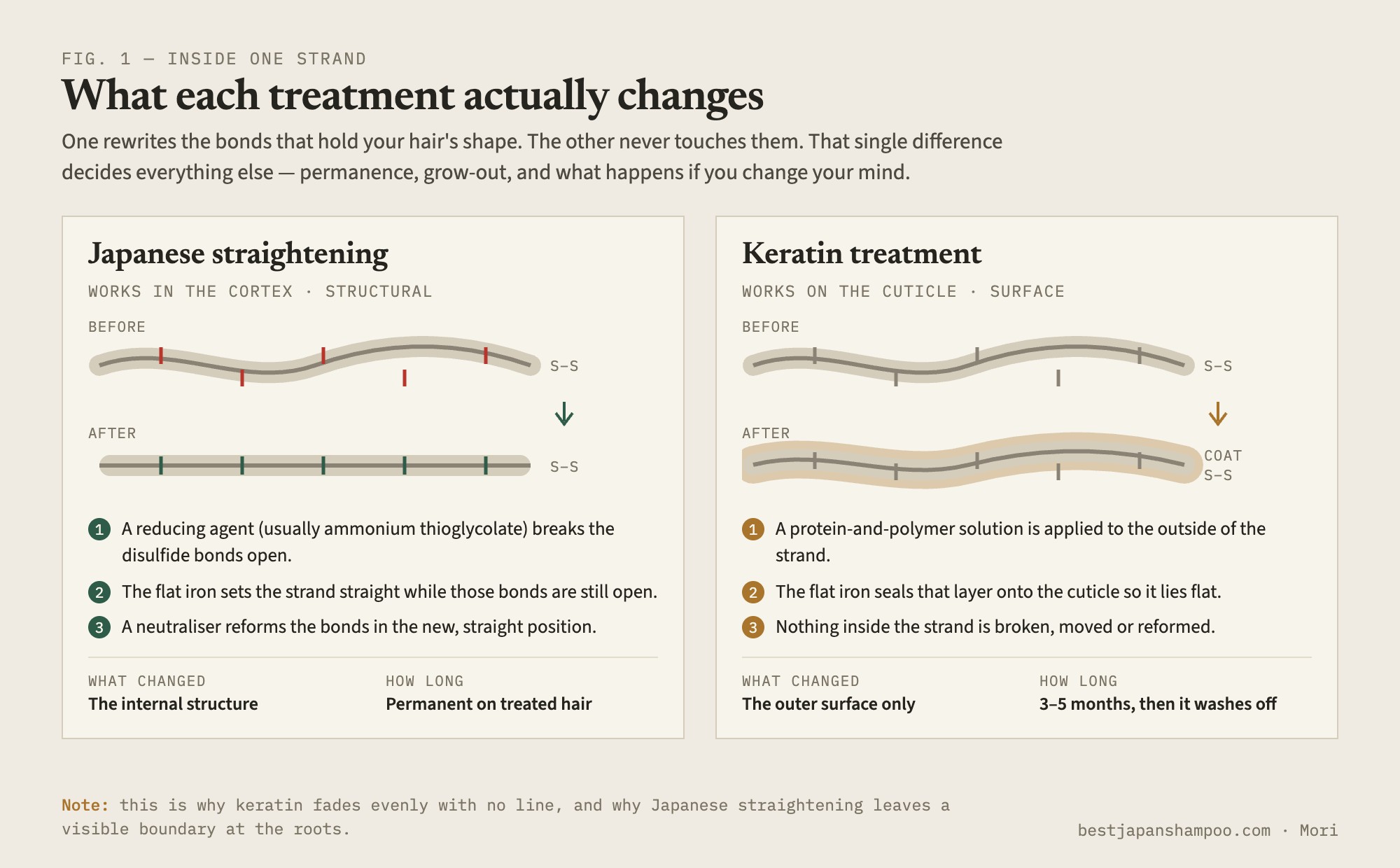
This is where the difference stops being marketing and becomes chemistry. It is also the only part you need to understand, because every practical difference below falls out of it.
Japanese straightening rebuilds the hair
Your hair’s shape is held by disulfide bonds inside the strand. Japanese straightening uses a reducing agent — usually ammonium thioglycolate — to break those bonds, flat-irons the hair straight while they are open, then uses a neutraliser to reform them in the new position.
The bonds are genuinely reformed. That hair is now straight hair. Not smoothed, not relaxed — structurally different from what grew out of your head. Nothing short of cutting it off changes it back.
Keratin coats the hair
A keratin treatment does not break disulfide bonds. It deposits a protein-and-polymer layer onto the outside of the strand and seals it with heat. The cuticle lies flat, the hair reflects light, frizz stops, and curl loosens without disappearing.
That coating is not permanent. It wears off with washing over three to five months, and the hair underneath is exactly as it was.
Neither is better. They are answers to different questions.
Japanese Straightening
Choose it if: you want straight hair permanently, your natural texture fights you daily, and you are tired of styling.
Do not choose it if: your hair is bleached or heavily highlighted, you like volume, you might want curls again, or you are not prepared to protect the treated lengths for years.
The honest downsides:
- It is a one-way door. If you decide you hate it, there is no undoing. Your only route back is growing it out and cutting the treated hair off — which on long hair means years
- Bleached hair is usually disqualified. Bleach has already broken down the structure this treatment needs to work with. A good stylist will refuse. If a salon says yes to bleached hair without a strand test, leave
- Very tight curl patterns carry more risk. More bonds to break means more processing means less margin for error
- The grow-out is visible. A distinct line where new texture meets straightened hair, and a touch-up cycle you are now on
- It does not hold a curl. People are surprised by this. You cannot curl straightened hair and have it stay
The upside is real too: on the right hair it is the most complete result available, it does not fade, and for people who have spent an hour a day fighting their hair, it gives that hour back permanently.
Keratin Treatment
Choose it if: frizz is the problem rather than curl, you want to keep body and movement, you want to try smoothing without committing, or your hair is coloured and you need something gentler.
Do not choose it if: you want genuinely straight hair. It will not get you there, and going back repeatedly to chase that result costs more than one Japanese treatment.
The honest downsides:
- It fades, and it fades faster than you hope if you wash frequently or use the wrong shampoo. Sulfates strip the coating directly
- The result varies by product and stylist far more than Japanese straightening does. Keratin treatment is a category, not a formula, and the strengths inside it differ enormously
- Ongoing cost. Three to five months means two to four treatments a year to maintain it
- The formaldehyde question is real — next section
The upside: it fades. If you do not like it, you wait. There is no line at the roots, no obligation, no permanent decision. For a first attempt at smoothing, that is worth a lot.
The Formaldehyde Question
This one gets stated backwards constantly, so here it is straight.
Japanese straightening does not use formaldehyde. It works by thiol chemistry — a reducing agent and a neutraliser. The formaldehyde discussion has nothing to do with it.
Keratin treatments are the category under scrutiny. Many use formaldehyde or formaldehyde-releasing chemicals, which release formaldehyde gas when the flat iron heats the hair. The concern is inhalation during the service — for you, and considerably more for the stylist doing it all day.
Where the federal rule actually stands
The FDA announced in 2023 that it intended to propose banning formaldehyde and formaldehyde-releasing substances in hair-smoothing products. It has never published that proposed rule. The target date has moved from October 2023 to April 2024, November 2024, March 2025, July 2025, and then December 31, 2025, which passed without action. The agency’s 2026 regulatory agenda now points at November 2026 for a Notice of Proposed Rulemaking.
Read that carefully, because the distinction matters: a notice of proposed rulemaking is the start of a rule, not a ban. Even if it lands on schedule, a comment period and a final rule follow it. As of September 2026 there is no federal ban in effect.
Where a ban is already in effect
California. The state’s Toxic-Free Cosmetics Act (AB 2762) took effect on 1 January 2025 and prohibits the manufacture or sale of cosmetic products containing formaldehyde, paraformaldehyde, methylene glycol or quaternium-15, among 24 listed ingredients. In practice that means formaldehyde-based smoothing formulas are off the shelf in California salons, several years ahead of anything federal.
If you are outside California, the responsibility is still yours.
- Ask for the product name and brand, not just whether it is formaldehyde-free
- Formaldehyde-free claims are not federally verified. Look up that product’s ingredient list — methylene glycol, formalin, methanediol and similar names are formaldehyde in solution
- Genuinely formaldehyde-free alternatives exist. They tend to give a softer result, which is exactly the trade-off
- Ventilation is not optional. If the salon does keratin in a closed room with no extraction, that tells you how seriously they take it
- If you are pregnant, ask your doctor rather than your stylist
I am not telling you to avoid keratin. I am telling you that this is a question you have to ask yourself, because outside one state, nobody is asking it for you.
The Grow-Out Is the Real Difference
Cost and chair time get all the attention. The grow-out is what you actually live with.
Japanese straightening produces a boundary — a demarcation line where new texture meets treated hair. It is visible, it is the most fragile point on your head, and it commits you to a cycle. Every 6–12 months you are booking again, and the stylist must apply to new growth only. Overlap onto already-treated hair is the classic cause of breakage. The touch-up guide covers the question to ask a salon before you book one.
Keratin has no boundary. The coating wears off gradually and evenly, and one day your hair is simply back to normal. No line, no appointment you are obliged to keep, no fragile section to protect.
If commitment worries you, that difference alone should decide it.
What Hair That Has Had Both Looks Like
This comes up constantly, and the answer depends entirely on the order.
Keratin on top of Japanese-straightened hair is the safe direction, and stylists do it — usually to put shine back into lengths that have been straight for a year or two. The structural work is already done; the keratin is only adding a surface layer over it. Tell the stylist exactly what was done and when, because the treated lengths are more porous than they look and will take the coating unevenly if nobody accounts for that.
Japanese straightening on top of keratin is the direction that goes wrong. The keratin coating is a barrier, and the straightening solution has to reach the cortex evenly to work. A partially faded coat is not evenly thick — it has worn off faster where you brush and where the sun hits — so the solution penetrates in patches. The result is patchy straightening on hair that has now been chemically processed twice. Wait until the keratin has substantially faded, which in practice means three to four months and a stylist confirming it, not a guess.
Either one on top of bleach is a conversation to have in person, with a strand test, not a decision to make from an article — mine included.
And whatever the history, tell your stylist all of it, including things done a year ago and things done at a different salon. Working blind on someone else’s chemistry is how hair breaks.
What Each One Costs
Japanese straightening, full head, US 2026: roughly $300 to $900, with $450 to $800 realistic in New York, Los Angeles, Portland and similar cities. Root touch-ups run $150 to $450 — not half price, because the ironing is the same work on a smaller area. A realistic first year in a major city is $600 to $1,700, then $300 to $900 a year after that.
Keratin, US 2026: roughly $150 to $600, by length, density and salon tier. Short hair sits at the bottom of that range; long or thick hair at the top.
The arithmetic that catches people out is repetition. Keratin at the middle of its range, three times a year to keep it, comes out close to a Japanese straightening plus a touch-up — and you are paying it forever rather than once per length of hair. That is not an argument for either one. It is an argument for being honest with yourself about what you are actually buying: keratin is a subscription, Japanese straightening is a purchase with a maintenance contract on the roots.
Full city-by-city pricing, what a salon is really pricing when it quotes you, and how to spot a quote that is too cheap are in the Japanese hair straightening cost guide.
Aftercare: Same Rule, Different Stakes
Both treatments demand sulfate-free shampoo. The reason differs, and for keratin it is more urgent than most people realise.
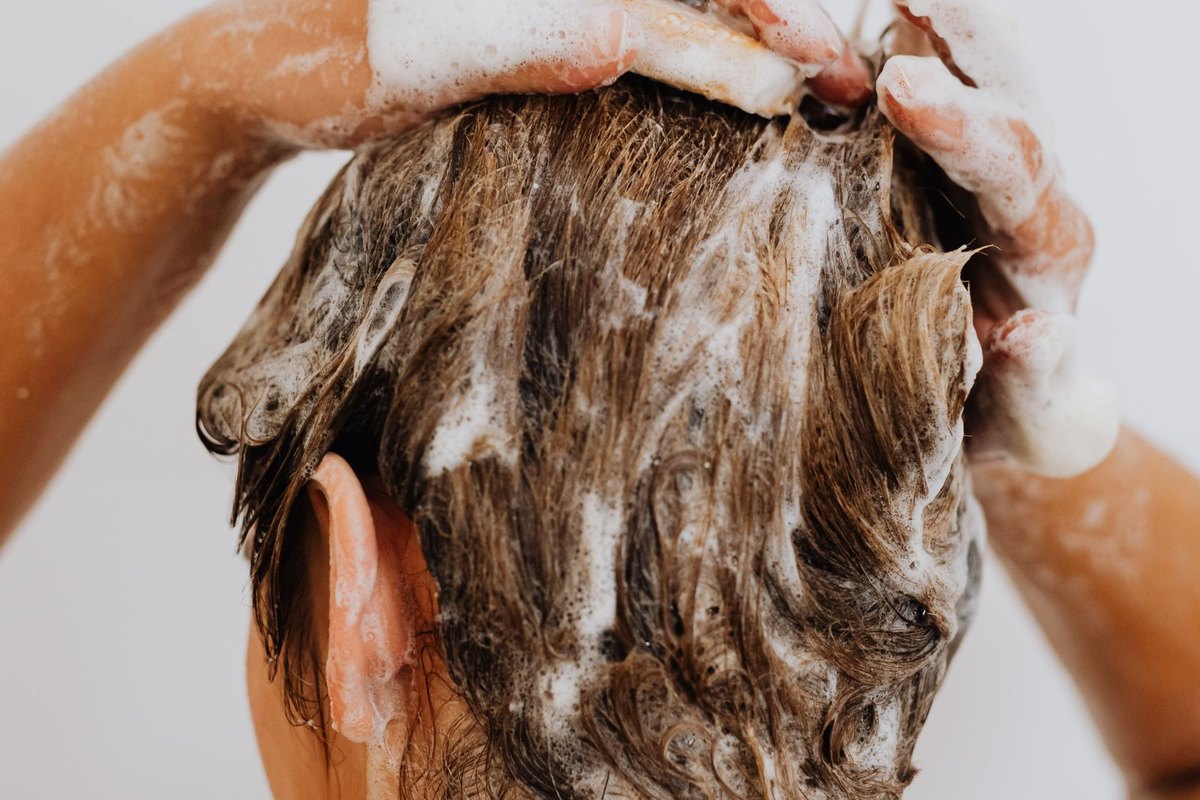
With Japanese straightening, sulfates strip moisture from permanently treated lengths — the hair stays straight but starts looking dull and faded months before it should.
With keratin, sulfates strip the coating itself. That is the treatment, physically leaving your hair. Washing a keratin treatment with a sulfate shampoo is the difference between three months and five — you can lose a large share of what you paid for through shampoo choice alone.
One warning about the label, because it is the mistake I see most. Sulfate-free is not the same as gentle. Several popular Japanese shampoos that say sulfate-free on the front use sodium C14-16 olefin sulfonate instead, which is a sulfonate rather than a sulfate and strips at close to the same strength. That is a perfectly good shampoo on thick dry hair and a bad one on a treatment you paid for. The BOTANIST vs &honey comparison shows what that looks like on an actual ingredient panel, and the Japanese sulfate-free guide lists the names to look for.
The four below are genuinely mild, and all four are in stock at the time of writing.
| Product | Best for | Price | Check Price on Amazon |
|---|---|---|---|
| Milbon Moisture Replenishing | The safe default after either treatment | $$$$ | Check Price on Amazon |
| Margaret Josefin Hotel Shampoo | Long treated lengths that have gone dry | $$$ | Check Price on Amazon |
| ONSENSOU Scalp Care | A tight, itchy scalp after treatment | $$ | Check Price on Amazon |
| DEMIKI Sulfate-Free | Roots that get oily between washes | $$ | Check Price on Amazon |
Price bands: $$ mid-range · $$$ premium · $$$$ salon tier. Amazon pricing moves — check the live listing.
And the tool you use every week: both treatments leave you blow-drying smooth for months or years. A dryer that dries fast at a lower temperature is the single piece of equipment that protects either result — see Japanese Hair Dryers on Amazon: Nanocare vs the US Models.
Never use a clarifying shampoo after either treatment. Ichikami and similar formulas exist to strip the hair shaft clean. On keratin they remove the treatment outright. See the full aftercare guide for the wider routine.
FAQ
Can I get Japanese straightening after a keratin treatment?
Not until the keratin has substantially faded — three to four months at minimum, confirmed by a stylist rather than guessed. The coating blocks the straightening solution unevenly, and uneven penetration means patchy results on hair that has now been processed twice.
Can I get keratin after Japanese straightening?
Yes, and this is the safe order. It is often done to put shine back into lengths that were straightened a year or two ago. Tell the stylist what was used and when, because treated lengths are more porous than they look.
Which is more damaging, keratin or Japanese straightening?
Structurally, Japanese straightening — it is the more aggressive chemical process, and it breaks and reforms internal bonds rather than coating them. Keratin is gentler to the fibre. But keratin carries the formaldehyde exposure question, which is a different kind of risk and one that falls on the stylist more than on you. Neither is safe in an absolute sense, and neither improves hair that is already damaged.
Which lasts longer?
Japanese straightening, by a wide margin. It is permanent on the hair it treated, and only regrowth brings your texture back. Keratin fades in three to five months.
Can I get Japanese straightening on bleached hair?
Usually no, and a salon that agrees without a strand test is one to walk away from. Keratin is the more realistic option for bleached hair.
Will keratin make my hair straight?
No. It will make it smoother, less frizzy and looser. If you want straight, keratin will disappoint you, and repeat treatments will not fix that.
Which is better for very curly or coily hair?
Keratin is generally the safer choice. Japanese straightening on tight curl patterns requires more processing and leaves less margin for error. The curly hair guide covers the no-treatment route.
Is Japanese straightening the same as a keratin treatment or a Brazilian blowout?
No. Brazilian Blowout is a brand of keratin-type smoothing treatment — surface coating, temporary. Japanese straightening is structural and permanent. They are different categories, and comparing them by price alone is how people end up with the wrong one.
How soon can I wash my hair after either?
Japanese straightening: 48–72 hours, and the rules in that window are strict — see The First 72 Hours. Keratin: follow your stylist, because the waiting period varies by product and is often shorter.
The Bottom Line
Japanese straightening if you want your curl gone permanently, your hair is healthy enough to take it, and you accept a touch-up cycle and a one-way decision.
Keratin if you want frizz gone while keeping movement, you would rather not commit, or your hair is coloured or bleached. Ask for the product name and check the ventilation — and note that in California the formaldehyde question is already settled for you.
Neither if your hair is fragile right now. Both are chemical processes on top of whatever condition your hair is already in, and no treatment improves damaged hair. Get it healthy first.
And whichever you choose, buy a genuinely mild shampoo before the appointment, not after. With keratin it directly buys you months. With Japanese straightening it is the difference between a treatment that still looks new at month three and one that does not.
About the author
Mori spent eight years as a licensed hairdresser — two in Shanghai at the Isetan salon, six in Tokyo — specialising in Japanese hair straightening (shukumo kyosei). He no longer works behind a chair but still holds the licence, and lives in Japan.
This article is based on professional knowledge of hair and formulation, plus aggregated customer reviews. It does not claim personal testing of every product. It is not medical advice. More about how this site works →