
Mori · licensed hairdresser, 8 years in Tokyo & Shanghai, specialising in Japanese straightening.
Matching a product to a hair type was the job. That is what this article is.
The honest number first: in the US in 2026, a full-head Japanese hair straightening costs roughly $300 to $900, and in the big coastal cities the realistic range is $450 to $800. A root touch-up runs $150 to $450. Anything under about $300 in a major metro is not a bargain — it is a shorter appointment, and I will explain below why that is the one thing you do not want.
I did this treatment for a living for eight years. The price is not arbitrary. It is four to six hours of one person’s time, a strand test, two chemical steps and a flat iron passed through every section of your head. Once you see what the hours are, the quotes make sense, and you can tell a fair one from a rushed one.
⏱️ In a hurry?
Full head, most US salons → $300–$900, typically $450–$800 in New York, Los Angeles, Portland and the like
Root touch-up (every 4–8 months) → $150–$450
Expect to sit for → 4–6 hours; anything quoted under 3 hours is being rushed
Too cheap? → under ~$300 in a major city with no strand test and a flat quote over the phone
After you pay → a sulfate-free wash and a decent dryer are the two purchases that protect the money; the aftercare shampoo guide has the full list
What US Salons Are Actually Charging in 2026
These are published prices I checked in September 2026, not averages from a calculator. Every salon prices by consultation, so treat each as a starting point.
| Where | Salon type | Full head | Notes |
|---|---|---|---|
| New York (Midtown) | Japanese salon, tiered by stylist | from $417–$627 | haircut and blow-dry included; student rate from $375 midweek |
| Fullerton, CA (Orange County) | Independent specialist | $450–$999 | quoted as a range by length, density and history |
| Portland, OR | Boutique salon, hourly | $800–$1,200 | billed at $200/hour, 4–6 hours |
| Philadelphia / South Jersey | Japanese straightening specialist | $785–$885 and up | relaxer and smoothing priced separately, lower |
| Phoenix area, AZ | Salon using the Yuko system | $365–$825 | by length; 4–8 oz of solution included, extra solution $25 per 2 oz; retouch from $270 |
| New York (chain, older listing) | Liscio system | $300–$400 | the low end of what a reputable city salon charges |
Two things stand out. The spread inside one salon (Fullerton’s $450 to $999) is as wide as the spread between cities — because your hair, not the postcode, is the main variable. And the retouch is not half price: the Arizona salon’s $270+ touch-up is roughly 60–75% of its short-hair full-head rate, because the hard part (the ironing) is the same work on a smaller area.
For comparison, a keratin smoothing treatment in the same cities runs about $150 to $600 and lasts around three months. Japanese straightening costs more per visit and lasts until the hair grows out. The Japanese straightening vs keratin comparison covers which one you should actually be getting; this article assumes you have decided on Japanese.
Why the Quote Moves: The Five Things a Stylist Is Pricing
When a salon says “from $450”, the “from” is a short-to-medium, medium-density, virgin head of hair. Here is what moves the number up.
1. Length. More hair is more solution, more rinsing, more drying and — above all — more ironing. Salons that publish a length scale typically add $100–$300 between short and long. Below the shoulder is where most price lists step up.
2. Density and texture. Thick, coarse or very curly hair takes smaller sections under the iron, which is where the time goes. Two heads of the same length can differ by an hour. A stylist who quotes a flat price without touching your hair is guessing.
3. Chemical history. Colour, bleach, a previous relaxer, a keratin treatment, box dye you have forgotten about — all of it changes how the first solution behaves. Bleached hair may be refused outright, or done at a lower strength with more time and a higher price. Some salons add a strand-test fee for treated hair; the good ones do the strand test on everyone and fold it into the price.
4. Stylist tier and the salon’s rent. The New York salon above charges $417 to $627 for the same service depending on who does it. A Midtown lease is in that number too; the same specialist in a suburb an hour away is often 30–50% less.
5. Time, billed as time. The Portland salon is the honest version of every quote: $200 an hour, four to six hours. Most salons bundle it, but that is the arithmetic underneath. Which is why a quote that implies two hours of work should worry you.
What the Hours Are Buying
A full-head Japanese straightening, done properly, breaks down roughly like this. The proportions matter more than the minutes.
- Consultation and strand test — 15–30 minutes. The stylist checks elasticity, porosity and history, and processes a test strand. This is the step a cheap salon skips.
- First solution (softening) — 30–60 minutes applied and processing, checked every few minutes on thick or treated hair.
- Rinse and blow-dry — 20–40 minutes. The hair must be completely dry before the iron. Damp hair under a plate is how cuticles blow open.
- Flat iron, section by section — 60–150 minutes. Fine sections, moderate heat, one or two passes each. On long, dense hair this alone can be two and a half hours, and it is the part that decides how the hair looks in six months.
- Second solution (neutraliser) — 15–30 minutes.
- Rinse, finish, aftercare briefing — 15–30 minutes.
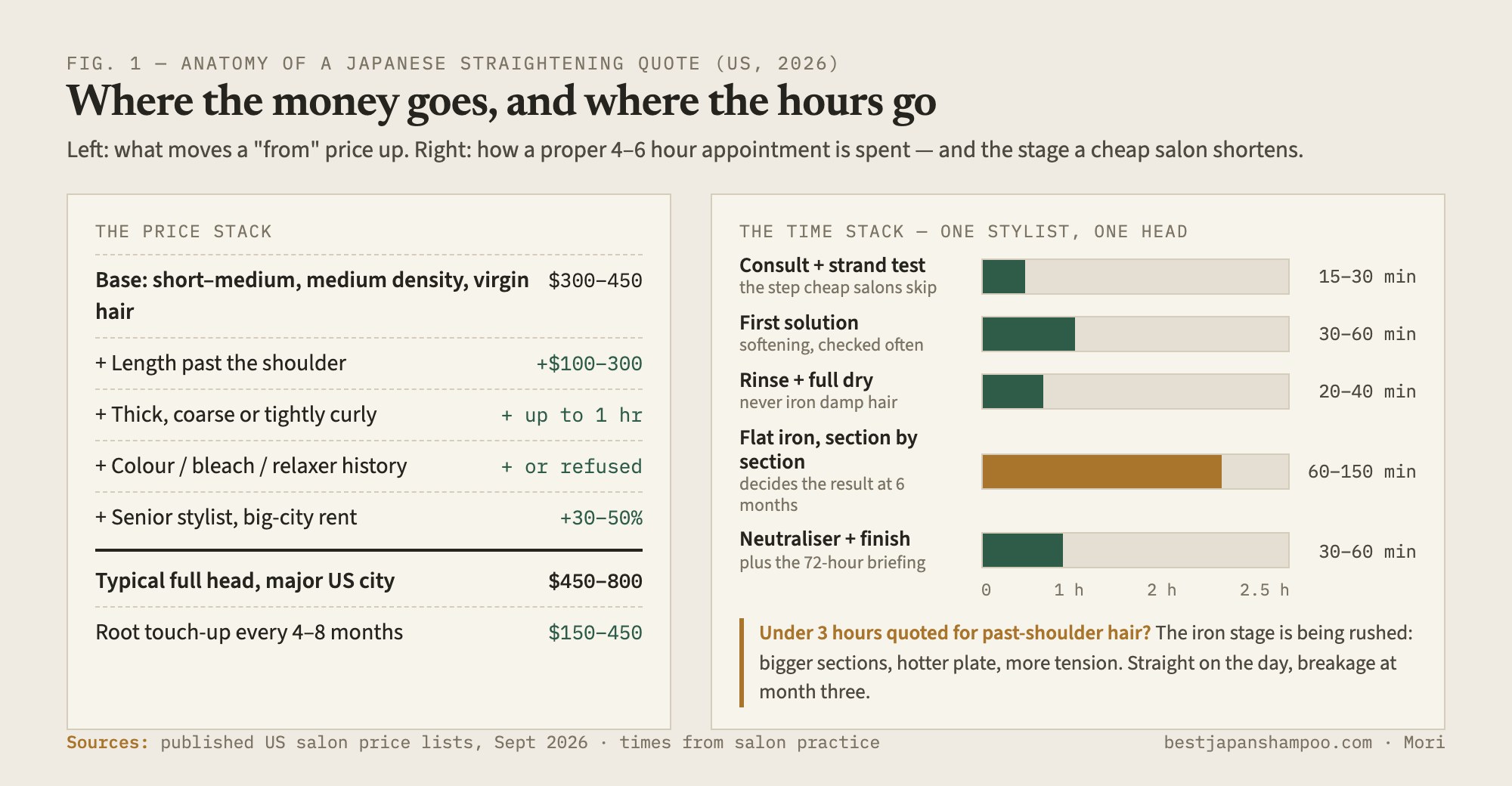
My professional judgement. The price you pay is mostly the iron. Every shortcut a salon can take to fit the appointment into three hours happens in that stage: bigger sections, higher plate temperature, pulling the hair taut to get a pass done faster. Those are the three inputs that damage hair — the article on why Japanese straightening damages hair goes through the mechanism — and none of them is visible on the day. The hair looks straight either way. The difference shows up as breakage at the mid-lengths three to six months later, when the cheap treatment has cost you more than the expensive one would have.
How to Tell “Good Value” From “Too Cheap”
A low price is not automatically a bad salon. A chain doing a high volume of straight East Asian hair can genuinely charge less because their appointments are shorter for a reason. These are the signals that separate that from a corner-cutter.
Red flags – A firm price over the phone without seeing your hair, or a website price with no “from”. – No strand test, or “we don’t need one for your hair type”. – An appointment quoted at under three hours for anything past the shoulder. – Willing to do it the same week as bleach, or on hair that has had a relaxer, without asking. – No mention of the 72-hour rule — no washing, tying, tucking or clips for three days. If the salon does not brief you on it, they are not tracking whether their work lasts. The first-72-hours guide is what they should have told you. – “Permanent” used to mean “forever”. It is permanent on the hair that was treated; the roots grow in curly.
Green flags – A consultation before booking, and a price that changes after it. – They ask what you have put on your hair in the last two years. – They tell you the touch-up interval and price up front. – They use the term “thermal reconditioning” or name the system (Yuko, Liscio, Shiseido) and can explain the difference.
The Real Cost Is Annual, Not Per Visit
The full-head price is the entry fee. Roots grow about half an inch a month, so a straight head needs a root touch-up every four to eight months depending on how much new growth you can live with. The touch-up guide covers how to work out your own interval.
A realistic first-year budget in a major US city:
- Full head: $450–$800
- One or two touch-ups at $150–$450: $150–$900
- Year one: roughly $600–$1,700, and $300–$900 a year after that on touch-ups alone
Which is why the aftercare products matter more here than for any other salon service. A sulfate wash can take a month or two off the life of the treatment. That is not a rounding error when the treatment is $600.
If You Are Paying for It, Protect It: What You Actually Need After
You do not need a shelf of products. You need a shampoo that does not strip, a conditioner that does not coat, and a way of drying that does not rough up a cuticle that has just been reset. Here are the four Japanese washes I would send someone home with, and the dryer.
| Product | Main cleanser | Weight | Built for | Price | Where to buy |
|---|---|---|---|---|---|
| BOTANIST Damage Care | amino-acid and taurate blend, no sulfates | Medium | Straightened hair, daily use — the default | $$ | Check Price on Amazon |
| Margaret Josefin Hotel Shampoo | betaine + cocoyl glutamate | Light | Fine or thin straightened hair; a minimal formula | $ | Check Price on Amazon |
| &Honey Deep Moist 1.0 | betaine + olefin sulfonate + alanine | Heavy | Thick, dry, coarse straightened hair | $$ | Check Price on Amazon |
| ONSENSOU Scalp Care | olefin sulfonate + betaine + taurate | Light | A scalp that itches or flakes after the treatment | $$ | Check Price on Amazon |
| Panasonic nanoe EH-NA67 dryer | — | 120 V US model | Drying straightened hair without a brush | $$$ | Check Price on Amazon |
Price bands: $ budget · $$ mid-range · $$$ premium. Amazon pricing moves — check the live listing.
One honest note on the “main cleanser” column. All four shampoos are sold as sulfate-free and none contains SLS or SLES. But two of them — &Honey and ONSENSOU — use sodium C14-16 olefin sulfonate as a primary cleanser, which is sulfate-free by the letter and cleans nearly as hard as a sulfate. That is fine for thick hair that needs a real wash, and it is why they are third and fourth on the list, not first. The sulfate-free guide explains how to read the label yourself.
BOTANIST Damage Care — The Default After Straightening
Cleanser: cocoyl methyl taurine, lauroyl methyl alanine, cocoyl glutamate, betaines · Weight: Medium · Built for: daily washing of chemically straightened hair
BOTANIST Damage Care is the one I would hand most people leaving the chair. The cleanser blend is genuinely mild — amino-acid and taurate surfactants, no olefin sulfonate — and the conditioning side (macadamia oil, rice ceramide, a small plant protein) is enough to keep straightened lengths smooth without the heavy silicone film that builds up on hair that no longer has any texture to hide it.
Who it is for – Anyone with a fresh Japanese straightening, medium or thick hair – Colour-treated hair on top of the straightening – Anyone who has been told “use a sulfate-free” and does not want to read ingredient lists
Who should skip it – Very fine hair that goes flat — see Margaret Josefin – An oily scalp that needs a proper clarify once a week — it will not do that
Pair it with: the matching BOTANIST Damage Care treatment on the lengths only, never the roots.
Margaret Josefin Hotel Shampoo — For Fine Straightened Hair
Cleanser: cocamidopropyl betaine, TEA-cocoyl glutamate · Weight: Light · Built for: fine or thin hair that a heavy wash flattens
Margaret Josefin is the shampoo you find in better Japanese business hotels — a short ingredient list built on an amino-acid cleanser, no sulfates, no silicone. On straightened hair that is also fine, that is exactly right: it cleans without stripping and leaves nothing behind to weigh the hair down. It is the cheapest bottle on this list and the one with the least in it, which for this hair type is a compliment.
Who it is for – Fine, thin or low-density straightened hair – Anyone with a reactive scalp – Anyone who wants one bottle for the whole household
Who should skip it – Thick, coarse or very dry hair — it will not condition enough on its own
Pair it with: a light rinse-out conditioner on the ends. Skip masks unless the ends are actually dry.
&Honey Deep Moist 1.0 — Good Shampoo, Wrong Job Here
Cleanser: lauramidopropyl betaine, sodium C14-16 olefin sulfonate, lauroyl methyl alanine · Weight: Heavy · Built for: coarse, thick or very dry hair after the treatment
&Honey Deep Moist is the moisture-heavy option. Three honeys, argan oil, shea derivatives, hydrolysed keratin — it is built to leave a film, and on thick hair that reads as glossy and calm. Updated September 2026: I no longer recommend it as straightening aftercare. When I went through the full panel for the BOTANIST vs &honey comparison, the cleanser was the deciding fact — sodium C14-16 olefin sulfonate is sulfate-free by the letter and strips at close to sulfate strength, and the heavy film that follows hides the fade rather than preventing it. On hair you paid several hundred dollars to straighten, that is the wrong trade at any hair thickness. It remains a good shampoo for thick, dry hair that has not been chemically straightened. If your straightened hair feels straw-dry, use a weekly Fino Premium Touch mask over a gentle shampoo instead — a mask adds moisture without a cleanser that can shorten the treatment.
Who it is for – Thick, coarse, or naturally very curly hair that has been straightened – Dry climates and winter – Anyone whose straightened hair feels rough rather than flat
Who should skip it – Fine hair — it will be heavy by the second day – The first two weeks after the treatment, when a milder wash is safer
Pair it with: its own Deep Moist treatment 2.0, lengths only, once or twice a week rather than daily.
ONSENSOU Scalp Care — For a Scalp That Reacts
Cleanser: sodium C14-16 olefin sulfonate, betaine, cocoyl taurate · Weight: Light · Built for: itching, flaking or tightness in the weeks after the treatment
Some scalps object to the first solution, and the itching starts a week or two later. ONSENSOU is a Japanese scalp-care shampoo built around hot-spring algae and yeast extracts with a light, cooling finish. It is sulfate-free on the label; the working cleanser is olefin sulfonate, so it cleans properly, which is part of why it settles an irritated scalp. Use it on the roots, keep the lengths mostly out of it, and go back to a milder wash once the scalp calms down.
Who it is for – A scalp that itches, flakes or feels tight after straightening – Oily roots on straightened hair – Men, or anyone who wants a scalp-first shampoo
Who should skip it – Dry, coarse lengths as the only shampoo — the cleanser is too strong for daily use on the ends – Anyone who dislikes menthol
Pair it with: a conditioner on the lengths only. The scalp does not need it.
Panasonic nanoe EH-NA67 — The Dryer
Voltage: 120 V, US model · Built for: drying straightened hair with air, not a brush
Straightened hair should be dried with the dryer pointed down the shaft and a hand, not a round brush — there is nothing to straighten, and a brush only adds tension. The EH-NA67 is the Panasonic model sold for the US grid, so there is no voltage trap, and its ion setting leaves the cuticle flatter than a standard dryer at the same heat. If you are tempted by the Japanese-market nanocare models, read the Japanese hair dryer guide first — most of them are 100 V only.
Who it is for – Anyone drying straightened hair daily who currently uses a hot, cheap dryer – Anyone who was going to buy a Japan-only dryer and a converter
Who should skip it – Anyone who already owns a good ionic dryer with a cool setting — the shampoo matters more than the second dryer
If You Still Cannot Decide
You want to know whether $600 is fair → In New York, Los Angeles, Portland or a similar city, for shoulder-length or longer hair with a consultation and strand test, yes. In a small city or suburb, $400–$500 is fair for the same.
You have been quoted $250 in a major city → Ask how long the appointment is and whether they strand-test. If the answers are two hours and no strand test, walk.
You have bleached or previously relaxed hair → Expect the top of the range or a refusal, and go to the specialist, not the cheapest salon that says yes. A refusal is cheaper than breakage.
You want to spend less over the year → Stretch the touch-up interval with aftercare: a mild wash from the list above, no sulfates, dry with air. That is where the savings are, not in the salon price.
You are choosing between this and keratin on price → Keratin is cheaper per visit and needs redoing every three months. Over a year they land in the same place. Choose by result, not price — the vs keratin article explains the difference.
FAQ
How much does Japanese hair straightening cost in the US? Roughly $300 to $900 for a full head in 2026, with $450 to $800 typical in major cities. Root touch-ups cost $150 to $450. Salons price by length, density, chemical history and the stylist’s tier, so a consultation quote is the only accurate one.
Why is Japanese straightening so much more expensive than keratin? Time. Keratin is applied, dried and sealed in about two hours. Japanese straightening is two chemical steps with a full section-by-section flat iron between them — four to six hours of one stylist’s time. It also lasts until the hair grows out instead of three months.
Is it cheaper to get Japanese straightening in Japan? Yes, by a lot. In Tokyo a full-head 縮毛矯正 at a regular salon runs about ¥15,000–¥28,000 (roughly $100–$190 depending on the exchange rate), and premium salons in Ginza or Omotesando charge around ¥25,000–¥35,000. If you are visiting Japan anyway, it is one of the better things to book — just leave the 72-hour window before flying home in dry cabin air.
How much is a Japanese straightening touch-up? $150 to $450 in the US, and typically 60–75% of the salon’s short-hair full price rather than half, because the ironing on the regrowth is the same skilled work. Most people need one every four to eight months.
Does short hair cost less? Usually, by $100–$300 at salons that publish a length scale. But density and texture matter as much as length — a short, thick, tightly curly head can take longer than long fine hair, and a good salon prices what it sees.
Should I tip on a $600 treatment? US salon convention is 15–20% on the service, the same as a cut or colour. Policies vary — some salons include service or ask for no tip — so ask when you book and follow the salon’s rule.
Can a cheap salon damage my hair? Any salon can. The damage in Japanese straightening comes from plate temperature, contact time and tension under the iron, and every one of those goes up when an appointment is squeezed into less time than the hair needs. That is the specific risk of a very cheap quote.
Bottom Line
Expect $450–$800 in a major US city, $300–$500 outside one, and $150–$450 for touch-ups. You are paying for four to six hours of one person’s attention, and the flat-iron stage in the middle is the part that decides whether the hair is still healthy in six months. Do not shop for the lowest number; shop for the salon that wants to see your hair before it quotes.
Then protect what you paid for. Most straightened hair → BOTANIST Damage Care. Fine hair → Margaret Josefin. Thick, dry hair → BOTANIST Damage Care plus a weekly Fino Premium Touch mask. Reactive scalp → ONSENSOU. And dry it with air, not a brush.
Salon prices were checked from published price lists in September 2026 and change by consultation. Prices and availability on Amazon change. Check the live listing before buying.