
Mori · licensed hairdresser, 8 years in Tokyo & Shanghai, specialising in Japanese straightening.
Matching a product to a hair type was the job. That is what this article is.
&honey and YOLU are the two Japanese shampoos people buy when their hair is dry and frizzy and they want it to feel heavier, smoother and calmer by the next morning. Both come in tall pump bottles, both are labelled sulfate-free on Amazon, and both promise to “repair” while you sleep or while you wait. Clients would bring me photos of both and ask which one was the good one.
Here is what surprised me when I put the two ingredient lists side by side this week: the shampoos clean with the same three ingredients. Same betaine, same amino-acid cleanser, same olefin sulfonate — just in a different order. So the choice between them is not really about the shampoo. It is about what each brand puts back on the hair afterwards, how heavy that is, and what you are prepared to pay for it.
⏱️ In a hurry?
Thick, coarse, dry hair → &honey Deep Moist set
Wavy hair that swells in humidity → &honey Melty Moist Repair set
Medium hair, frizz and tangles from the pillow → YOLU Night Repair set
Not sure yet → YOLU travel-size kit
Fine hair, or chemically straightened hair → neither one as your daily wash
Quick Comparison
| Line | Weight | Built for | Price | Check Price on Amazon |
|---|---|---|---|---|
| &honey Deep Moist (shampoo + conditioner set) | Heaviest | Thick, coarse, dry, frizzy hair | $$ | Check Price on Amazon |
| &honey Deep Moist Shampoo 1.0 (single bottle) | Heavy | Same shampoo, no conditioner | $ | Check Price on Amazon |
| &honey Melty Moist Repair set | Heavy | Wave that swells and loses shape | $$ | Check Price on Amazon |
| YOLU Night Repair set (US formula) | Medium | Medium hair, frizz, tangles, night washers | $$$ | Check Price on Amazon |
| YOLU travel-size kit | Medium | Testing YOLU before committing | $$ | Check Price on Amazon |
Price bands: $ budget · $$ mid-range · $$$ premium. Amazon pricing moves constantly — check the live listing. All five were in stock with a buy button, delivering to a New York address, when I checked on 29 October 2026.
Who Makes Them, and What Each Brand Is Trying to Do
&honey belongs to ViCREA, a Tokyo company, and it is built on one idea: water retention. The brand’s claim is that over 90% of the formula, once you set aside water and the cleansing ingredients, is moisturising material — a blend of honeys, argan oil, royal jelly, propolis and keratin. The point is to wrap the hair fibre in enough material that it stops losing moisture between washes. There is no night story. &honey is a daytime-finish shampoo: you wash, you dry, your hair is heavier and smoother.
YOLU belongs to I-ne, the Osaka company that also makes BOTANIST, and its whole identity is night. The theory is that hair takes much of its damage from friction against the pillow while you sleep, so the conditioner is designed to leave a slippery film that reduces that friction. On Amazon US you get the brand’s own US line — one shampoo, one conditioner, a hair oil, a scalp serum and a travel kit — not the four Japanese lines. I explained that split in detail in YOLU vs BOTANIST; the short version is that the US shampoo is a separate formula, closest in structure to Japanese Calm Night Repair.
So one brand is selling moisture, the other is selling less friction. Keep that in mind, because it decides which hair each one suits.
The Same Three Cleansers, in a Different Order
As always with Japanese shampoo, the useful part of the label is the first four ingredients. Here they are, from the Amazon US listings:
- &honey Deep Moist Shampoo 1.0: water → lauramidopropyl betaine → sodium C14-16 olefin sulfonate → sodium lauroyl methylaminopropionate → glycerin
- YOLU Rejuvenating Shampoo (US): water → sodium lauroyl methylaminopropionate → sodium C14-16 olefin sulfonate → cocamidopropyl betaine → cocamide methyl MEA
Three of those are the same job done by near-identical molecules. The betaine is a mild, foam-supporting cleanser. The methylaminopropionate is an amino-acid cleanser — the gentle kind Japanese brands are known for. And olefin sulfonate is the strong one. It is not a sulfate, which is why both listings can say sulfate-free, but it cleans at a strength much closer to a sulfate than to the amino-acid cleanser beside it.
On a Japanese ingredient list, ingredients are written in descending order of amount, so the order is the only clue to proportion. YOLU puts the gentle amino-acid cleanser first. &honey puts a betaine first and the amino-acid cleanser third. In both, the olefin sulfonate sits second.
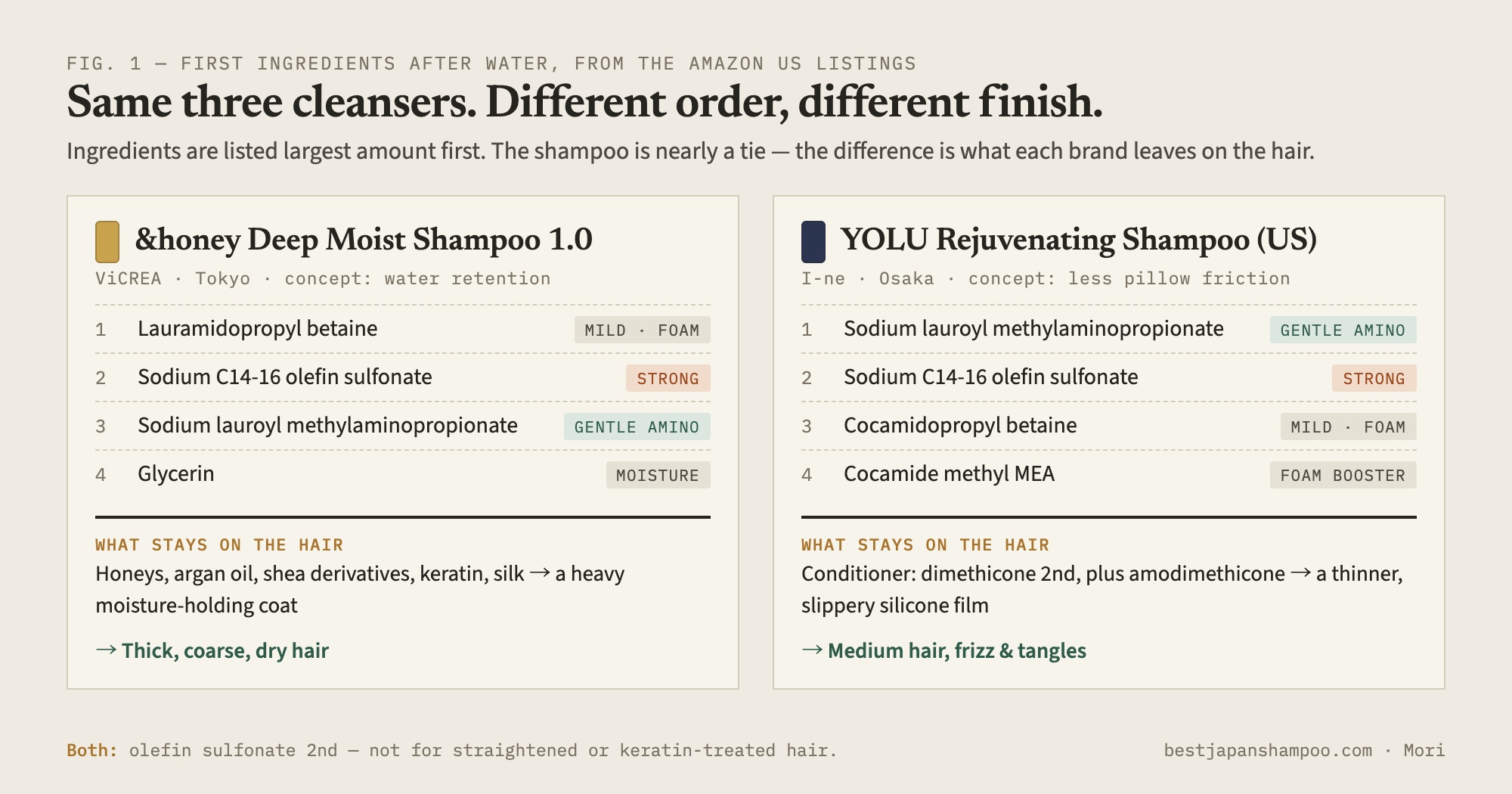
What that means in practice — and this is my professional judgement, not a lab measurement — is that the two shampoos clean at a similar, moderate-to-firm strength. YOLU’s order makes it slightly gentler on paper. &honey adds glycerin straight after the cleansers, which you can feel on wet hair as extra slip. Neither one is a mild shampoo, and neither is harsh. The real difference starts in the conditioner.
If you want to read these names on a Japanese bottle yourself, the guide to sulphate-free labels in Japan shows the katakana versions — オレフィン(C14-16)スルホン酸Na is the one to look for.
Where They Actually Differ: What Stays on the Hair
YOLU’s conditioner lists water, then dimethicone second, then a fatty alcohol, then the conditioning agent behentrimonium chloride. Further down it adds amodimethicone, aminopropyl dimethicone and polyquaternium-61. That is a silicone-led film. Silicone is what makes hair slide against fabric rather than catch on it, which is exactly the job YOLU claims. It is also why YOLU feels sleek rather than heavy, and why it washes out cleanly with the next shampoo.
&honey goes the other way. Its shampoo is already carrying honey, honey ferment, argan oil, shea butter derivatives, keratin and silk, and the brand describes its conditioner the same way: moisture-holding ingredients meant to sit in and on the fibre. The result is weight. On coarse hair, weight is the cure for frizz. On medium hair, it is the reason people write “greasy on day two” reviews.
My professional judgement: if your hair is thick enough that you can feel it in your hand like a rope when it is in a ponytail, &honey’s weight is an advantage. If your ponytail feels like a pencil or less, YOLU’s thinner silicone film is the safer of the two.
&honey Deep Moist — For Thick, Coarse, Dry Hair
Weight: Heaviest · Scent: Peony honey · Built for: Thick, coarse, dry or frizzy hair
Deep Moist is the bottle that made &honey, and on the right head it is the most visible one-wash change you can get from a drugstore shampoo. Hair dries smoother and lower, with the fluff on top flattened down. The effect is reliable because it is mechanical: you are adding mass to the surface of the hair.
The set linked here is a third-party listing — the official-store set went out of stock in November 2026 — and it was in stock and shipping within about ten days when checked. If you already own a conditioner you like, the single Deep Moist shampoo is the same formula on its own, sold by third-party importers.
Who it is for – Thick, coarse, dry hair that frizzes on the surface – Hair that looks dull rather than damaged – Anyone who has tried a gentle shampoo and found it did nothing
Who should skip it – Fine or soft hair — it will be flat within two washes – Oily scalps, for the same reason – Chemically straightened hair, because of the olefin sulfonate
Pair it with: the conditioner in the set, from mid-length to ends. For dry ends, add the Deep Moist hair oil — a small amount, on damp hair. If you want a direct comparison with Japan’s other heavy dry-hair shampoo, Tsubaki vs &honey covers it.
&honey Melty Moist Repair — For Wave That Swells
Weight: Heavy · Scent: Rose honey · Built for: Wavy hair that swells and loses shape in humidity
Melty is &honey’s line for uneri — the Japanese word for the bending, swelling frizz that wavy hair develops in humid weather. The brand’s explanation is that this frizz comes from uneven moisture across the fibre, and Melty is designed to even it out. The cleanser structure is the same family as Deep Moist; the finish is slightly lighter and more repair-leaning.
If Deep Moist made your roots heavy but your real complaint is that your waves turn shapeless by lunchtime, Melty is the one you should have bought.
Who it is for – Wavy hair that loses definition in humid weather – Wavy hair that is also coloured or heat-damaged – Anyone in a humid summer climate
Who should skip it – Straight, fine hair — the weight has nothing to hold on to – Tight curls — they usually want more conditioner than shampoo; start with the Japanese conditioner guide for curly hair
Pair it with: the three-step set with the hair oil, or add the Melty hair oil to what you already own. On wavy hair the oil does more than the shampoo.
YOLU Night Repair (US Formula) — For Medium Hair and Pillow Frizz
Weight: Medium · Scent: Neroli & night jasmine · Built for: Medium-density hair, frizz and tangles, people who wash at night
The YOLU Night Repair set is the better choice for the hair &honey overloads. The shampoo cleans firmly enough to remove styling products, and the conditioner leaves a sleek silicone film rather than a heavy one. The night logic is real, as far as it goes: hair that goes to bed fully dry and coated tangles less on the pillow. It is not a treatment that works because you sleep — it simply suits people who wash in the evening.
It is also the more expensive of the two by a clear margin in the US. You are paying for a brand-run US line rather than imported Japanese bottles.
Who it is for – Medium-density hair that frizzes and tangles, especially at the back of the head – People who wash at night and go to bed with dry hair – Anyone who found &honey heavy or greasy on the second day
Who should skip it – Very fine hair — even this film is enough to flatten it – Chemically straightened hair, because of the olefin sulfonate – Very thick, coarse hair — it will feel tidy, but &honey does more for that texture
Pair it with: the conditioner in the set — most of YOLU’s result comes from it. The single shampoo and conditioner are sold separately, and the YOLU hair oil helps dry ends. Dry your hair fully before bed; a low-heat Japanese dryer makes that quicker without cooking the ends.
YOLU Travel-Size Kit — The Cheapest Way to Be Wrong
Weight: Medium · Built for: Testing before you commit to the full set
Because the full YOLU set sits at the top of the drugstore price range, the travel kit is the sensible first order if you are between the two brands. It holds the shampoo, conditioner, oil and scalp serum in small bottles — enough for three or four washes, which is how long it takes to see whether a conditioner is too heavy for you.
My professional judgement: if your hair has movement on the second morning, YOLU suits you and you can upgrade. If it looks flat and separated, go back to the comparison table: you are probably a fine-hair case, and neither brand is your answer.
Two Things to Watch Before You Buy
1. Chemically straightened, keratin-treated or freshly coloured hair. Both shampoos contain olefin sulfonate. It shortens the life of a straightening or keratin treatment and fades colour faster than an amino-acid or taurate shampoo. That rules both out as a daily wash for those readers, however good the conditioner. The aftercare guide for Japanese straightening lists what I would use instead.
2. Fine hair. Both brands are moisture-and-weight products. If your hair is fine, soft or oily at the root, you want a lighter taurate shampoo — BOTANIST, covered in BOTANIST vs &honey — rather than the lighter of two heavy ones.
If You Are in Japan
The answer changes, because you have the Japanese ranges at drugstore prices.
- YOLU Relax, Deep and Mellow were reformulated in 2025 and no longer use olefin sulfonate; they clean with an amino-acid cleanser, a taurate and betaines. Only YOLU Calm keeps the stronger cleanser. If you liked the idea of YOLU but your hair is coloured, Relax is the bottle to pick up.
- &honey Professional System Repair launched in Japan in 2026. The ingredient list I checked on a Japanese drugstore listing leads with sodium lauroyl methylalaninate and cocamidopropyl betaine, without olefin sulfonate. It is not on Amazon US.
- Buy refills (つめかえ用). Both brands sell them, and they cost noticeably less per millilitre than the pump bottle.
If You Still Cannot Decide
Thick, coarse, dry → &honey Deep Moist set.
Wavy, swells in humidity → &honey Melty Moist Repair set.
Medium, frizzy, tangles, washes at night → YOLU Night Repair set.
Curious but unsure → YOLU travel-size kit.
Fine, straightened, or coloured and fading → neither. Start with the frizzy-hair guide, which separates frizz from damage first.
Outside the US: You Can Buy the Singles
Amazon US sells most of this as sets, which is why the buttons above point at sets. Overseas the singles are easier to get, and that changes what is worth buying. Stylevana ships worldwide and lists the &honey bottles individually — Deep Moist Shampoo 1.0 at about $24, the Deep Moist oil at about $35, and the Melty Moist repair oil at about $20. Prices checked November 2026.
👉 &honey Deep Moist Shampoo 1.0 on Stylevana →
The YOLU side does not transfer. The YOLU sold on Amazon US is the US formula described above. What ships from Japan is the domestic Calm / Relax / Deep Night Repair range, which is not the same formula — so if you have been choosing on the cleanser, do not assume the Japanese bottle behaves like the US one.
FAQ
Are &honey and YOLU sulfate-free? Technically, yes. Neither contains sodium lauryl or laureth sulfate. Both contain sodium C14-16 olefin sulfonate, which is not a sulfate but cleans at close to sulfate strength.
Which one is gentler? On paper, YOLU, because its first cleanser is the amino-acid one. In practice the difference is small; both share the same strong secondary cleanser.
Which one is heavier? &honey, especially Deep Moist. YOLU’s finish is a thinner silicone film.
Is &honey a night shampoo like YOLU? No. &honey is built around moisture retention, not overnight repair. Only YOLU is designed around sleep and pillow friction.
Is the YOLU on Amazon US the same as in Japan? No. The US line is its own formula with its own names. Its shampoo is closest in structure to Japanese Calm Night Repair, which is the one Japanese YOLU that still uses olefin sulfonate.
Which is better for curly hair? For loose waves, &honey Melty. For tighter curls, neither is ideal on its own — a heavier conditioner matters more than either shampoo. The four Japanese picks for curly hair and frizz is the better starting point.
Can I use them together? Yes. My professional judgement: on medium-to-thick frizzy hair, &honey shampoo with YOLU conditioner is a sensible mix — the &honey wash adds slip, and the YOLU conditioner keeps the finish lighter than &honey’s own.
Bottom Line
Same cleansers, different finish. &honey and YOLU both clean with a betaine, an amino-acid cleanser and olefin sulfonate. &honey then loads the hair with moisture-holding weight, which is right for thick, coarse, dry hair. YOLU leaves a thinner silicone film designed to cut pillow friction, which is right for medium hair that frizzes and tangles — and it costs more.
Neither is the right daily wash for straightened, keratin-treated or fine hair.
Thick, coarse, dry → &honey Deep Moist set Wavy, swells → &honey Melty Moist Repair set Medium, frizzy, night washer → YOLU Night Repair set
Prices, sellers and availability on Amazon change constantly. Check the live listing before buying.