
Mori · licensed hairdresser, 8 years in Tokyo & Shanghai, specialising in Japanese straightening.
Matching a product to a hair type was the job. That is what this article is.
In Shanghai, clients brought me Korean bottles as often as Japanese ones, and the question was nearly the same every time: which country makes the gentler shampoo? It is a reasonable thing to ask. Both countries have a reputation for careful, ingredient-led beauty, and both shelves look calm and expensive next to an American drugstore aisle.
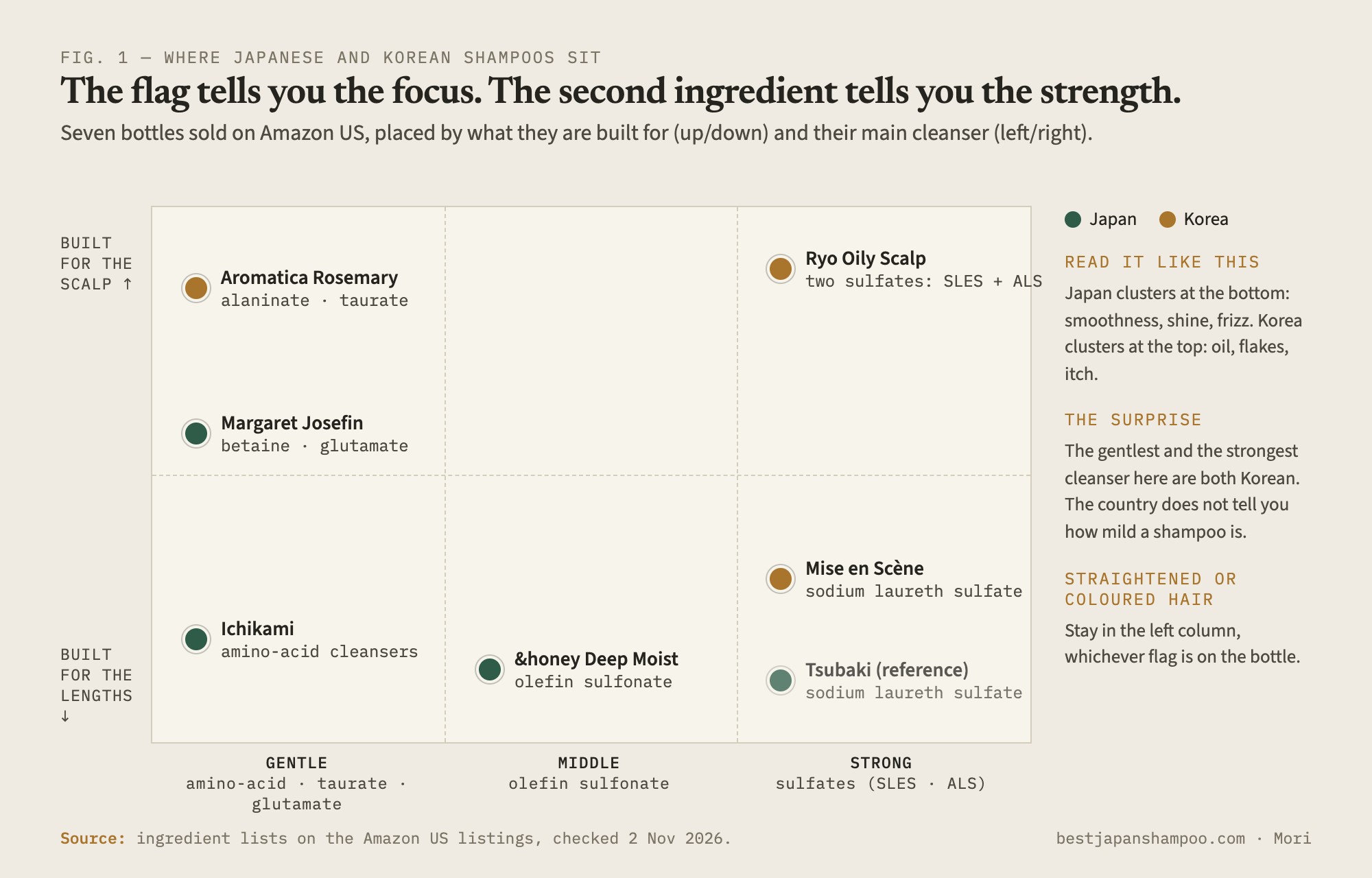
The honest answer is that the country does not tell you how gentle a shampoo is. I checked the ingredient lists of the Japanese and Korean shampoos you can actually buy on Amazon US this week, and the strongest cleanser and the mildest cleanser in the group were both Korean. What the country does tell you is where the bottle puts its effort. Japanese shampoo is mostly designed around the lengths of the hair — smoothness, shine, frizz. Korean shampoo is mostly designed around the scalp — oil, buildup, itch and thinning. Once you know which of those is your problem, the choice gets easy.
⏱️ In a hurry?
Frizzy, dry or straightened lengths → Ichikami Moisturizing set (Japan)
Thick, coarse hair that needs weight → &honey Deep Moist (Japan)
Oily scalp, buildup, flakes — gently → Aromatica Rosemary Scalp Scaling (Korea)
Very oily scalp, you want a strong clean → Ryo Hair Strength, Oily Scalp (Korea)
Fine hair, sensitive scalp → Margaret Josefin Hotel Shampoo (Japan)
Damaged ends, you only want one extra product → Lador Hydro LPP Treatment (Korea)
Outside the US? Most of these ship worldwide — the link sits next to each Amazon button.
Quick Comparison
| Line | Weight | Built for | Price | Check Price on Amazon |
|---|---|---|---|---|
| Ichikami Moisturizing (shampoo + conditioner set) · Japan | Medium | Frizzy, dry, straightened lengths | $ | Check Price on Amazon |
| &honey Deep Moist Shampoo 1.0 · Japan | Heavy | Thick, coarse, dry hair | $ | Check Price on Amazon |
| Margaret Josefin Hotel Shampoo · Japan | Light | Fine hair, sensitive scalp | $$$ | Check Price on Amazon |
| Aromatica Rosemary Scalp Scaling Shampoo · Korea | Light | Oily scalp, buildup, flakes | $$ | Check Price on Amazon |
| Ryo Hair Strength Expert Care, Oily Scalp · Korea | Light | Very oily scalp, heavy product users | $ | Check Price on Amazon |
| Mise en Scène Perfect Serum Original Shampoo · Korea | Medium | Normal hair, heat-styled ends, budget | $ | Check Price on Amazon |
| Lador Hydro LPP Treatment · Korea (treatment) | Medium | Damaged, bleached, heat-styled ends | $$ | Check Price on Amazon |
Price bands: $ budget · $$ mid-range · $$$ premium. Amazon pricing moves constantly — check the live listing. All seven were in stock with a buy button, delivering to a New York address, when I checked on 2 November 2026.
The Real Difference: Lengths vs Scalp
Walk down a Japanese drugstore aisle and read the front of the bottles. The words you see most are tsuya (shine), matomari (hair that stays together instead of puffing out), damage repair and frizz. Tsubaki, Ichikami, &honey, YOLU — nearly every big line is built to change how the lengths look and feel when they are dry. The conditioner and the mask carry much of the result, and the shampoo is designed to leave the hair ready for them.
Korean haircare grew up around a different worry. The bestselling lines are scalp lines: Ryo’s ginseng ranges, rosemary scalp shampoos, scalp scrubs and scaling shampoos that exfoliate. Korea even has a regulated category of functional cosmetics for products that help relieve hair-loss symptoms, and brands compete hard to get into it. The scalp is treated like facial skin — cleansed, exfoliated, toned.
So the useful question is not Japanese or Korean? It is which end of your hair is the problem?
- If your scalp is fine and your lengths are frizzy, dry, dull or chemically treated, start on the Japanese side.
- If your lengths are fine and your scalp is oily, itchy, flaky or thinning, start on the Korean side.
- If both are a problem, you can — and in my opinion should — use one from each. I explain how at the end.
The Second Ingredient Tells You the Strength
This is where most comparison articles go wrong. They assume Korean means gentle, or Japanese means gentle. Neither is true across the board. The way to know is to read the ingredient list, where ingredients appear in descending order of amount. The first is nearly always water; the second is usually the main cleanser.
Here is what the second ingredient is on the bottles in this article, taken from the Amazon US listings:
- Ryo Hair Strength, Oily Scalp (Korea): sodium laureth sulfate, then ammonium lauryl sulfate — two sulfates
- Mise en Scène Perfect Serum (Korea): sodium laureth sulfate
- &honey Deep Moist (Japan): a betaine, with sodium C14-16 olefin sulfonate right behind it — not a sulfate, but close to sulfate strength
- Ichikami (Japan): plant-derived amino-acid cleansers, labelled sulfate-free by Kracie
- Margaret Josefin (Japan): a mild betaine, then a glutamate amino-acid cleanser
- Aromatica Rosemary (Korea): sodium cocoyl alaninate, an amino-acid cleanser, followed by isethionates and taurates
That puts the two strongest cleansers and the mildest one all on the Korean side. The pattern I see — and this is my professional judgement from reading labels, not a market survey — is that Korean mass-market shampoo is often sulfate-based, while Korean indie and clean-beauty brands like Aromatica are among the gentlest bottles on Amazon. Japanese mid-price shampoo sits mostly in the middle, with amino-acid or olefin cleansers.
If you want to read these names in Japanese on a bottle in Tokyo, the guide to sulphate-free labels in Japan shows the katakana for each cleanser.
Ichikami Moisturizing — Japan’s Answer for Frizzy Lengths
Origin: Japan (Kracie) · Cleanser: amino-acid · Built for: frizzy, dry or straightened lengths on a budget
Ichikami is the clearest example of the Japanese approach. Kracie labels the range sulfate-free, the cleansers are amino-acid types, and the whole formula is aimed at the lengths: it leaves dry hair smoother and lower without the heaviness of an oil-loaded shampoo. On frizzy, coloured or chemically straightened hair, it does more than its price suggests.
The set linked here includes the conditioner, which matters — most of the smoothing comes from it.
Who it is for
- Dry or frizzy lengths with a normal scalp
- Coloured or chemically straightened hair that needs a gentle daily wash
- Anyone on a budget who wants a Japanese amino-acid shampoo
Who should skip it
- Oily scalps — it cleans gently, which means oil can build up by day two
- Very fine hair that goes flat with any conditioner
Pair it with: the conditioner in the set, from mid-length down. I compared it with Japan’s best-known premium line in Ichikami vs Tsubaki.
👉 Check Price on Amazon → · Stylevana (ships worldwide) →
Delivery note, November 2026: the set ships from Amazon but was quoting two to three weeks for delivery when checked. If you would rather not wait, the Ichikami Moisturizing shampoo refill pouch (330 ml) is the same formula and was shipping in days.
&honey Deep Moist — When the Lengths Need Weight
Origin: Japan (ViCREA) · Cleanser: betaine + olefin sulfonate · Built for: thick, coarse, dry hair
&honey Deep Moist is the Japanese lengths-first idea taken to the extreme. It is loaded with honey, glycerin, oils and proteins to make hair heavier, smoother and calmer. On coarse hair that puffs out, that weight is the cure. There is nothing like it among the Korean bottles here.
Who it is for
- Thick, coarse, dry hair that frizzes on the surface
- Hair that looks dull rather than damaged
Who should skip it
- Fine hair or oily scalps — it will be flat and greasy within two washes
- Chemically straightened or keratin-treated hair, because of the olefin sulfonate
Pair it with: a light hair oil on dry ends. If you are deciding between &honey and Japan’s other moisture brand, &honey vs YOLU compares them cleanser by cleanser.
👉 Check Price on Amazon → · Stylevana (ships worldwide) →
Margaret Josefin Hotel Shampoo — Japan’s Gentle Option for Fine Hair
Origin: Japan · Cleanser: betaine + glutamate · Built for: fine hair and sensitive scalps
Margaret Josefin is the exception to the Japanese lengths-first rule. It is light, it leaves fine hair with movement, and it cleans with a betaine and a glutamate — two of the gentlest cleansers in common use. It is also the most expensive bottle in this article, because it reaches the US through an importer rather than a drugstore brand’s own store.
Who it is for
- Fine or soft hair that flattens under heavier Japanese shampoos
- Sensitive scalps that sting with sulfates
- Chemically straightened hair, once the first 72 hours have passed
Who should skip it
- Very oily scalps — gentle may not be enough
- Anyone on a tight budget; Ichikami covers most of the same ground for less
Pair it with: a light conditioner on the ends only. For straightened hair, the aftercare guide explains why the cleanser matters more than the brand.
👉 Check Price on Amazon → · YesStyle (ships worldwide) →
Aromatica Rosemary Scalp Scaling — Korea’s Gentle Scalp Shampoo
Origin: Korea (Aromatica) · Cleanser: alaninate + isethionate + taurate · Built for: oily scalp, buildup, flakes
Aromatica Rosemary is the Korean scalp-first approach done gently, and it surprised me. The current US formula leads with an amino-acid cleanser, then isethionates, taurates and a glucoside — no sulfate and no olefin sulfonate. The scaling part comes from salicylic acid, a mild exfoliant that loosens flakes and oil around the follicles, plus rosemary oil, panthenol, niacinamide and caffeine.
A word on the hair-growth claims on the listing. Rosemary oil has some early research behind it, but none of it shows that a rinse-off shampoo regrows hair. My professional judgement: buy this for a cleaner, calmer scalp, not for growth.
Who it is for
- Oily scalps that itch or flake by evening
- Product-heavy styling that leaves buildup at the roots
- Coloured hair that needs a scalp clean without stripping the ends
Who should skip it
- Very dry, tight scalps — salicylic acid can be too much every day
- Anyone sensitive to essential oils; the scent comes from a long list of them
Pair it with: a Japanese conditioner on the lengths, and a soft scalp brush while you wash — see Japanese scalp brushes.
👉 Check Price on Amazon → · Stylevana (ships worldwide) →
Ryo Hair Strength Expert Care, Oily Scalp — Korea’s Strong Clean
Origin: Korea (Amorepacific) · Cleanser: sodium laureth sulfate + ammonium lauryl sulfate · Built for: very oily scalps
Ryo is the Korean drugstore classic, sold on Amazon US by Amorepacific’s own store. The pitch is ginseng — the brand uses extract from the whole plant — plus caffeine and menthol for a cool, tingling finish. Underneath, it is a firm sulfate shampoo. That is not a criticism: on a scalp that is greasy by the afternoon, a strong cleanser is the correct tool.
Who it is for
- Very oily scalps that need washing daily
- People who use dry shampoo, wax or heavy styling products
- Short hair, where the lengths barely matter
Who should skip it
- Coloured, bleached or chemically straightened hair — two sulfates will shorten all of them
- Dry or sensitive scalps
Pair it with: a conditioner on the ends only. If your lengths are long, use Ryo on the scalp and let the foam run through rather than scrubbing the ends.
👉 Check Price on Amazon → · Stylevana (ships worldwide) →
Mise en Scène Perfect Serum — Korea’s Lengths-First Budget Bottle
Origin: Korea (Amorepacific) · Cleanser: sodium laureth sulfate · Built for: normal hair, heat-styled ends
Mise en Scène Perfect Serum is the Korean line that behaves most like a Japanese one. It is built on the brand’s famous hair oil and carries seven plant oils — argan, jojoba, coconut, olive, apricot, camellia and marula. It feels soft and conditioned. It also cleans with sodium laureth sulfate, which puts it in the strong group.
Who it is for
- Normal, uncoloured hair that you blow-dry or straighten with heat
- Anyone who wants a big, cheap bottle that leaves hair soft
Who should skip it
- Coloured or chemically straightened hair
- Sensitive scalps
Pair it with: the Perfect Serum Original hair oil, which is the stronger product of the two. Two or three drops on damp ends before drying.
Lador Hydro LPP Treatment — Korea’s Protein Fix for Damaged Ends
Origin: Korea (Lador) · Type: rinse-out treatment · Built for: bleached, coloured or heat-damaged ends
Lador Hydro LPP is not a shampoo, but it belongs here because it is the Korean product that does the job Japanese masks do — and it does it differently. The listing names hydrolyzed keratin, soy protein, silk and conchiolin, with olive and jojoba oils. That is a protein approach: it fills in damaged sections of the fibre so the hair feels firmer. Japanese masks such as Fino lean on oils and lipids to coat and smooth instead.
Who it is for
- Bleached or highlighted hair that feels mushy or stretchy when wet
- Heat-damaged ends that snap
Who should skip it
- Healthy, coarse hair — too much protein can make it feel stiff and straw-like
Pair it with: any gentle shampoo above. If your damage is dryness rather than breakage, compare it with the Japanese approach in Fino vs Tsubaki Hair Mask, or try the Fino Premium Touch mask itself.
👉 Check Price on Amazon → · Stylevana (ships worldwide) →
Two Things to Watch Before You Buy
1. The same brand name can hide different formulas. Korean and Japanese brands both make US-specific versions, refresh formulas often, and sell the same name in several scalp types. Ryo alone has oily, dry, sensitive and anti-dandruff versions. Read the ingredient list on the listing you are buying, not a review of an older bottle.
2. Chemically straightened or keratin-treated hair. Ryo and Mise en Scène use sulfates, and &honey uses olefin sulfonate. All three will shorten the life of a straightening treatment. If you have had Japanese straightening, your daily wash should come from the gentle group — Ichikami, Margaret Josefin or Aromatica.
If You Still Cannot Decide
Normal scalp, frizzy or dry lengths → Ichikami Moisturizing set.
Thick, coarse hair that puffs out → &honey Deep Moist.
Oily or flaky scalp, coloured hair → Aromatica Rosemary Scalp Scaling.
Very oily scalp, uncoloured hair → Ryo Hair Strength, Oily Scalp.
Oily scalp and dry ends → my favourite combination: a Korean scalp shampoo on the roots, a Japanese conditioner on the lengths. Aromatica plus the Ichikami conditioner covers both for a reasonable price.
Frizz and you are not sure why → read the frizzy-hair guide first; it separates frizz from damage.
FAQ
Is Korean shampoo better than Japanese shampoo?
Neither is better overall. Korean haircare is strongest on the scalp; Japanese haircare is strongest on the lengths. Pick the country that matches your problem.
Is Korean shampoo sulfate-free?
Some is, much is not. On Amazon US, Aromatica is sulfate-free, while Ryo and Mise en Scène both use sodium laureth sulfate. Check the second ingredient.
Is Japanese shampoo sulfate-free?
Also mixed. Ichikami and Margaret Josefin use amino-acid cleansers. Tsubaki uses sodium laureth sulfate, and &honey uses olefin sulfonate, which is not a sulfate but cleans nearly as strongly.
Which is better for hair loss?
Neither will regrow hair. Korean scalp shampoos can keep an oily, flaky scalp cleaner and calmer, which is a reasonable goal. For thinning, see a dermatologist. More on scalp health in the science of the scalp barrier.
Can I use a Korean shampoo with a Japanese conditioner?
Yes. My professional judgement: for an oily scalp with dry ends, it is the best use of both.
Which is better after Japanese straightening?
A gentle amino-acid shampoo, whichever country it comes from: Ichikami, Margaret Josefin or Aromatica. Avoid Ryo, Mise en Scène and &honey as a daily wash.
Why do Korean shampoos tingle?
Many scalp lines add menthol or peppermint for a cooling feel. It is a sensation, not a sign the shampoo is working, and sensitive scalps may not like it.
Bottom Line
The country tells you the focus. The second ingredient tells you the strength. Japanese shampoo is built for the lengths — smoothness, shine and frizz. Korean shampoo is built for the scalp — oil, buildup and itch. Within each country you will find both gentle and strong cleansers, so read the label before you trust the flag.
Frizzy or straightened lengths → Ichikami Moisturizing set
Oily, flaky scalp → Aromatica Rosemary Scalp Scaling
Both → Korean on the roots, Japanese on the ends
Prices, sellers and availability on Amazon change constantly. Check the live listing before buying.