
Mori · licensed hairdresser, 8 years in Tokyo & Shanghai, specialising in Japanese straightening.
Matching a product to a hair type was the job. That is what this article is.
Three Japanese dryer brands come up in almost every conversation I have with readers: Panasonic nanocare, ReFa BEAUTECH and KINUJO. All three are built around the same idea — dry the hair faster at a lower temperature and leave moisture in it — which is the opposite of the 2,000-watt salon blaster most people in the US grew up with.
The problem is not choosing between them. The problem is that most of the models people search for either run on 100 volts, are not sold on Amazon in the US, or both — and most roundups skip that part. So this guide explains what each brand is doing to your hair, then goes model by model on the only question that matters first: can you plug it into a US outlet?

⏱️ In a hurry?
Most people in the US → Panasonic EH-NA67 nanoe — US voltage, diffuser included, plug and go
Travel, fine hair, small bathroom → Panasonic EH-NA27-K nanoe Compact — folds, 1,400 W, US voltage
You want the Japanese flagship → Panasonic EH-NA0J nanocare (100 V) + a 3,000 W step-down transformer
ReFa or KINUJO → only the worldwide-voltage models (ReFa SMART W · KINUJO Voyage), and not from Amazon — details below
Quick Comparison
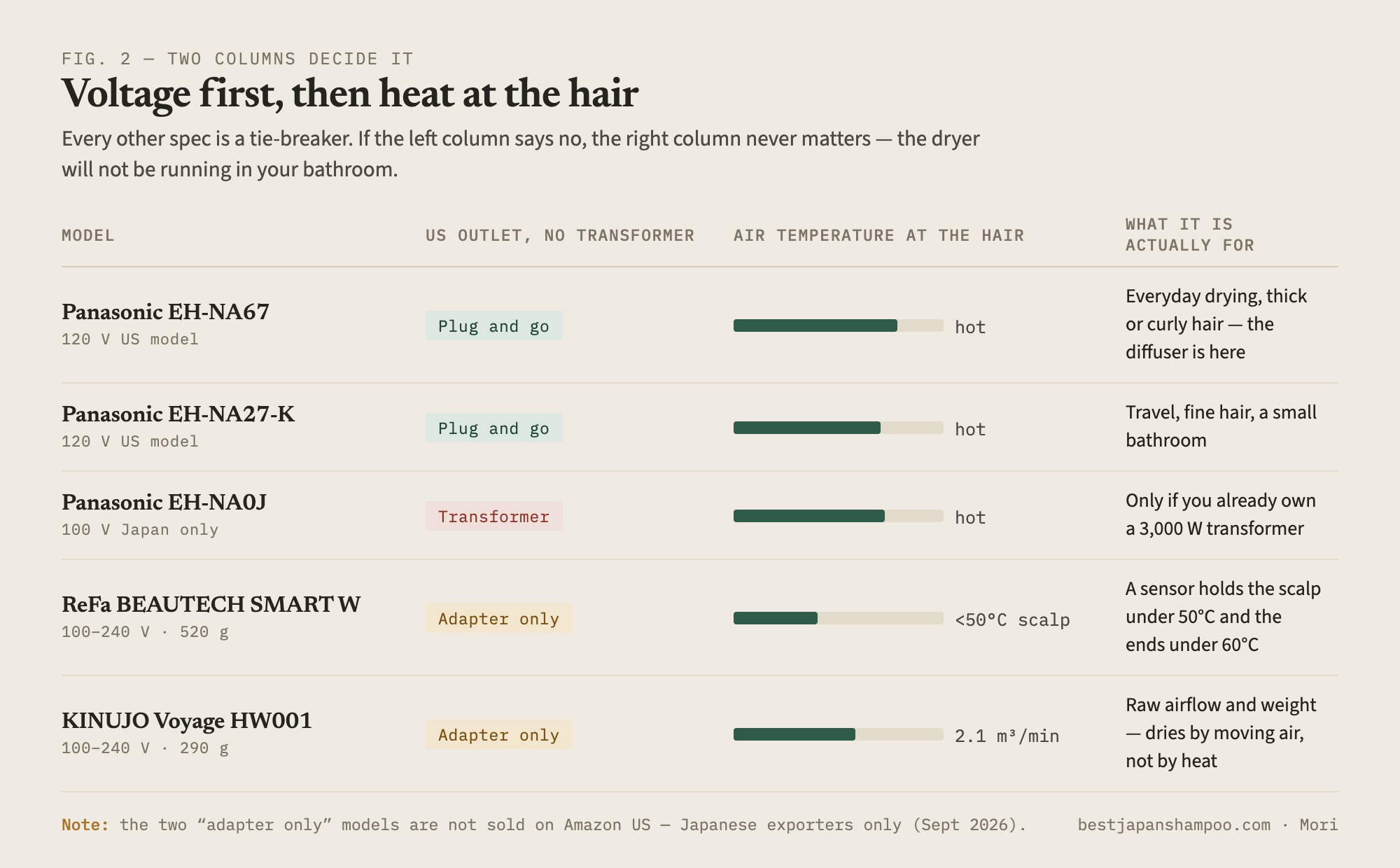
| Model | Voltage | Weight | Built for | Price | Where to buy |
|---|---|---|---|---|---|
| Panasonic EH-NA67 | US (120 V) — plug and go | Full-size | Everyday use, thick or curly hair | $$ | Check Price on Amazon |
| Panasonic EH-NA27-K | US (120 V) — plug and go | Compact, folding | Travel, fine or shoulder-length hair | $ | Check Price on Amazon |
| Panasonic EH-NA0J nanocare | 100 V Japan only — transformer required | Full-size | People who already own a transformer | $$$$ | Check Price on Amazon |
| 3,000 W step-down transformer | 120 V → 100 V | Heavy | Running any 100 V Japanese dryer in the US | $$ | Check Price on Amazon |
| ReFa BEAUTECH DRYER SMART W | 100–240 V worldwide | 520 g, folding | Scalp-safe, sensor-controlled heat | $$$$ | Not on Amazon US — see below |
| KINUJO Hair Dryer Voyage (HW001) | 100–240 V worldwide | 290 g, folding | The lightest serious dryer you can buy | $$$ | Not on Amazon US — see below |
Price bands: $ budget · $$ mid-range · $$$ premium · $$$$ flagship. Imported models move a lot in price — check the live listing.
One column in that table matters more than all the others: voltage. Read the next section before you buy anything.
The Voltage Rule That Sorts Every Japanese Dryer
Japan runs on 100 V. The US runs on 120 V. For a phone charger the difference is irrelevant. For a hair dryer — a heating element and a motor — it is the whole story. Feed a 100 V element 120 V and it draws more current than it was designed for: it runs hotter, the motor spins faster, and the thermal cut-off works overtime. Some units last a while. Some do not. None are under warranty used that way.
Every Japanese dryer falls into one of three groups:
- US-market models (120 V). Panasonic makes two — the EH-NA67 and the EH-NA27-K — and they are the only Japanese-brand dryers on Amazon US you can plug straight in.
- Worldwide-voltage models (100–240 V). They run anywhere with a plug adapter. This is where the ReFa and KINUJO worth having live — the ReFa BEAUTECH DRYER SMART W and the KINUJO Voyage. Both are sold in Japan and by Japanese exporters; as of September 2026 neither is listed on Amazon.com.
- Japan-domestic 100 V models. The Panasonic EH-NA0J and the new EH-NA0K, the ReFa BEAUTECH DRYER PRO, and KINUJO’s standard KH301/302 dryer. These need a step-down transformer — and not a small one. A dryer draws two to four times its rated wattage at start-up, so a 1,200 W dryer wants a transformer rated around 3,000 W: a heavy metal box that lives on your counter. The Nanocare vs US models guide goes through the arithmetic.
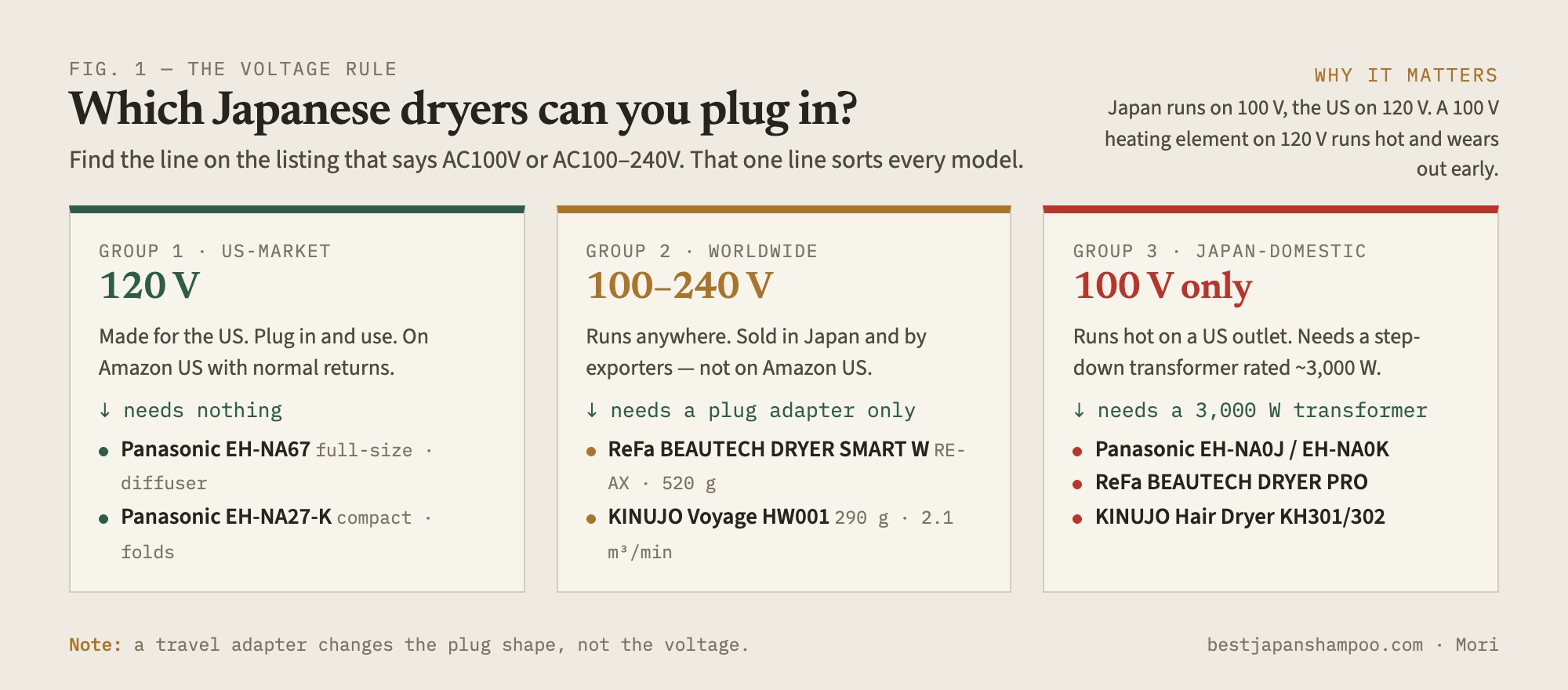
If you remember one thing: find the line on the listing that says AC100V or AC100–240V. If it says AC100V and you live in the US, add a transformer to the basket or close the tab.
What Each Brand Is Actually Doing
Manufacturer claims first, then my own view — I want to keep those separate.
Panasonic nanocare / nanoe. The dryer generates very fine, moisture-carrying particles (nanoe) in the airflow; Panasonic’s claim is that they penetrate the cuticle and leave the hair holding more water after drying. The Japanese domestic line gets each generation first — the 2022 EH-NA0J added high-penetration nanoe and a mineral emitter; the EH-NA0K, released in Japan on 1 September 2025, adds the largest airflow in the series and a night-cap nozzle. The US models carry the earlier nanoe generation.
ReFa BEAUTECH. ReFa pairs hydro ions with a Sensing Program: a sensor reads the temperature of whatever is in front of the nozzle and switches between hot and cool air to keep the hair under about 60 °C and the scalp under about 50 °C. The dryer will not let you cook a section, even if you hold it there too long.
KINUJO. The brand behind the Silk Plate flat irons builds its dryers around far-infrared heat — the claim being that infrared warms the water inside the hair rather than the surface — plus a negative-ion emitter, very high airflow for the size (2.1–2.2 m³/min), and unusually low weight.
My professional judgement. The ions are what the marketing leads with and what I care least about. What protects hair during drying is temperature and time: hair is at its most fragile while wet, and drying damage comes from holding hot air on a wet section for too long (the Japanese straightening damage article explains why wet hair is the weak point). So the features I would pay for, in order: a temperature sensor (ReFa), high airflow at lower heat (KINUJO, the newest nanocare), and a moisture system (nanoe) third. The gap between these three brands is smaller than the gap between any of them and the dryer most people already own.
Panasonic EH-NA67 nanoe — Best for Most People in the US
Voltage: US 120 V · Style: Full-size · Built for: Everyday drying, especially thick, wavy or curly hair
The EH-NA67 is Panasonic’s full-size nanoe dryer built for the US market. No adapter, no transformer, and three attachments in the box: a concentrator, a diffuser, and an oscillating quick-dry nozzle that sweeps the airflow side to side so you are not holding one hot spot against the hair.
That oscillating nozzle is the feature I point people to. It does mechanically what a good stylist does by hand — keeps the heat moving — and it is why this dryer is gentler than its wattage suggests.
Who it is for
- Anyone in the US who wants the Japanese approach without an import project
- Thick, coarse, wavy or curly hair — the diffuser is included and the airflow can move it
- Hair already damaged by a hot dryer
Who should skip it
- Frequent travellers — it is a counter dryer, not a suitcase dryer
- Anyone who specifically wants the newest nanoe generation; that is Japan-only for now
Pair it with: the diffuser in the box, if your hair has any wave. The Japanese curly hair products guide ranks the dryer as the biggest single change for curls — above the shampoo.
Panasonic EH-NA27-K nanoe Compact — Travel and Fine Hair
Voltage: US 120 V · Style: Folding handle, 1,400 W · Built for: Travel, small bathrooms, fine or shoulder-length hair
The EH-NA27-K is the same idea in a folding 1,400 W body that fits in a carry-on. It ships with a quick-dry nozzle (not oscillating) and no diffuser.
For fine hair, 1,400 W is not a limitation — it is the correct amount of power. Fine hair dries fast and over-dries easily, and a smaller dryer forces you to keep the heat moving. For thick or long hair it is under-powered, and you will resent it by the second week.
Who it is for
- Fine, thin or shoulder-length hair
- Anyone who travels more than a few times a year
Who should skip it
- Thick, coarse or very long hair — buy the EH-NA67
- Curly hair — no diffuser, and no easy way to add one
Panasonic EH-NA0J nanocare — The Flagship Import (100 V)
Voltage: 100 V Japan-domestic · Style: Full-size, 1,200 W · Built for: People who already own a step-down transformer, or are moving to Japan
The EH-NA0J is the dryer the Japanese beauty press writes about — high-penetration nanoe plus a mineral emitter, and a noticeably smoother finish on long hair than the US models. It is a genuinely different dryer, not a re-badge.
It is also 100 V only and shipped from Japan. Straight into a US outlet it runs hot and shortens its own life; through a 3,000 W step-down transformer it works as designed. Budget for both or buy neither.
The newer EH-NA0K (Japan, September 2025) is not on Amazon US as I write this, so the NA0J remains the import you can actually order — and its listings come and go, so if the link shows nothing, that is why.
Who it is for
- Anyone already running a 100 V Japanese appliance through a transformer (a rice cooker is the usual reason)
- Anyone relocating to Japan
- Long, straight, fine-to-medium hair — the hair type nanocare was designed around
Who should skip it
- Everyone who does not own a transformer and does not want one on the counter
- Curly hair — the airflow is tuned for smoothness, not for a diffuser
Pair it with: a 3,000 W 120 V → 100 V step-down transformer. Not a travel adapter, and not a 500 W converter — those trip or overheat the first time the element draws its start-up surge.
ReFa BEAUTECH DRYER SMART W — The One With a Brain
Voltage: 100–240 V worldwide · Style: Folding, 520 g, 1,150 W · Built for: Scalp-safe, sensor-controlled drying; frequent flyers
Of the three brands, ReFa is the one I would hand to someone who has burned their hair with a dryer before. The Sensing Program keeps the hair below about 60 °C and the scalp below about 50 °C on its own. It has an LED readout, it folds, and — the important part — the SMART W is a 100–240 V model, so it runs in the US with a plug adapter and nothing else.
If the dryer you are really weighing ReFa against is a Dyson Supersonic, the ReFa vs Dyson comparison explains the difference between the two brands’ sensors — Dyson watches the air, ReFa watches what the air lands on.
The trap is the model name. ReFa also sells the BEAUTECH DRYER PRO: more powerful (1,200 W), heavier (740 g) and 100 V only. Export shops list both, and the Pro is the one that arrives and cannot be used. Buy the SMART W, and check the listing says AC100–240V with a model number starting RE-AX.
Where to buy: as of September 2026 the SMART W is not listed on Amazon.com. It is sold through ReFa’s site in Japan and by Japanese export retailers — and a failure in month four is a return to Japan. No affiliate link, so no button below.
Who it is for
- A sensitive scalp, or scalp irritation after drying
- Fine or damaged hair that over-dries easily
- Travellers who want one dryer for every country
Who should skip it
- Thick or very long hair — 1,150 W with a temperature cap means slower drying
- Anyone who needs a diffuser — there is not one
KINUJO Hair Dryer Voyage (HW001) — The Lightest Serious Dryer
Voltage: 100–240 V worldwide · Style: Folding, 290 g, 1,000 W · Built for: Speed at low weight; travel
KINUJO’s Voyage is the brand’s worldwide-voltage model, and it is remarkable mainly for its numbers: 290 g, an airflow of 2.1 m³/min, from a 1,000 W element. A lot of air at modest heat is exactly the profile I described as protective above, in a body light enough to hold above your head for ten minutes without noticing.
Like ReFa, the trap is the sibling. KINUJO’s standard Hair Dryer (KH301/302) is 1,250 W with GLOSS / SCALP / SWING modes — and AC100V only. Export listings rarely make that obvious. For the US, the Voyage is the one.
Where to buy: the Voyage is not listed on Amazon.com as of September 2026 — KINUJO’s Amazon US store carries its flat irons, not its dryers. It is sold on KINUJO’s site in Japan and by Japanese export retailers. No affiliate link, no button.
Who it is for
- Anyone who finds a normal dryer too heavy — long hair that takes ten minutes, or a shoulder that complains
- Fine to medium hair that wants speed without high heat
Who should skip it
- Very thick or coarse hair — 1,000 W is honest about its limits
- Curly hair — no diffuser. Frizz is decided in the ten minutes after the shower (the frizzy hair guide covers why), and a concentrated jet with no diffuser blows the curl clumps apart
ReFa vs KINUJO: Which One If You Are Importing Anyway
These two get compared constantly, and the comparison is usually done on price. It should be done on what they are each solving, because they are not solving the same problem.
| ReFa BEAUTECH SMART W | KINUJO Voyage HW001 | |
|---|---|---|
| Weight | About 520 g with the cord | About 290 g |
| Airflow | About 1.0 m³/min on high | About 2.1 m³/min |
| Heat | A sensor targets under 50°C at the scalp and under 60°C at the ends | Far-infrared, no sensor — it dries by moving air |
| Voltage | 100–240 V, plug adapter only | 100–240 V, plug adapter only |
| Buy it for | A scalp that reacts, or hair you have burned before | Long, thick hair and a tired arm |
The short version. The KINUJO dries faster because it moves twice as much air, and at 290 g it is the only dryer here you can hold above your head for ten minutes without your shoulder complaining. The ReFa dries more gently because it measures the room and keeps the heat off your scalp, which matters if yours goes red or itchy — and matters more if you have a chemical treatment to protect.
My professional judgement: long or coarse hair, take the KINUJO — time under heat is the damage, and halving the drying time beats lowering the temperature. Sensitive scalp, colour-treated or chemically straightened hair, take the ReFa. If you cannot decide, weight wins: the dryer you do not mind holding is the one you will actually use on low heat instead of rushing on high.
ReFa vs Panasonic: The Honest Answer for a US Bathroom
This one is not close, and the reason has nothing to do with which dryer is better.
Panasonic sells two models built for a 120 V outlet — the EH-NA67 and the EH-NA27-K. They arrive from Amazon in two days, they are covered by a warranty you can actually use, and they cost a fraction of the ReFa. The ReFa SMART W is the better-engineered dryer — the temperature sensor is a genuinely good idea and nothing Panasonic sells in the US does it — but it has to be imported from a Japanese exporter, and if it fails you are shipping it back to Japan.
My professional judgement: buy the Panasonic unless you have a specific reason not to. The reason that justifies the ReFa is a scalp that reacts to heat, or hair you are protecting after a chemical service. “It looks nicer” is not one — you will be holding it in a steamy bathroom, not displaying it.
👉 Check Panasonic EH-NA67 on Amazon →
If You Still Cannot Decide
You live in the US and want a Japanese dryer, full stop → Panasonic EH-NA67. Plug it in and use it.
You travel, or your hair is fine and short → Panasonic EH-NA27-K.
You already own a transformer, or you are moving to Japan → Panasonic EH-NA0J. The only case where the flagship makes sense.
Your scalp is sensitive, or you have burned your hair before → ReFa SMART W, from a Japanese exporter — and only the SMART W.
Weight is the problem → KINUJO Voyage, from a Japanese exporter.
Curly hair → EH-NA67 with the diffuser. Nothing else here has one.
Chemically straightened hair → any of them on low heat; the aftercare guide has the decision that matters more.
FAQ
Can I use a Japanese 100 V hair dryer in the US? Only through a step-down transformer rated around 3,000 W. A travel adapter changes the plug shape, not the voltage. Plugged straight in, a 100 V dryer runs hot and wears out early, and the manufacturer will not cover it.
Is the Panasonic EH-NA0K available in the US? Not on Amazon US as of September 2026. It was released in Japan on 1 September 2025 and, like every nanocare domestic model, it is 100 V. Importing it means the same transformer as the NA0J.
Which ReFa dryer works in the US? The BEAUTECH DRYER SMART W (model numbers beginning RE-AX) — it is 100–240 V. The BEAUTECH DRYER PRO is 100 V only. Check the voltage line before you pay.
Is the KINUJO dryer dual voltage? The Voyage (HW001) is 100–240 V. The standard KINUJO Hair Dryer (KH301/302) is 100 V only. Neither is currently sold on Amazon US.
Does a Japanese dryer actually reduce damage? The mechanism is real — lower temperature, more airflow, and in ReFa’s case a sensor that stops you over-heating a section. The moisture and ion claims are the manufacturers’. My view is that any of these dryers, on a medium setting and kept moving, does less damage than a hot conventional dryer held still — and kept moving is doing most of the work.
Bottom Line
Three brands, one rule: check the voltage before the features. In the US the two Panasonic nanoe models plug straight in; the flagship nanocare needs a transformer; and the ReFa and KINUJO worth having are the worldwide-voltage versions — SMART W and Voyage — bought outside Amazon.
Most people in the US → Panasonic EH-NA67 Travel, fine hair → Panasonic EH-NA27-K The flagship, with a transformer → Panasonic EH-NA0J + 3,000 W step-down transformer
Prices and availability on Amazon change. Check the live listing before buying.