
Mori · licensed hairdresser, 8 years in Tokyo & Shanghai, specialising in Japanese straightening.
Matching a product to a hair type was the job. That is what this article is.
In a Japanese salon, the shampoo is not the quick part before the haircut. It is a scalp treatment in its own right, done with the pads of the fingers, and most clients notice it more than the cut. Japan has built a whole category of tools to copy that at home — silicone “kenzan” brushes, long-pin nylon brushes, dry scalp brushes, and Panasonic’s waterproof Scalp Esthe, which kneads the scalp with motorised heads.
Outside Japan, the choice is narrower than it looks. Most of these tools reach Amazon US only through Japanese export sellers, and the Panasonic device is not listed at all. Below: what a scalp brush actually does (and what the research does not show), which tool fits which job, the four I would buy on Amazon US, and whether the Panasonic is worth importing.
⏱️ In a hurry?
You want one brush to use in the shower → uka Kenzan (or Kenzan Soft for a sensitive scalp)
Thick or long hair, and the lather never reaches your scalp → S-HEART-S Scalp Brush World Model
You want a firm, wide brush on a budget → VESS Scalp Beaut (Hard)
You want a dry brush for between washes → IKEMOTO Scalp Care Brush TC1300
You want the salon head spa, hands-free → Panasonic Scalp Esthe EH-HE0J (100–240 V, import only)
Scalp is broken, inflamed or freshly chemically treated → no brush for now
Quick Comparison
| Line | Weight | Built for | Price | Check Price on Amazon |
|---|---|---|---|---|
| uka Kenzan / Kenzan Soft · silicone · Japan | Medium-firm (Soft version: light) | Daily use in the shower; oily scalps, product build-up | $$ | Check Price on Amazon |
| S-HEART-S Scalp Brush World Model · long nylon pins · made in Japan | Light to medium, deep reach | Thick, long or dense hair; wet or dry | $$$ | Check Price on Amazon |
| VESS Scalp Beaut (Hard) · BEA-1200 · made in Japan | Firm, wide | People who like pressure; short to medium hair | $ | Check Price on Amazon |
| IKEMOTO Scalp Care Brush TC1300 · stepped nylon bristles · Japan | Light, dry use | Brushing between washes; fine hair losing body | $ | Check Price on Amazon |
| Panasonic Scalp Esthe EH-HE0J · motorised · 100–240 V | Adjustable (3 speeds + lift mode) | Hands-free head-spa massage, wet or dry | $$$$ | Not on Amazon US — import only |
Price bands: $ budget · $$ mid-range · $$$ premium · $$$$ flagship or import. Check the live listing for today’s price.
What a Scalp Brush Actually Does — and What It Does Not
What it does. A scalp brush does the job a salon shampoo does with the fingertips: it moves lather over the skin of the scalp instead of over the hair, and it loosens sebum, flakes and styling product so the shampoo can rinse them away. On thick or long hair, fingers often never reach the scalp properly — they wash the top layer of hair and stop. Pins get underneath.
It also replaces nails. Most people who “scrub” their scalp are using their nails, and scratching skin that is already tight or itchy is exactly the wrong move. A rounded pin presses without cutting.
What the research shows. The study most quoted for scalp massage is small. In Koyama and colleagues (Eplasty, 2016), nine healthy Japanese men used a scalp massage device for four minutes a day for 24 weeks, and average hair thickness rose from about 0.085 mm to 0.092 mm compared with their own baseline. There was no control group, and part of the funding came from a Japanese scalp-care company. A 2019 survey by English and Barazesh (Dermatology and Therapy) asked people with pattern hair loss who had tried twice-daily, 20-minute hand massages how their hair had changed; most of the 327 who had tried them reported stabilisation or some regrowth — but that is self-reported, from a self-selected group, and one author runs a site that promotes the method.
My professional judgement. Buy a scalp brush for a cleaner scalp and a better wash, not to grow hair. In the salon, the clients who gained most had build-up — dry shampoo, styling cream, sweat — or thick hair whose roots were never properly rinsed. Hair-growth claims on the box are the part I would ignore. If you are losing hair, that is a conversation for a dermatologist, and a brush will not change it.
The scalp barrier matters more than the tool. If your scalp itches or tightens within minutes of washing, the cleanser is the first thing to change — the scalp barrier article explains why, and a brush on top of a harsh shampoo only makes it worse.
Pick the Tool by the Job, Not by the Brand
Scalp tools fall into four types, and each is built for a different moment of the routine.
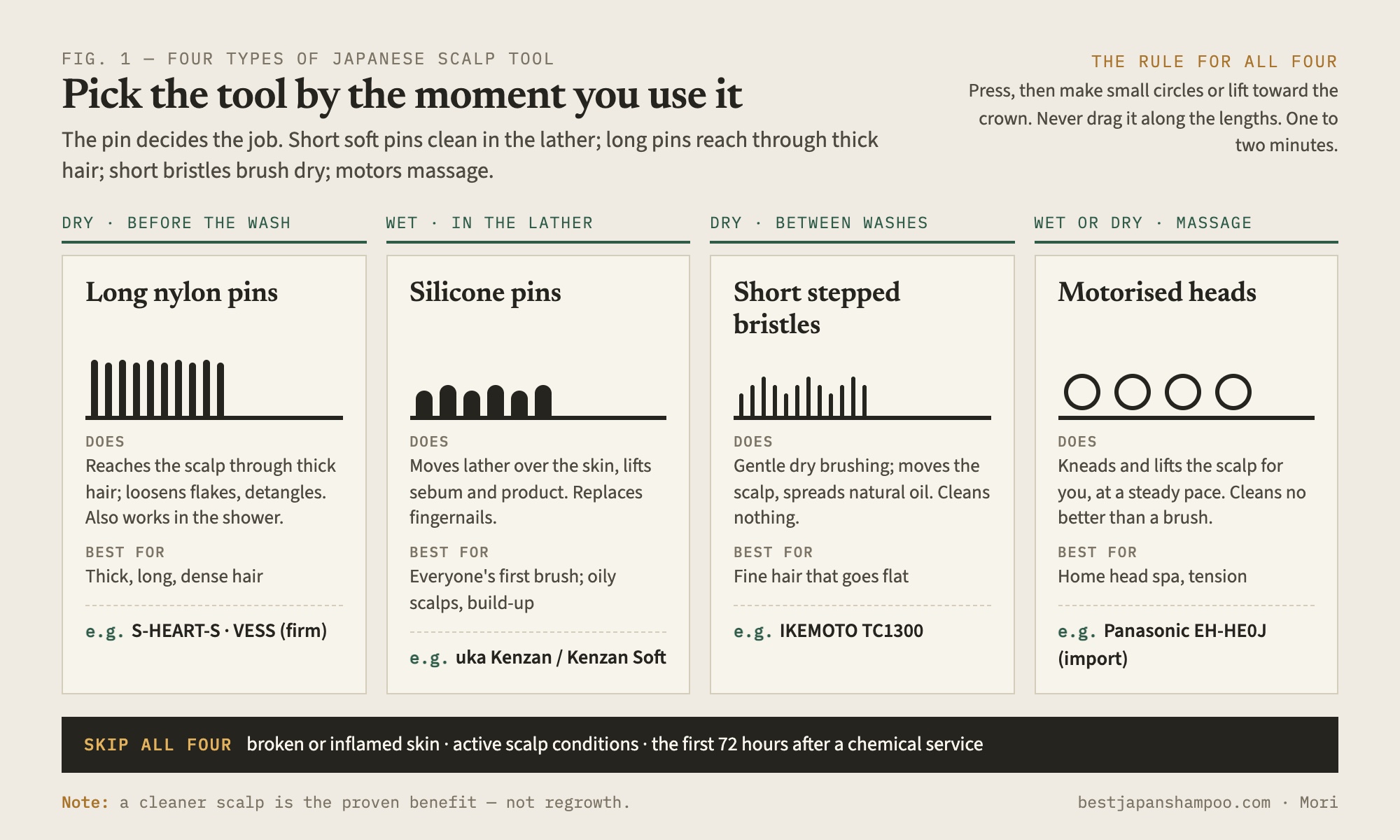
- Silicone pins, in the lather. Used while shampooing. Short, soft pins grip wet skin and do not tangle. This is the everyday tool.
- Long nylon pins, wet or dry. Long enough to reach the scalp through thick hair. Used dry before washing, they loosen flakes and detangle; used in the shower, they push lather to the roots.
- Short stepped bristles, dry. A brush you use on dry hair between washes. Gentle, and closer to a hairbrush than a scrubber.
- Motorised heads. A device that does the kneading for you. The only type that adds anything a hand cannot — consistency and time.
How you use it matters more than which one you buy. Press, then move in small circles or lift towards the crown. Do not drag it back and forth along the lengths — that is friction on the cuticle, and on curly or long hair it creates knots. One or two minutes is enough.
uka Kenzan — The Everyday Shower Brush
Material: Silicone · Use: Wet or dry · Built for: Daily use in the shower, oily scalps, product build-up
uka is a Tokyo salon brand, and the Kenzan is named after the spiked holder used in ikebana flower arranging. It is a palm-sized silicone brush shaped so it stays in a soapy hand. In Japan it comes in several firmness levels — Soft, Medium, the original Kenzan, and an extra-firm version. The two that reach Amazon US are the original Kenzan, which is firmer than Medium, and the Kenzan Soft.
This is the brush I would hand to almost anyone first. Silicone does not hold water the way a nylon brush with a hollow handle can, so it dries quickly and is easy to keep clean in a bathroom. The original Kenzan suits most scalps that are not sensitive; if your skin is thin, sensitive, or reacts easily, start with the Soft.
One honest note: on Amazon US both are sold by third-party Japan exporters, and stock is often low. If one listing is empty, check the other — and check the seller before ordering.
Who it is for
- Anyone starting with scalp brushes
- Oily scalps and people who use dry shampoo or styling product
- Short to shoulder-length hair
Who should skip it
- Very thick or long hair — the short pins may not reach the scalp
- Anyone hoping for a strong massage; it is a cleaning tool first
Pair it with a gentle cleanser. If you are not sure what is in yours, the sulfate-free shampoo guide shows how to read the label.
S-HEART-S Scalp Brush World Model — For Thick or Long Hair
Material: Long nylon pins, rounded tips · Use: Wet or dry · Built for: Thick, long or dense hair
S-HEART-S is a Japanese brand known for one product: a scalp brush with hundreds of long nylon pins that end in rounded tips. The length is the point. Where a silicone brush works on the surface, these pins go through thick hair and reach the scalp.
I would use it two ways. Before the shower, on dry hair, it loosens flakes and detangles so the shampoo goes on evenly. In the shower, it pushes lather down to the roots on hair that fingers cannot get through.
Who it is for
- Thick, coarse, dense or long hair
- People who want one brush for dry brushing and for the shower
Who should skip it
- Fine, thin hair — it is more brush than you need
- Anyone who wants a firm, pressing massage; the pins are flexible
Pair it with a conditioner that matches your hair’s weight — the curly hair products guide explains why that matters more on thick hair.
VESS Scalp Beaut (Hard) — Firm and Wide, on a Budget
Material: Long, firm pins with soft tips · Use: Before and during washing · Built for: People who like pressure
VESS is a Japanese brush maker, and the Scalp Beaut (model BEA-1200) is made in Japan. Its pins are cut on a curve — shorter in the centre, longer at the edges — so the brush follows the shape of the head. It is wide and held in the whole palm, which makes it quick to cover the back and sides of the scalp.
The Hard type is the one on Amazon US. It is among the firmest brushes in this list, and it is the one I would choose for someone who says other brushes feel like nothing.
Who it is for
- People who want a firm, massage-like feel
- Short to medium hair
- A budget first brush
Who should skip it
- Sensitive or easily irritated scalps — start with the uka Kenzan Soft instead
- Very long hair, where a wide brush is more likely to tangle
Pair it with a light hand. Firm pins and hard pressure together are how people end up with a sore scalp.
IKEMOTO Scalp Care Brush TC1300 — For Brushing Between Washes
Material: Stepped nylon bristles with rounded tips · Use: Dry · Built for: Daily dry brushing, fine hair losing body
IKEMOTO (Ikemoto Brush Industry) is an old Japanese brush maker, and the TC1300 is sold in Japan as a scalp care brush for people who feel their hair losing body. The bristles are set at stepped heights to soften the feel, and the tips are rounded. The maker’s instruction is simple: keep the bristles on the scalp and move towards the crown in small strokes.
This is a different tool from the others. It is for dry hair, between washes — a few minutes in the morning or evening to move the scalp and spread natural oil. It will not clean anything in the shower.
Who it is for
- Fine or thinning-looking hair that goes flat
- People who wash every other day and want something for the day in between
Who should skip it
- Anyone who wants a shower brush — this is not one
- Thick or very curly hair, where dry brushing disturbs the pattern
Pair it with a gentle dryer routine — low heat matters more for fine hair than any brush. The Japanese hair dryer guide compares the options sold in the US.
Panasonic Scalp Esthe EH-HE0J — The Salon Head Spa, Import Only
Power: Rechargeable, AC 100–240 V charger · Use: Wet or dry, waterproof · Built for: Hands-free head-spa massage
This is the device people mean when they say “Japanese scalp care device”. Panasonic’s Scalp Esthe line has been sold in Japan since 2011, and the current model, the EH-HE0J (released 1 September 2023), adds a stretch-and-slide motion and a lift mode to the four-finger spiral heads.
The specifications Panasonic publishes:
- Modes: HIGH, MID, LOW and a lift mode
- Heads: a stretch brush and a close-contact kneading brush
- Battery: about 1 hour to charge; one 3.5-minute session a day gives about 5–7 days per charge
- Weight: about 365–390 g depending on the head
- Power: AC 100–240 V, 50/60 Hz, automatic voltage switching — Panasonic marks it as usable overseas
- Water: designed for use in the bath; Panasonic states its Scalp Esthe models pass an IPX7 immersion test
The US reality. It is not sold on Amazon US. You buy it from a Japanese retailer or an export seller. Because the charger is 100–240 V and the Japanese plug fits a US outlet, it works here — unlike most Japanese hair dryers (see the hair dryer voltage guide). What you give up is an easy warranty claim and returns.
My professional judgement. Of everything here, this is the only one that copies the salon head spa rather than the shampoo. But it does not clean better than a silicone brush, and it costs many times more. I would import it for the massage and the routine — not as a hair-loss treatment, and not as your first scalp tool.
Who it is for
- People who want a head-spa massage at home, regularly
- Tension and tightness across the scalp after long days
Who should skip it
- Anyone who mainly wants a cleaner scalp — a brush does that
- Anyone who needs a US warranty
When Not to Use a Scalp Brush
- Broken, scratched or inflamed skin. Let it heal first.
- Active scalp conditions — psoriasis, eczema, heavy dandruff that does not respond to washing. See a dermatologist before adding friction.
- Right after a chemical service. After colour, bleach or Japanese straightening, the scalp can be sensitised. After straightening, nothing should touch the hair for the first 72 hours anyway — the first 72 hours guide explains why — and I would wait a few more days before going back to a firm brush.
- On the lengths. A scalp brush is for the scalp. Scrubbing straightened, bleached or curly lengths with it is friction your hair does not need — the straightening damage article explains how friction adds up.
If You Still Cannot Decide
You want one shower brush and you are not sure → uka Kenzan.
Your scalp is sensitive → uka Kenzan Soft.
Your hair is thick or long → S-HEART-S Scalp Brush World Model.
You want it firm and cheap → VESS Scalp Beaut (Hard).
You want something for dry hair between washes → IKEMOTO TC1300.
You want the massage, not the cleaning → Panasonic Scalp Esthe EH-HE0J, imported.
If You Live in Japan: These Are Drugstore Prices Here
Scalp brushes are the category where the import markup is hardest to justify, because the products themselves are cheap. Prices are Amazon.co.jp in November 2026, tax included, and move quickly — check before you buy.
uka スカルプブラシ ケンザン — ¥2,202. The バリカタ (hard) and ソフト (soft) versions are the same price; pick by scalp sensitivity, not by budget.
👉 uka ケンザン を Amazon.co.jp で見る →
S HEART S スカルプブラシ ワールドモデル (376 pins) — ¥7,012. The one salons hand you.
👉 S HEART S ワールドモデル を Amazon.co.jp で見る →
ベス スカルプ・ビュート (hard) — ¥1,111. Made in Japan by an actual brush manufacturer, and the cheapest thing here that still works properly.
👉 ベス スカルプ・ビュート を Amazon.co.jp で見る →
IKEMOTO エイジングスカルプケアブラシ TC1300 — ¥1,430. Note that this one carries the same ASIN on both Amazon stores, so the US link above and this one are the same product.
👉 IKEMOTO TC1300 を Amazon.co.jp で見る →
Where else: Loft, Tokyu Hands and the bigger Matsumoto Kiyoshi stores carry most of these, and you can hold one before buying — which matters more for a brush than for a dryer.
FAQ
Do scalp brushes help hair grow? The evidence is thin. One small Japanese study found slightly thicker hair after 24 weeks of daily device massage in nine men, with no control group. Buy a brush for a cleaner scalp, not for regrowth.
Can I use a scalp brush every day? Yes, with light pressure and for a minute or two. If your scalp feels sore, tight or itchy afterwards, use it less often or switch to a softer brush.
Should I use it on wet or dry hair? Silicone brushes are for wet hair, in the lather. Long nylon pin brushes work both ways. Dry brushes such as the IKEMOTO TC1300 are for dry hair only.
Is a scalp brush safe after Japanese straightening? On the scalp, yes — after the first 72 hours, and gently. Keep it off the straightened lengths, and wait a few extra days if the scalp felt sensitive after the treatment.
Is the Panasonic Scalp Esthe sold in the US? Not on Amazon US as of October 2026. The EH-HE0J charges on 100–240 V and the Japanese plug fits US outlets, so an imported unit works here, but warranty and returns are harder.
Do scalp brushes work on curly hair? Yes, if you press and lift rather than scrub back and forth. Scrubbing tangles curls. A silicone brush with short pins is the safest choice.
How do I clean a scalp brush? Rinse out shampoo after every use and let it dry with the pins facing down or hanging. Wash it with a little shampoo once a week, and replace it when the pins bend or split.
Bottom Line
A Japanese scalp brush is one of the cheapest upgrades to a wash routine, as long as you buy it for what it does: a cleaner scalp, a better rinse, and no nails. For most people, the uka Kenzan in the shower is enough. Go longer and softer for thick hair, firmer if you like pressure, and keep the Panasonic Scalp Esthe for when you want the head spa itself.
One shower brush for most people → uka Kenzan Sensitive scalp → uka Kenzan Soft Thick or long hair → S-HEART-S Scalp Brush World Model Firm and budget → VESS Scalp Beaut (Hard) Dry brushing between washes → IKEMOTO TC1300 Hands-free head spa → Panasonic Scalp Esthe EH-HE0J (import only)
Prices and availability on Amazon change. Check the live listing before buying.