
Mori · licensed hairdresser, 8 years in Tokyo & Shanghai, specialising in Japanese straightening.
Matching a product to a hair type was the job. That is what this article is.
Fino and Tsubaki are the two hair masks you see in every Japanese drugstore, usually on the same shelf, usually a few yen apart. Outside Japan they are the two Japanese masks people ask me about most, and the question is always the same: which one?
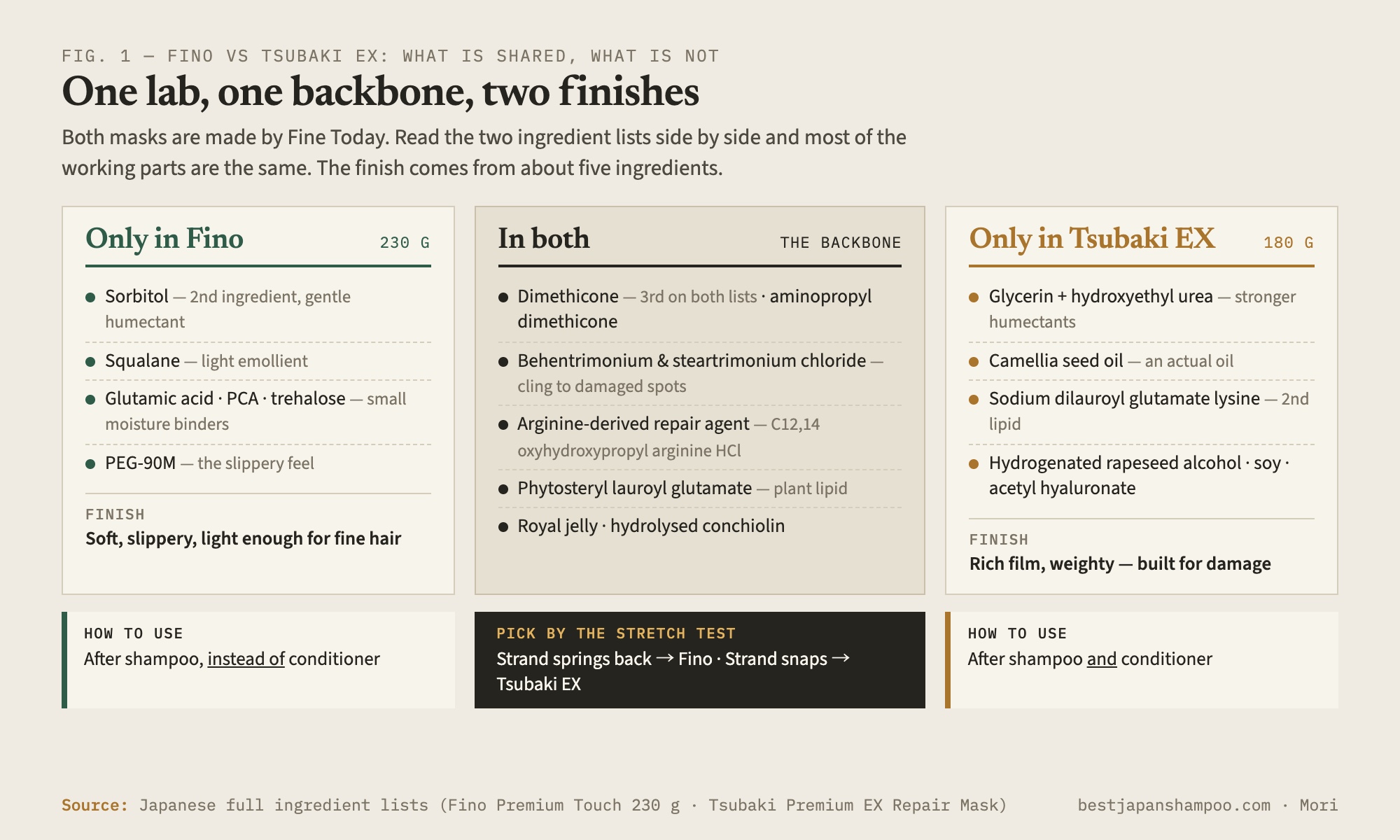
Here is the part most comparisons miss. Both are made by the same company. Fino and Tsubaki both moved from Shiseido to Fine Today in 2021, and when you put the two ingredient lists side by side, the backbone is almost identical — the same silicones, the same conditioning agents, the same arginine-derived repair ingredient. The difference sits in a handful of ingredients, and in one instruction on the back of the jar that changes how you use them.
So this is not “good mask vs bad mask.” It is two finishes from one lab, and the right one depends on your hair and on what you already use in the shower.
⏱️ In a hurry?
Fine to medium hair, dry ends, you want one product instead of conditioner → Fino Premium Touch Hair Mask
Bleached, coloured or heat-damaged hair that snaps → Tsubaki Premium EX Repair Mask
Thick, coarse or very dry hair → Tsubaki Premium EX Repair Mask
Chemically straightened hair, past the first 72 hours → Fino Premium Touch Hair Mask once a week
Curly hair following a silicone-free routine → neither — both contain silicones
Outside the US? YesStyle ships most of these worldwide — the link sits next to each Amazon button.
Quick Comparison
| Line | Weight | Built for | Price | Check Price on Amazon |
|---|---|---|---|---|
| Fino Premium Touch Hair Mask · 230 g jar | Medium · slippery, soft | Dry ends on fine to medium hair; used after shampoo in place of conditioner | $$ | Check Price on Amazon |
| Tsubaki Premium EX Repair Mask · 180 g jar | Rich · oil film, weighty | Bleach, colour and heat damage; thick or coarse hair; used after conditioner | $$ | Check Price on Amazon |
Price bands: $$ mid-range. Amazon pricing moves — check the live listing. Fino gives you more product per jar (230 g against 180 g).
Neither mask contains a sulfate — masks do not clean — but both contain silicones (dimethicone sits third on both lists). That matters for one group of readers, and I will come back to it.
Same Company, Same Backbone
Japanese ingredient lists are printed in order of quantity, down to the ingredients under 1%, which can appear in any order. Read the two lists from the top and this is what you find in both:
- Dimethicone and aminopropyl dimethicone — the silicones that give slip and seal the surface
- Behentrimonium chloride and steartrimonium chloride — the conditioning agents that stick to the negatively charged, damaged parts of the hair
- An arginine-derived repair ingredient — alkyl (C12,14) oxyhydroxypropyl arginine HCl, the same one Fine Today uses in the Tsubaki EX shampoo line
- A phytosterol lipid — di(phytosteryl/octyldodecyl) lauroyl glutamate, a plant-based stand-in for the lipids bleach strips out
- Royal jelly extract and hydrolysed conchiolin (a pearl protein)
That is most of what does the work. The two jars differ in about five places:
Only in Fino: sorbitol as the second ingredient (a humectant, gentler than glycerin), squalane, and a set of small moisture-binding molecules — glutamic acid, PCA and trehalose — the kind of ingredients that mimic the hair’s own water-holding factors. Plus PEG-90M, which is a big part of why Fino feels so slippery.
Only in Tsubaki EX: glycerin second, plus hydroxyethyl urea (both stronger humectants), camellia seed oil, a second lipid (sodium dilauroyl glutamate lysine), hydrogenated rapeseed alcohol (a heavier fatty alcohol), soy seed extract and acetyl hyaluronate.
My professional judgement: those extras are why Tsubaki EX feels richer on the hand and leaves a heavier film. More humectant, an actual oil, a second lipid. On hair that has lost its own lipids to bleach, that is the right direction. On healthy fine hair, it is too much.
The Instruction on the Back of the Jar
This is the difference that decides how you use them.
Fino is used after shampoo: squeeze the water out, work it through the lengths, rinse. In Japan most people use it instead of a conditioner, either every wash or as the special-occasion step.
Tsubaki EX is used after shampoo and conditioner: it is designed as an extra layer on top of the Tsubaki EX conditioner, not a replacement for it.
Both brands say the same thing about timing: it works even if you rinse straight away, and once or twice a week is the suggested routine — more often if your hair needs it.
What that means in practice: Fino is one product. Tsubaki EX is the third step of a three-step routine. If you hate long showers, that alone may decide it.
Fino Premium Touch Hair Mask — The Everyday Mask
Jar: 230 g · Weight: Medium · Built for: Dry ends, fine to medium hair, one-product routines
Fino Premium Touch is the mask Japanese women buy when they want salon softness without a salon routine. The texture is thick in the jar and melts once it hits wet hair, and it rinses out cleaner than you expect from something that rich. The finish is soft and slippery rather than heavy: hair moves, ends feel closed, and it does not collapse fine hair the way an oil-heavy mask does.
Because it can replace your conditioner, it is also the easiest way to try a Japanese mask at all. You are swapping one bottle, not adding a step.
Who it is for – Fine to medium hair with dry or rough ends – Anyone who wants one product after shampoo, not two – Chemically straightened hair, once the first 72 hours are over — weekly, mid-lengths to ends – Light colour (not bleach) that has made the hair feel dry
Who should skip it – Heavily bleached hair that snaps when stretched — Fino will feel lovely and leave the problem where it is. Go to Tsubaki EX. – Very thick or coarse hair — it will soften it, but you will use half the jar in two weeks – Anyone following a silicone-free routine
Pair it with: any mild shampoo you like. On straightened hair, one of the shampoos that will not shorten the treatment. For frizz on the ends after drying, the Fino Premium Touch hair oil — a drop, not a palmful.
One honest note on buying: on Amazon US the Fino mask is sold by Japanese export sellers, not by Fine Today. Check that the listing says 230 g and “Premium Touch“; older Fino jars were labelled 浸透美容液 and the current ones 濃厚美容液 — same mask, renamed.
👉 Check Price on Amazon → · YesStyle (ships worldwide) →
Tsubaki Premium EX Repair Mask — For Damage
Jar: 180 g (refill pouches exist in Japan) · Weight: Rich · Built for: Bleach, colour, heat damage; thick, coarse hair
Tsubaki Premium EX Repair Mask is the mask that belongs to the gold EX line — the damage line in the Tsubaki range. It is the richer of the two by a clear margin: more humectant, camellia oil, a second lipid. It leaves a film you can feel when the hair is dry, and on damaged hair that film is exactly what makes ends stop catching and splitting.
On Amazon US it is sold by Tsubaki’s official store (Fine Today), which is not the case for Fino. You will also still see listings for the older “Tsubaki Premium Repair Mask.” That jar was reformulated as EX in September 2022; buy the EX.
Who it is for – Bleached, balayaged, or repeatedly coloured hair – Hair that snaps in the stretch test (hold one strand at both ends and pull gently — if it breaks almost at once, it is damaged, not just dry) – Thick, coarse or very dry hair that drinks product – Anyone already using the Tsubaki EX shampoo and conditioner
Who should skip it – Fine hair that is not damaged — it will look flat and greasy by the second day – Oily scalps — keep it off the roots entirely – Anyone who wants a single step after shampoo — Tsubaki designs EX as a layer on top of conditioner
Pair it with: the Tsubaki Premium EX Damage Care & Repair conditioner every wash, and the EX mask on top once or twice a week. For whether red, white or gold is your shampoo, the Which Tsubaki guide has a 10-second test.
What a Mask Can and Cannot Do
A rinse-off mask changes how hair feels and behaves: slip, shine, fewer tangles, ends that stop catching. It does that by leaving conditioning agents, silicones and lipids on the surface — most heavily on the damaged parts, because that is where the positively charged conditioners stick.
What it does not do is rebuild the inside of the fibre. Neither Fine Today nor anyone else has a rinse-off product that reverses bleach damage; “repair” on a Japanese label means the surface is smoothed and protected. My professional judgement, after eight years of reading hair before chemical services: a good mask buys you time and fewer split ends. A haircut is still the only thing that removes damage.
Three things that make a bigger difference than which jar you pick:
- Squeeze the water out first. A mask on dripping hair is diluted before it touches anything. Both brands say this on the jar.
- Lengths and ends only. Neither mask belongs on the scalp.
- Heat after the mask is where most damage happens. If you flat-iron daily, a lower temperature does more than any mask — the flat iron guide covers why.
Straightened Hair and Curly Hair: Two Special Cases
Japanese-straightened hair. Do not use either mask in the first 72 hours — you should not be washing at all yet. After that, a weekly mask is good aftercare, because straightened hair has been through a chemical service and dries out at the ends. I lean to Fino here: it is lighter, so straight hair stays swingy, and it can replace your conditioner. If the ends were bleached before the straightening, use Tsubaki EX on the ends only.
Curly hair. Both masks contain dimethicone near the top of the list. If you follow a curly-girl or silicone-free routine, neither fits, and you will want a Japanese conditioner chosen for curls instead. If you do use silicones, Tsubaki EX is the better match for thick curls; Fino is less likely to weigh down fine waves.
If You Are in Japan: Both, for the Price of One Imported Jar
These two are Shiseido drugstore products, and Japan is where they are priced as such. Prices are Amazon.co.jp in November 2026, tax included, and move — check before you buy.
Fino Premium Touch Hair Mask — ¥1,190 for the 230 g jar. This is the single most reliable thing in Japanese haircare at the price, and it is the reason the brand has the reputation it does.
👉 フィーノ プレミアムタッチ ヘアマスク 230g を Amazon.co.jp で見る →
If you already use it, buy the refill instead. The 700 g 詰め替え is ¥2,665 — three jars’ worth for a little over twice the price of one. This is the format Japanese buyers actually use, and it is not sold overseas.
👉 フィーノ 詰め替え 700g を Amazon.co.jp で見る →
Tsubaki Premium EX Repair Mask — ¥1,121 for the 180 g tub, which makes it the cheaper of the two here, the reverse of how they usually line up on Amazon US.
👉 ツバキ プレミアムEX リペアマスク 180g を Amazon.co.jp で見る →
⚠️ One listing to avoid. The older Tsubaki Premium Repair Mask (without the EX) shows a price on Amazon.co.jp but has no Add to Cart button — it is third-party stock only. Buy the EX version, which is the current product.
So the honest answer in Japan is: buy both. ¥2,311 for the pair is less than one imported jar of either, and the comparison in this article stops being a decision and becomes a rotation — Fino as the everyday mask, the Tsubaki EX when damage needs it.
If You Still Cannot Decide
Fine or medium hair, dry ends, no bleach → Fino. This is the majority of people asking.
Bleached, or hair that snaps → Tsubaki EX, on top of its conditioner.
Thick, coarse, very dry → Tsubaki EX.
Straightened → Fino once a week, after the first 72 hours.
You want the shortest routine → Fino, in place of conditioner.
No idea → Fino. Its failure mode — not quite enough on badly damaged hair — is milder than Tsubaki EX’s failure mode on fine hair, which is flat, greasy roots by the next morning.
FAQ
Are Fino and Tsubaki made by the same company? Yes. Both brands moved from Shiseido to Fine Today in 2021. The two masks share most of their base — the same silicones, conditioning agents, arginine-derived repair ingredient and phytosterol lipid. Older Amazon listings still say “Shiseido.”
Which is better for damaged hair, Fino or Tsubaki? For bleach, colour or heat damage, Tsubaki Premium EX Repair Mask. It has more humectant, camellia seed oil and a second lipid, and it is designed to sit on top of the EX conditioner. Fino is better for hair that is dry rather than damaged.
Can I use Fino instead of conditioner? Yes. Fino’s instructions are to apply it after shampoo, and most people in Japan use it in place of a conditioner. Tsubaki EX is meant to be used after conditioner, not instead of it.
How long should I leave a Japanese hair mask on? Both brands say the mask works even if you rinse it straight away. In practice, leaving it on for a few minutes while you do something else does no harm. Squeezing the water out of your hair first matters more than the waiting time.
Do Fino and Tsubaki masks contain silicone? Yes. Dimethicone is the third ingredient in both, with aminopropyl dimethicone and amodimethicone further down. Neither contains sulfates, because masks do not clean.
Can I use a hair mask after Japanese hair straightening? Yes, after the first 72 hours. Once a week on the mid-lengths and ends is good aftercare. For which shampoo to pair it with, see the straightening aftercare guide — the shampoo affects how long the treatment lasts far more than the mask does.
Is the old Tsubaki Premium Repair Mask the same as the EX? The EX is its reformulated successor, released in Japan in September 2022. Older stock is still listed on Amazon. Buy the EX from the official Tsubaki store if you can.
Bottom Line
Same company, same base, different finish. Fino is the lighter, one-step mask for dry hair. Tsubaki EX is the richer, three-step mask for damaged hair. Do the stretch test before you buy — if the strand snaps, it is Tsubaki; if it stretches and springs back, it is Fino.
Dry ends, fine to medium hair, one-product routine → Fino Premium Touch Hair Mask Bleached, coloured, breaking, or thick and coarse → Tsubaki Premium EX Repair Mask
If you are still choosing a shampoo to go with it, Tsubaki vs &Honey and Ichikami vs Tsubaki cover the two drugstore comparisons people ask about most.
Prices and availability on Amazon change. Check the live listing before buying.