
Mori · licensed hairdresser, 8 years in Tokyo & Shanghai, specialising in Japanese straightening.
Matching a product to a hair type was the job. That is what this article is.
Shukumo kyosei (縮毛矯正, pronounced shoo-koo-moh kyoh-say) is the Japanese name for what American salons call Japanese hair straightening or thermal reconditioning. It was my main job for eight years, in Tokyo and then in Shanghai.
The part nobody puts on the menu is what comes after. The salon visit is a single bill. Keeping the result means three running costs: a shampoo that does not strip, a dryer that does not overheat, and a touch-up when the roots grow in. Those are what decide whether the money you spend in the chair lasts six months or a year.
⏱️ In a hurry?
What it is → a two-step chemical treatment with a flat iron in between; the treated hair stays straight until it is cut off
US name → Japanese straightening, thermal reconditioning, or a system name such as Yuko
First three days → no washing, tying, clips or tucking behind the ear; the 72-hour guide has the full list
Shampoo afterwards → Margaret Josefin Hotel Shampoo for fine hair, BOTANIST Damage Care for medium to thick hair
Dryer afterwards → Panasonic EH-NA67 nanoe, or the Dyson Supersonic Nural for bleached hair or a sensitive scalp
Touch-up → roots only, typically every 4 to 12 months
Outside the US? YesStyle ships most of these worldwide — the link sits next to each Amazon button.
What “Shukumo Kyosei” Actually Means
The word is literal. 縮毛 (shukumō) means “shrunken hair” — the Japanese term for frizzy, kinked or tightly waved hair that seems to shrink as it dries. 矯正 (kyōsei) means “correction,” the same word used for orthodontic braces. Put together: correcting curly hair.
In Japan it is an everyday menu item, priced next to a cut or a colour. A lot of Japanese hair is coarse with frizz or a bend at the nape, and humid summers make it worse, so salons treat it as maintenance — which is why so many Japanese stylists are very practised at it.
You will also see ストレートパーマ (straight perm) on Japanese menus. It is not the same thing: a straight perm skips the flat iron, so it relaxes a wave but does not hold against real curl.
The Same Treatment Under Different Names in the US
In the US, shukumo kyosei is sold as Japanese hair straightening, thermal reconditioning, or under a brand name such as Yuko, Liscio or Shiseido’s straightening systems. The best-known is Yuko Yamashita’s system, developed in Japan in the 1990s and, per trade press, brought to the US around 2000. The systems differ in chemistry, but the structure is the one I was trained in: soften, dry, iron, fix.
How It Works: Two Chemicals and an Iron
Hair holds its shape largely through disulfide bonds between keratin proteins; in curly hair they are locked into a curve.
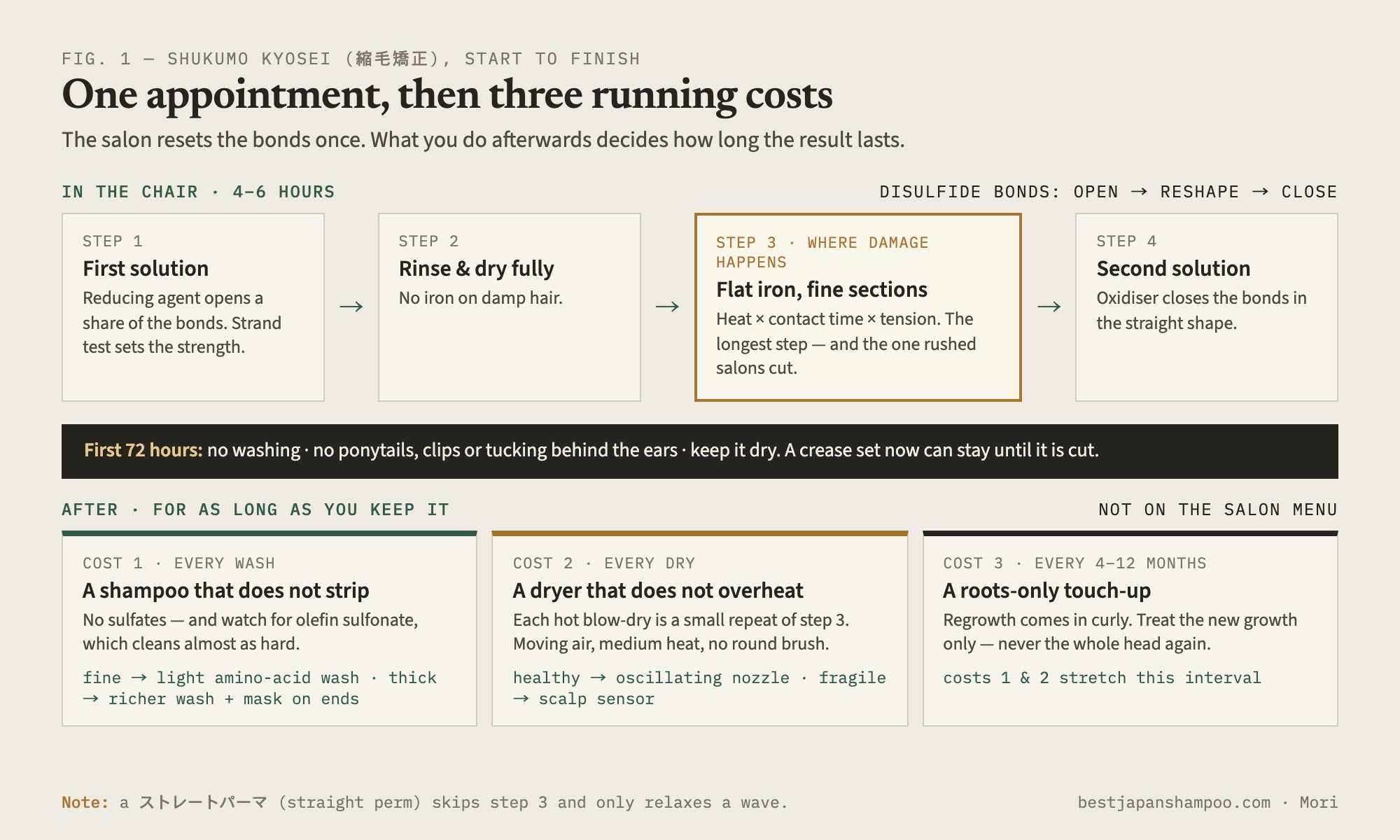
- First solution — open the bonds. A reducing agent, usually based on thioglycolate (cysteine and cysteamine formulas are also used), breaks a share of the disulfide bonds. The hair softens. This is the step a strand test calibrates.
- Rinse and dry completely. The hair must be fully dry before any iron touches it.
- Flat iron, section by section. Fine sections are pressed straight while the bonds are open. This is the longest part of the appointment and the one that decides the result.
- Second solution — close the bonds. An oxidiser re-forms the bonds in their new, straight position. That is why the treated hair stays straight until it grows out or is cut off.
Fig. 1 shows the four steps and the three costs that follow.
My professional judgement. Clients usually fear the chemicals. In my experience the iron does more of the lasting damage: plate temperature, how long it sits on each section, and how hard the hair is pulled. I explain the mechanism in why Japanese straightening damages hair. Hair that has been through this does not repair itself; everything you do afterwards either preserves it or wears it down.
Shukumo Kyosei vs Keratin and Brazilian Blowouts
A keratin treatment or Brazilian blowout coats and seals the hair; it smooths frizz and washes out over a few months. Shukumo kyosei changes the bond structure, so it straightens real curl and does not wash out — and cannot be undone on the treated lengths. If you are still choosing, Japanese straightening vs keratin goes through which hair suits which.
The Three Costs That Come After
Once the hair is straightened, three things decide how long the result looks good:
- Cost 1 — a shampoo that does not strip. Harsh cleansers roughen a cuticle that has just been reset.
- Cost 2 — a dryer that does not overheat. Every hot blow-dry is a small repeat of the iron step.
- Cost 3 — the touch-up. The roots grow in with your natural texture.
Here is what I would buy for the first two.
| Line | Weight | Built for | Price | Check Price on Amazon |
|---|---|---|---|---|
| Margaret Josefin Hotel Shampoo | Light | Fine or thin straightened hair, reactive scalps | $$ | Check Price on Amazon |
| BOTANIST Damage Care · import | Medium | Medium to thick straightened hair, daily use | $$$ | Check Price on Amazon |
| ONSENSOU Scalp Care | Light | A scalp that itches or flakes in the weeks after | $$ | Check Price on Amazon |
| Fino Premium Touch Hair Mask | Rich | Dry ends, once or twice a week | $ | Check Price on Amazon |
| Panasonic EH-NA67 nanoe · US 120 V | Full-size dryer | Medium to thick hair, the household dryer | $$$ | Check Price on Amazon |
| Panasonic EH-NA2C nanoe Compact · US 120 V | Folding dryer | Fine or shoulder-length hair | $$ | Check Price on Amazon |
| Dyson Supersonic Nural · US 120 V | Full-size dryer | Bleached or fragile hair, sensitive scalps | $$$$ | Check Price on Amazon |
Price bands: $ budget · $$ mid-range · $$$ premium · $$$$ flagship. Amazon pricing moves; check the live listing.
Cost 1: Margaret Josefin Hotel Shampoo — For Fine Straightened Hair
Cleanser: betaine and cocoyl glutamate, no sulfates · Weight: Light
A short ingredient list built on an amino-acid cleanser, with no sulfates and no silicone. On fine straightened hair that is exactly what you want: it cleans without stripping and leaves nothing behind to flatten the hair by the second day. It ships quickly from the brand’s own Amazon US store.
Who it is for
- Fine, thin or low-density straightened hair
- Reactive scalps, and households that want one bottle for everyone
Who should skip it
- Thick, coarse or very dry hair — it will not condition enough on its own
Pair it with: a light conditioner on the ends only, and the Fino mask once a week if the ends feel dry.
👉 Check Price on Amazon → · YesStyle (ships worldwide) →
Cost 1: BOTANIST Damage Care — For Medium to Thick Hair
Cleanser: taurate, alanine and glutamate surfactants with betaines · Weight: Medium
This is the wash I would hand most people leaving the chair with medium or thick hair: a genuinely mild cleanser blend and enough conditioning to keep straightened lengths smooth without a heavy silicone film. The catch is availability. On Amazon US it is a Japanese import from a third-party seller, and grey-market prices move week to week — check the live listing.
Who it is for
- Medium or thick straightened hair, including colour-treated
Who should skip it
- Very fine hair that goes flat — choose Margaret Josefin
Pair it with: a conditioner on the lengths only, never the roots.
Cost 1: ONSENSOU Scalp Care — For a Scalp That Reacts
Cleanser: sodium C14-16 olefin sulfonate, betaine, taurate · Weight: Light
Some scalps object to the first solution, and itching or flaking starts a week or two later. ONSENSOU is a Japanese scalp-care shampoo with a cooling finish. Be clear on one thing: it is sulfate-free on the label, but its main cleanser, olefin sulfonate, cleans nearly as hard as a sulfate. Keep it on the roots and go back to a milder wash once the scalp calms. The sulfate-free guide explains how to read that on any label.
Who it is for
- A scalp that itches, flakes or feels tight after the treatment
- Oily roots on straightened hair
Who should skip it
- Dry lengths as your only shampoo, or anyone who dislikes menthol
Cost 1: Fino Premium Touch Hair Mask — For the Ends
Use: after shampoo, in place of conditioner, once or twice a week · Weight: Rich
If your straightened ends feel straw-dry, the answer is a mask on the ends, not a heavier shampoo. I compared it ingredient by ingredient with Tsubaki’s mask in Fino vs Tsubaki hair mask.
Who it is for
- Dry, rough ends on straightened hair, especially long hair
Who should skip it
- Fine hair that is not actually dry — it will weigh it down
👉 Check Price on Amazon → · YesStyle (ships worldwide) →
Cost 2: Panasonic EH-NA67 nanoe — The Dryer Most People Should Use
Voltage: US 120 V · Style: Full-size, with oscillating nozzle and diffuser
Dry straightened hair with air and a hand, nozzle pointed down the shaft — a round brush only adds tension. The EH-NA67 is Panasonic’s US model, sold by Amazon.com, and its oscillating QuickDry nozzle keeps hot air from sitting on one section.
Who it is for
- Medium, thick or long straightened hair
Who should skip it
- Bleached hair or a scalp that burns — see the Dyson Nural below
Cost 2: Panasonic EH-NA2C nanoe Compact — For Fine Hair
Voltage: US 120 V · Style: Folding, lower wattage
The same oscillating nozzle in a smaller, lower-powered body. On fine hair, lower power on a moving nozzle is hard to overheat with.
Who it is for
- Fine, thin or shoulder-length straightened hair
Who should skip it
- Long or thick hair — it will take too long
Cost 2: Dyson Supersonic Nural — For Bleached Hair or a Sensitive Scalp
Voltage: US 120 V · Style: Full-size, with scalp sensor
If your hair was bleached before it was straightened, or your scalp reacted to the treatment, the Nural is the dryer I would want you to use. Scalp protect lowers the heat as the dryer nears your head, and Pause detect cuts the heater when you put it down. For healthy hair the Panasonic does most of the job — see Dyson vs Panasonic.
Who it is for
- Bleached and straightened hair, or scalps that burn after drying
Who should skip it
- Healthy hair on a budget
Cost 3: The Touch-Up
Hair grows roughly half an inch a month, and every bit of it comes in with your natural texture. The touch-up treats the regrowth only and stays off the lengths that are already straight.
Most of my clients came back somewhere between four and twelve months. The one rule I would not bend: never let a salon re-straighten the whole head “to even it out.” Treated hair taken through the process twice is where breakage starts. The touch-up guide covers how to work out your own interval, and the two costs above are what stretch it.
The 72-Hour Rule
For roughly three days after the appointment, the newly re-formed bonds are still settling. Salons in Japan and the US give the same instructions: no washing, no ponytails or clips, no tucking hair behind your ears, and avoid getting it wet in rain or steam. A crease made in that window can stay until the hair is cut; the first 72 hours guide lists everything. After day three, switch straight to the shampoo you chose above; the aftercare shampoo guide has more options.
Getting It Done in Japan vs the US
In Tokyo, shukumo kyosei at a regular neighbourhood salon usually costs well under half of a big-city US quote, and often includes a cut. Japanese salons do a very high volume of it; in the US you pay for four to six hours of a rarer specialist’s time. The real numbers, salon by salon, are in Japanese hair straightening cost in the US.
If you are visiting Japan anyway, it is one of the better appointments to book. Book it early in your trip so the 72-hour window is over before you fly, and look for 縮毛矯正, not ストレートパーマ, on the menu.
Before You Book: Four Things to Check
- A strand test. Without one, the salon is guessing at the strength of the first solution.
- Your chemical history. Bleach, relaxer, recent keratin — tell the stylist all of it. A refusal is cheaper than breakage.
- Colour timing. My professional judgement: straighten first, colour a week or two later.
- The time quoted. Past the shoulder, under three hours usually means the iron stage is being rushed.
If You Still Cannot Decide
Fine straightened hair → Margaret Josefin Hotel Shampoo and the Panasonic EH-NA2C.
Medium to thick straightened hair → BOTANIST Damage Care and the Panasonic EH-NA67.
Bleached and straightened, or a scalp that burns → Margaret Josefin and the Dyson Supersonic Nural.
Itching or flaking after the treatment → ONSENSOU Scalp Care on the roots until it settles.
FAQ
What is shukumo kyosei? It is the Japanese name (縮毛矯正) for Japanese hair straightening: a two-step chemical treatment with a flat iron in between that permanently straightens the treated hair. In the US it is also called thermal reconditioning.
Is shukumo kyosei the same as Japanese hair straightening? Yes. Shukumo kyosei is the Japanese term; Japanese hair straightening, thermal reconditioning and system names such as Yuko describe the same type of treatment in the US.
How long does shukumo kyosei last? The treated hair stays straight until it is cut off. New growth comes in with your natural texture, so most people book a root touch-up somewhere between four and twelve months later.
Is it the same as a straight perm (ストレートパーマ)? No. A straight perm uses the chemicals without the flat iron and only relaxes a wave. Shukumo kyosei uses the iron and holds against real curl.
Do I really need sulfate-free shampoo afterwards? I would not skip it. Strong cleansers roughen the cuticle on hair that has already had its structure rearranged, and the result looks dull sooner.
Is it cheaper to get it done in Japan? Yes, considerably. A regular Tokyo salon usually charges well under half of a major US city price for the same treatment, often with a cut included.
Bottom Line
Shukumo kyosei is simply Japanese hair straightening under its Japanese name — the treatment I did for a living. The salon visit is the entry fee. Whether it was worth it is decided afterwards, by the shampoo, the dryer and how carefully the touch-ups are done.
Fine hair → Margaret Josefin Hotel Shampoo
Medium to thick hair → BOTANIST Damage Care
Reactive scalp → ONSENSOU Scalp Care
Dry ends → Fino Premium Touch Hair Mask
The dryer → Panasonic EH-NA67 nanoe, or the Dyson Supersonic Nural for bleached hair
Prices and availability on Amazon change. Check the live listing before buying.