
Mori · licensed hairdresser, 8 years in Tokyo & Shanghai, specialising in Japanese straightening.
Matching a product to a hair type was the job. That is what this article is.
I held a flat iron for a living for eight years, so the uncomfortable part first: the iron matters less than the hand holding it. Most of the damage I repaired in the salon came from a hot plate held too long on hair pulled tight — not from a bad brand. The article on why Japanese straightening damages hair covers that mechanism; this one is about the tools.
Still, the three Japanese brands people ask me about — KINUJO, Panasonic and ReFa — are built around a different idea from the titanium irons on US shelves: moderate plate temperature, water kept inside the hair, fewer passes. Two you can buy on Amazon US today. One you cannot. And a fourth, cheaper Japanese iron belongs in the comparison because it is what half of Japan actually uses.
⏱️ In a hurry?
Most people, most hair → KINUJO W (worldwide model) — 100–240 V, 231 g, the Silk Plate is the real thing
Fine or damaged hair, US warranty → Panasonic nanoe EH-HS99-K — ceramic 1-inch plates, dual voltage, sold by Panasonic USA
Budget, or a first iron → SALONIA SL-004S — Japan’s best-selling iron, 100–240 V, titanium plates
ReFa BEAUTECH STRAIGHT IRON → excellent, dual voltage — but not sold on Amazon US as of September 2026; details below
Quick Comparison
| Model | Voltage | Plate | Weight | Built for | Price | Where to buy |
|---|---|---|---|---|---|---|
| KINUJO W worldwide (DS200) | 100–240 V | Silk Plate, 24 × 87 mm, 140–220 °C in 5 steps | 231 g | Everyday straightening, thick to medium hair, anyone who irons often | $$$ | Check Price on Amazon |
| Panasonic nanoe EH-HS99-K | 100–240 V (auto) | Ceramic, 1 in × 4 in, 5 settings 270–395 °F | ~280 g | Fine, colour-treated or already-damaged hair; straight-and-curl in one tool | $$ | Check Price on Amazon |
| SALONIA SL-004S | 100–240 V | Titanium-coated, 24 mm, 120–230 °C dial | 305–345 g | A first iron, a budget, a travel spare | $ | Check Price on Amazon |
| ReFa BEAUTECH STRAIGHT IRON (RE-AC02A) | 100–240 V | Carbon layer plate, 140–220 °C in 5 steps | 295 g | Damaged or fine hair, low-heat styling | $$$ | Not on Amazon US — see below |
| ReFa STRAIGHT IRON PRO | 100–240 V | Carbon layer plate, twin heat sensors, 140–220 °C | 325 g | Thick, long or stubborn hair | $$$$ | Not on Amazon US — see below |
Price bands: $ budget · $$ mid-range · $$$ premium · $$$$ flagship. Imported listings move in price — check the live page.
Good News: Voltage Is Not the Problem This Time
If you read the Japanese hair dryer guide, you know the trap: most Japanese dryers are 100 V only, and a 120 V US outlet cooks them. A dryer pulls 1,200 watts and more at start-up. A flat iron pulls 38 to 45 watts — a light bulb. So the Japanese makers simply built their irons for the world: every iron in this article is rated AC 100–240 V. Even Panasonic’s Japan-domestic nanocare irons (EH-HS0J, EH-HN50) are dual voltage, which their dryers never are. No transformer, no arithmetic.
The sorting question for irons is different: what does the plate do to the water in your hair, and how much control do you have over temperature?
What Each Brand Is Actually Doing
Manufacturer claims first; my own view after.
KINUJO — the Silk Plate. A proprietary plate surface that KINUJO says holds heat evenly and stops the “steam explosion” — the sizzle you hear when a hot plate hits hair with water in it — even at 200 °C. Whatever the chemistry, the observable effect is that a KINUJO does not hiss on slightly damp hair, and hair comes off it feeling less papery than off titanium at the same setting.
Panasonic — nanoe. The same technology as the nanocare dryers: the iron generates fine, water-carrying ions that Panasonic says are drawn into the hair as the plates pass, offsetting the moisture the heat drives out. The plates themselves are plain ceramic. The US model, the EH-HS99-K, is the one Panasonic sells through its own US store, with five settings from 270 to 395 °F (about 130–200 °C) and a 60-minute auto-off.
ReFa — the carbon layer plate. ReFa (MTG, the company behind the ReFa rollers) builds a three-layer plate — high-density carbon, heater, and a soft “low-rebound” coating that grips without pressure — so the plate glides with the section rather than clamping it. The STRAIGHT IRON PRO adds twin heat sensors that correct the temperature mid-pass, which matters on thick hair where the plate cools at every new section.
SALONIA — the plain one. A titanium-coated plate, a 120–230 °C dial, negative-ion outlets, a 30-minute auto-off, and a price that makes it the most-bought iron in Japan. No plate technology. It works because it is small, hot and fast.
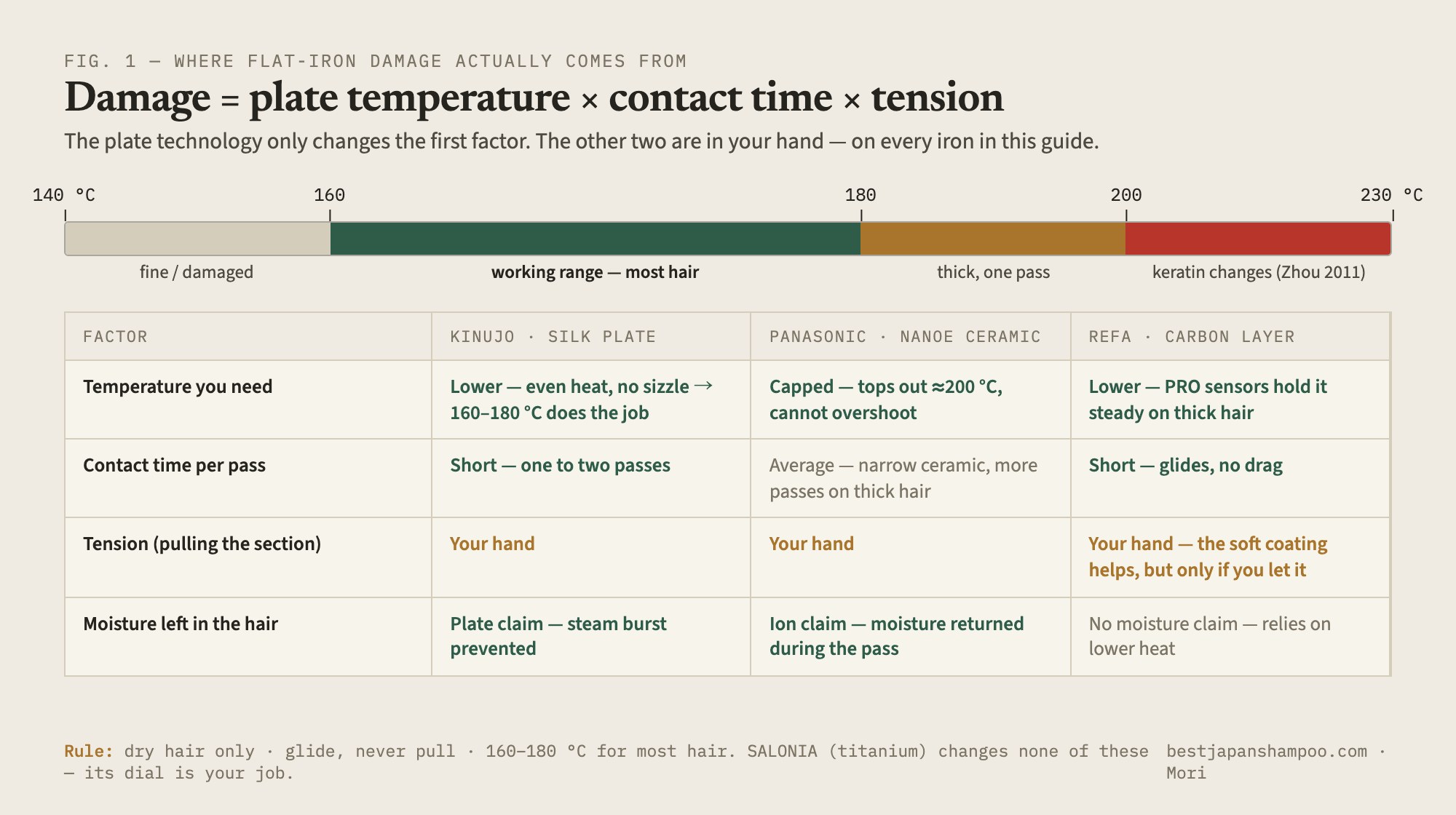
My professional judgement. What damages hair in a flat iron is plate temperature × contact time × tension — nothing else. Zhou and colleagues showed in the Journal of Cosmetic Science (2011) that irons running above 200 °C convert the hair’s keratin from its natural α-helix into a β-sheet structure, reduce how much water the hair can hold afterwards, and sharply increase breakage on combing. That is the whole mechanism, and no plate coating overrides it. What the Japanese brands do well is make the safe range work: a plate that transfers heat evenly at 160–180 °C gets a section straight in one or two passes, so you never reach for 220 °C. KINUJO and ReFa are the best I have used at that. Panasonic’s ions I rate below its plate — the ceramic is good, the ions are a bonus. The SALONIA is fine if you leave the dial at 160–180 °C and ignore the 230 °C it offers.
The Setting That Matters More Than the Brand
Every iron here lets you pick a temperature. This is where the result is decided.
- Fine, colour-treated, or already-damaged hair: 140–160 °C (285–320 °F). It will take one extra pass. That is the trade.
- Medium, healthy hair: 160–180 °C (320–355 °F). The working range for almost everyone.
- Thick, coarse, very curly hair: 180–200 °C (355–390 °F), one pass, and never higher.
- 220–230 °C (430–450 °F): a salon setting for a stylist working fast on hair they will not see again. Not for home use, ever.
Two rules that outrank the number: never iron hair that is wet or damp (the water inside turns to steam and blows the cuticle open from the inside — the 72-hour aftercare article explains why this is also the rule after a treatment), and let the plates do the work. Close, glide, release. If you are pulling the section taut while you iron, you are adding tension to heat, and that is the combination that snaps hair.
KINUJO W (worldwide model) — Best for Most People
Voltage: 100–240 V · Plate: Silk Plate, 24 × 87 mm · Weight: 231 g · Heat: 140–220 °C in five 20 °C steps, about 10 seconds to temperature
The KINUJO W is the worldwide version of the iron KINUJO says more than 20,000 Japanese hairdressers use, and it is the one I would put in most hands. Three things stand out. It is light — 231 g, and you feel that around the back of the head. The plate is wide enough for a full section but narrow enough to reach the root. And it does not sizzle on hair with a little moisture left in it, which is the most common home mistake. (The current worldwide model is the DS200; the older DS100 was 346 g. The Amazon US listing’s 231 g matches the current one.)
Who it is for
- Medium to thick hair that you straighten several times a week
- Anyone who has been using a titanium iron at 200 °C+ and wants the same result at a lower setting
- Curly hair on the days you wear it straight — the curly hair products guide has the section on how to pass an iron through curls without pulling
Who should skip it
- Very short hair or fringe work — the plate is standard width, not a mini
- Anyone who wants to curl with the same tool; the edges are not rounded for it
Pair it with: a heat-protectant spray on dry hair before the first pass. The 2011 study above found polymer pretreatments measurably reduced breakage after ironing — this is one product category where the research supports the habit.
Panasonic nanoe EH-HS99-K — Best for Fine or Damaged Hair
Voltage: 100–240 V automatic · Plate: ceramic, 1 in × 4 in · Weight: about 280 g · Heat: 5 settings, 270–395 °F (about 130–200 °C), 60-minute auto-off
The EH-HS99-K is the only iron here sold by Panasonic’s own US operation — a US warranty and a listing that has been stable since 2017. The plates are smooth ceramic with rounded edges, so it curls as well as it straightens; the nanoe emitter sits in the barrel.
I steer fine and damaged hair here because of the temperature ceiling: it tops out around 200 °C, which for that hair is a feature. You cannot accidentally set a salon temperature. It is also the most forgiving iron for someone learning — the ceramic glides and the slim body is easy to control near the face.
Who it is for
- Fine, thin, colour-treated or bleached hair
- Anyone who wants one tool for straight days and wave days
- Anyone who wants a US warranty and a US seller
Who should skip it
- Thick, coarse or very long hair — 1-inch ceramic at 200 °C max means more passes than a KINUJO at the same setting
- Anyone who wants the newest nanoe generation; Panasonic’s EH-HN50 with high-penetration nanoe is Japan-only and not on Amazon US as of September 2026
Pair it with: a sulfate-free wash if the hair is chemically straightened — the shampoo-after-straightening guide covers why the cleanser decides how long the treatment lasts.
ReFa BEAUTECH STRAIGHT IRON and STRAIGHT IRON PRO — The One You Cannot Buy on Amazon US
Voltage: 100–240 V · Plate: carbon layer plate, 140–220 °C in five steps · Weight: 295 g (standard) / 325 g (PRO)
I like the ReFa irons. The carbon plate with its soft coating is the closest I have used to a plate that does not pull — the section slides through as if on a cushion — and the PRO’s twin sensors keep the temperature honest on thick hair, where most irons quietly drop 20 degrees mid-section and you compensate by going slower, which is worse.
The problem is availability. As of September 2026 ReFa’s Amazon US store carries face rollers and shower heads, not irons, and the straight irons do not appear in Amazon US search at all. They are sold on ReFa’s site in Japan and by Japanese export retailers, at import prices, with returns going back to Japan. Both are dual voltage (check for AC100–240V and a model number starting RE-AC or RE-AT). No affiliate link, no button.
Who it is for
- Thick, long or stubborn hair (PRO)
- Fine or damaged hair that wants a plate that grips without pressure (standard)
- Anyone already buying from a Japanese exporter
Who should skip it
- Anyone who wants an Amazon return window — this is not that purchase
SALONIA SL-004S — The Budget Japanese Iron
Voltage: 100–240 V · Plate: titanium-coated, 24 mm · Weight: 305–345 g depending on colour · Heat: 120–230 °C dial, about 30 seconds to temperature, 30-minute auto-off
The SALONIA is the iron in most Japanese bathrooms, and on Amazon US it ships from Amazon’s own warehouse. A straightforward titanium-plate iron with a dial: fast, compact, a fraction of the KINUJO’s price.
What you give up is plate technology. Titanium transfers heat aggressively — which is why it sizzles on hair with moisture in it and why it is easy to overdo. At 160–180 °C on fully dry hair it is a perfectly good iron. At the 230 °C the dial allows, it is the fastest route to the damage described above. The dial has no click stops, so set it once and leave it.
Who it is for
- A first flat iron, or a spare for travel
- Short hair or a fringe — the compact body is easy to steer
- Anyone who irons occasionally rather than daily
Who should skip it
- Damaged, bleached or fine hair — buy the Panasonic
- Anyone who has ever turned an iron all the way up “just to be sure”
If Your Hair Is Chemically Straightened
A flat iron on Japanese-straightened hair is for the new growth and the odd humid day, not the lengths — those are already straight and already at their most fragile, so every pass is heat with no benefit. Keep it at 160 °C or under and keep it to the roots. If you are ironing the lengths every morning, the treatment is fading: read about touch-ups rather than iron harder.
If You Still Cannot Decide
You iron often and want the best plate you can buy on Amazon → KINUJO W.
Your hair is fine, coloured or damaged → Panasonic EH-HS99-K. The 200 °C ceiling is the point.
You want one tool for straight and waves → the Panasonic again; the rounded ceramic edges curl properly.
Budget, first iron, travel spare → SALONIA SL-004S, and leave the dial at 180 °C.
Thick, long, stubborn hair and no problem importing → ReFa STRAIGHT IRON PRO from a Japanese exporter.
Frizz is the actual problem → the iron is treating a symptom. The frizzy hair guide covers the drying step that causes it.
Drying is the other half of the same problem. If you are replacing the iron you should probably look at the dryer too — ReFa vs KINUJO vs Panasonic covers which ones actually run on a US outlet.
FAQ
Do Japanese flat irons work in the US without a transformer? Yes — every iron in this article is rated AC 100–240 V, including the Japan-domestic Panasonic nanocare models. An iron draws about 40 watts, so the makers build them for worldwide voltage — the opposite of Japanese hair dryers, most of which are 100 V only.
Is the KINUJO W on Amazon the real worldwide model? The Amazon US listing is KINUJO’s own store and shows the 231 g weight of the current DS200 worldwide model. Check that the listing says worldwide model and 100–240 V; KINUJO also sells a Japan-domestic iron that is 100 V only.
Which ReFa straight iron works in the US? Both the BEAUTECH STRAIGHT IRON (RE-AC02A) and the STRAIGHT IRON PRO (RE-AT series) are AC 100–240 V. Neither is sold on Amazon US as of September 2026; ReFa’s US Amazon store lists rollers and shower heads only.
What temperature should I use on a Japanese flat iron? 160–180 °C (320–355 °F) for most hair; 140–160 °C for fine or damaged hair; up to 200 °C for thick, coarse hair, in one pass. Research on flat-iron damage shows keratin structure changes above 200 °C, so treat that as the ceiling at home regardless of what the dial allows.
Does the Silk Plate really reduce damage? KINUJO’s claim is that the plate prevents the steam burst when heat meets moisture. In use it does not sizzle the way titanium does, and hair comes off it smoother at the same setting. My view: the plate gets you the result at a lower temperature, and the lower temperature is what reduces the damage.
Can I use a flat iron on Japanese-straightened hair? On the new growth, at 160 °C or below, on fully dry hair — yes. Through the treated lengths, no; they are already straight and every pass is unearned heat. Wait the full 72 hours after a treatment before any heat at all.
Bottom Line
The three brands share one idea — even heat at a moderate temperature so you never need a high one — and all are dual voltage, so for once there is no transformer trap. The KINUJO W is the best plate you can buy on Amazon US; the Panasonic EH-HS99-K is the safe choice for fine or damaged hair with a US warranty; the SALONIA SL-004S is the honest budget pick. ReFa is worth the import only if you have thick hair and patience.
Whichever you buy: dry hair, 160–180 °C, glide without pulling. The iron is a third of the result. The other two thirds are in your hand.
Prices and availability on Amazon change. Check the live listing before buying.