
Mori · licensed hairdresser, 8 years in Tokyo & Shanghai, specialising in Japanese straightening.
Matching a product to a hair type was the job. That is what this article is.
Dyson and Panasonic are the two dryer brands I am asked about most by readers outside Japan, and the question is always the same: is the Dyson worth more than twice the price of a Panasonic? Both are sold by Amazon.com, both plug straight into a US outlet, and both promise “healthier-looking hair.” That makes this one of the few premium comparisons where you do not have to import anything or buy a transformer.
The honest answer is that they protect hair in two different ways. Dyson controls the temperature of the air. Panasonic changes what is in the air and where it lands. Once you see that, the choice mostly makes itself — and for a lot of people, the cheaper machine is the right one.
⏱️ In a hurry?
Sensitive scalp, fine or bleached hair, budget is not the issue → Dyson Supersonic Nural
Thick, long or curly hair, sensible budget → Panasonic EH-NA67 nanoe — diffuser in the box
You want Dyson speed without the sensors → Dyson Supersonic Origin
Travel, one dryer for every country → Dyson Supersonic Travel
Fine hair, small bathroom, smallest spend → Panasonic EH-NA2C nanoe Compact
Quick Comparison
| Line | Weight | Built for | Price | Where to buy |
|---|---|---|---|---|
| Dyson Supersonic Nural · US 120 V | Full-size, 1,600 W | Sensitive scalps, fragile hair, curls (diffuser included) | $$$$ | Check Price on Amazon |
| Dyson Supersonic Origin · US 120 V | Full-size, 1,600 W | Fast drying for people who manage their own heat | $$$$ | Check Price on Amazon |
| Dyson Supersonic Travel · universal voltage | Compact, 1,220 W | Travel, short to medium hair | $$$ | Check Price on Amazon |
| Panasonic EH-NA67 nanoe · US 120 V | Full-size, 1,875 W | Thick, long or curly hair; the family dryer | $$ | Check Price on Amazon |
| Panasonic EH-NA2C nanoe Compact · US 120 V | Folding, 1,400 W | Fine to medium hair, travel within the US | $ | Check Price on Amazon |
Price bands: $ budget · $$ mid-range · $$$ premium · $$$$ flagship. Both brands run sales; check the live listing.
The Real Difference: Sensor vs Nozzle
This is the part both brands blur in their marketing, so here are their claims first, then my view.
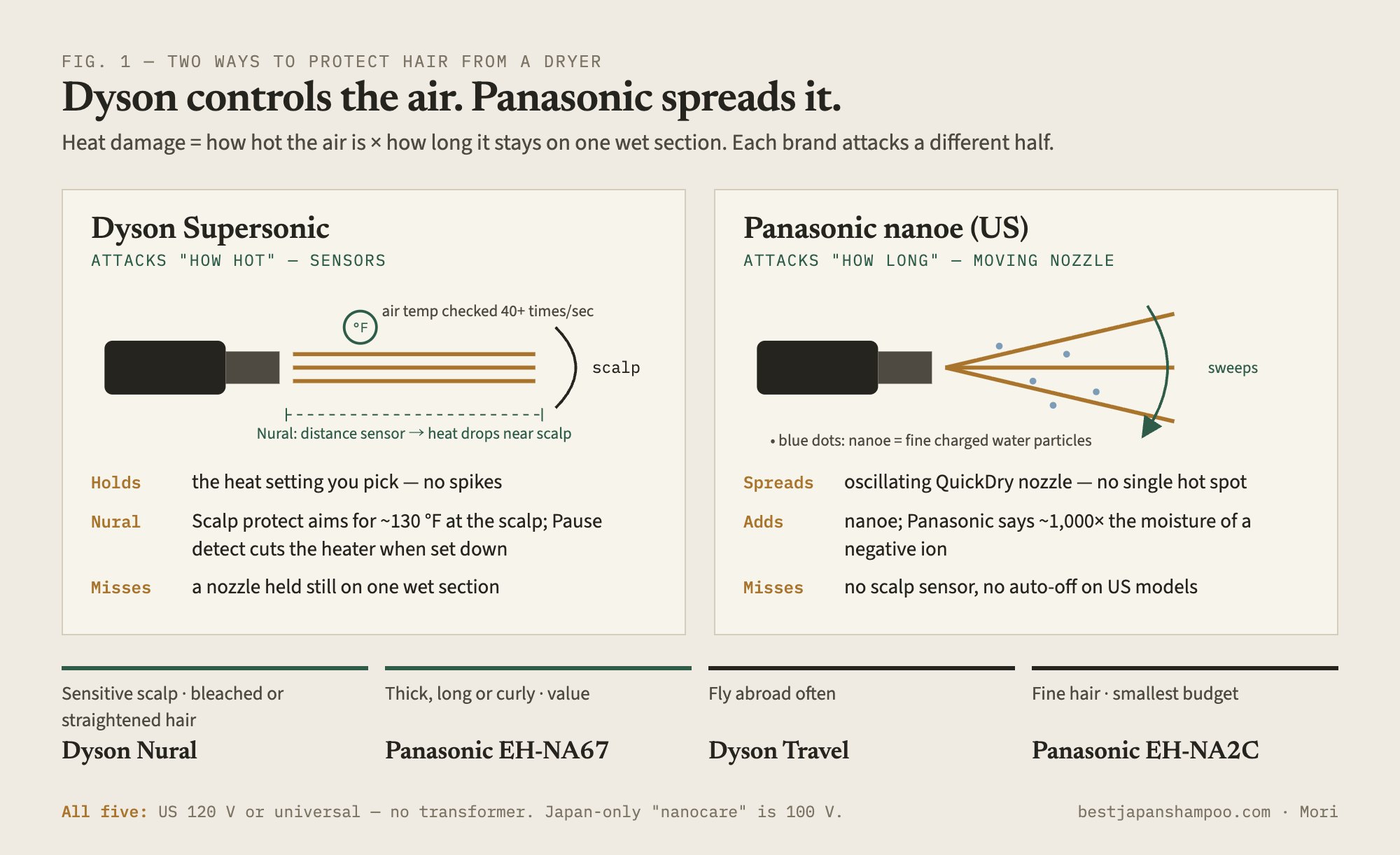
Dyson measures the air. Every Supersonic uses what Dyson calls intelligent heat control: the dryer measures the air temperature over 40 times a second and regulates the heater so the air does not spike into extreme heat. You pick the setting; the dryer holds it. The Nural adds distance. A sensor in the nozzle measures how far the dryer is from your head, and in Scalp protect mode it lowers the heat as you come closer, aiming for about 130 °F (roughly 54 °C) at the scalp. Its Pause detect turns the heater off when you put the dryer down.
Panasonic moves the air and adds moisture particles. The US nanoe models have no temperature sensor. The EH-NA67 instead uses an oscillating QuickDry nozzle that sweeps the airflow back and forth, so no single section takes the hot air for long — Panasonic’s wording is “no hot spots.” On top of that, the dryer releases nanoe: very fine, electrically charged water particles that Panasonic says carry about 1,000 times more moisture than an ordinary negative ion.
My professional judgement. Heat damage is not only about how hot the air is. It is about how long hot air sits on one wet section. Dyson’s sensor stops the air from overheating, but it cannot stop you parking the nozzle on your crown. Panasonic’s oscillating nozzle attacks exactly that habit, mechanically, at a fraction of the price. Where Dyson wins clearly is at the scalp — Scalp protect on the Nural is the most effective feature in this comparison for anyone whose scalp burns or itches after drying. Where I am less convinced is nanoe: hair dried with it does feel smoother and less static to me, but I would not pay extra for nanoe alone. Temperature and movement matter more than particles.
So the short version: Dyson protects by precision, Panasonic protects by spreading the heat. Fig. 1 puts both on one page.
Dyson Supersonic Nural — The Gentlest Dryer You Can Buy in the US
Voltage: US 120 V · Style: Full-size, 1,600 W · Built for: Sensitive scalps, fine, bleached or straightened hair, curls
The Supersonic Nural is the Dyson I recommend. It keeps the Supersonic motor and heat control and adds Scalp protect, Pause detect and attachment learning, which remembers your last heat and airflow for each attachment. The box is generous: a Wave+Curl diffuser, a gentle air attachment, a styling concentrator, a flyaway attachment and a wide-tooth comb. It has three airflow settings, and the capsule light changes colour with the heat setting so you can see how much heat you are using.
For the hair I worried about most in the salon — bleached or chemically straightened hair, which has already lost part of its internal structure — a dryer that backs off near the scalp and stops heating the moment you set it down removes the two most common mistakes. If you have had Japanese straightening, this is the dryer I would want you to use.
Who it is for
- Sensitive, easily irritated scalps — switch Scalp protect on and leave it on
- Fine, bleached, coloured or chemically straightened hair
- Curly or wavy hair, because the diffuser is included
- Anyone who wants the most protection they can buy without importing
Who should skip it
- Anyone who will never use Scalp protect — the Origin does the rest for less
- Frequent flyers — it is 120 V only; see the Travel
- Healthy, thick hair on a budget — the Panasonic EH-NA67 does the job
Pair it with: a heat protectant on the lengths, and finish on cool. For curls, the Japanese curly hair products guide covers what to use before you diffuse.
Buying tip: choose the listing shipped and sold by Amazon.com. Premium dryers attract grey-market sellers, and a third-party unit may not carry Dyson’s US warranty.
Dyson Supersonic Origin — The Classic, Without the Sensors
Voltage: US 120 V · Style: Full-size, 1,600 W · Built for: Fast, controlled drying for people with good habits
The Supersonic Origin is the core Supersonic: the small high-speed motor, Air Multiplier airflow, three airflow settings and heat control that checks the air over 40 times a second. What it does not have is the Nural’s sensor network — no Scalp protect, no Pause detect — and the box is smaller, with a styling concentrator.
That makes it a very good dryer for someone who already dries sensibly. Next to the Panasonic EH-NA67, its argument is speed and finish on straight hair; the EH-NA67’s argument is the diffuser and the price.
Who it is for
- Straight to wavy hair of any thickness
- People who want Dyson’s speed and smooth finish, and control their own heat
Who should skip it
- Sensitive scalps — Scalp protect is the feature worth paying for; check the Nural’s live price, as the two often sit close
- Curly hair — no diffuser in the box
Dyson Supersonic Travel — One Dryer for Every Country
Voltage: Universal, adapts automatically · Style: Compact, 1,220 W · Built for: Travel, short to medium hair
The Supersonic Travel is, in Dyson’s words, 32% smaller and 25% lighter than the Nural, with universal voltage that adapts on its own. It has three heat settings (including constant cool) and two speeds, ships with a travel concentrator and accepts your other Supersonic attachments.
Panasonic has nothing that matches it here: its compact EH-NA2C is a 120 V US model, so it is a travel dryer for the US, not for Europe or Asia. If you split your year between countries — including Japan, which runs on 100 V — the Travel is the one machine in this article that goes everywhere with only a plug adapter.
Who it is for
- Frequent international travellers
- Short to medium hair
Who should skip it
- Long or thick hair as your only dryer at home
- Curly hair that depends on a diffuser
Panasonic EH-NA67 nanoe — The One Most People Should Buy
Voltage: US 120 V · Style: Full-size, 1,875 W · Built for: Thick, long or curly hair; the whole family
The EH-NA67 is Panasonic’s full-size nanoe dryer for the US, sold by Amazon.com. It has two speeds, three heat settings and a cool shot, and three attachments: the oscillating QuickDry nozzle, a concentrator, and a full-size diffuser.
It is the more powerful machine on paper — 1,875 W against Dyson’s 1,600 W — and on thick or long hair you feel it. The oscillating nozzle is the reason I trust it on that hair: high power on a moving nozzle is a very different thing from high power held still. The diffuser makes it a serious option for curls; I compared it with the ReFa range in Panasonic vs ReFa, and it wins on curly hair there for the same reason.
What you give up against the Nural: there is no scalp sensor and no auto-off, and it is the louder, bulkier dryer. What you keep is most of the practical protection, at less than half the Nural’s price on most days.
Who it is for
- Thick, coarse, long or curly hair
- Healthy hair that does not need a sensor to stay healthy
- A household sharing one dryer
Who should skip it
- Sensitive scalps that burn with any dryer — the Nural’s Scalp protect is the better tool
- Bleached or chemically straightened hair, if you can stretch to the Nural
Pair it with: for frizz, the shampoo and conditioner matter as much as the dryer — the frizzy hair guide covers that half.
Panasonic EH-NA2C nanoe Compact — Small, Gentle, Cheap
Voltage: US 120 V · Style: Folding, 1,400 W · Built for: Fine to medium hair, small bathrooms, US travel
The EH-NA2C keeps the EH-NA67’s best feature, the oscillating nozzle, in a folding body. At 1,400 W it has less power, and for fine hair I see that as an advantage: low wattage on a moving nozzle is genuinely hard to overheat with. Of everything here it is the cheapest way to get the Japanese approach.
Who it is for
- Fine, thin or shoulder-length hair
- A second dryer, or a dryer for a small apartment
Who should skip it
- Thick, long or curly hair — under-powered, and there is no diffuser
- International travel — it is 120 V only
Before You Buy: Three Things to Check
- “Nanocare” is not the US model. Panasonic’s Japanese flagships (the EH-NA0J and its successors) are sold as nanocare and run on 100 V. Some appear on Amazon US through third-party sellers. They need a step-down transformer rated around 3,000 W to run safely here — the 100 V problem guide explains the arithmetic. The US models in this article are nanoe, 120 V, and plug straight in.
- The seller. For both brands, buy the listing shipped and sold by Amazon.com, or from the brand. That is what keeps the US warranty intact.
- Your habit. No dryer fixes a nozzle held still on wet hair. Keep it moving, use medium heat, finish on cool. If you also use a straightening iron, the Japanese flat iron comparison covers the other half of your heat exposure.
Where ReFa Fits
If you came here from ReFa vs Dyson: ReFa’s BEAUTECH DRYER SMART W is the gentlest of the three brands, because it reads the room temperature and runs a program that keeps the air under set ceilings. But ReFa’s dryers are not sold on Amazon.com, so it means importing and a Japanese warranty. Between the two brands you can buy here, the Nural is the closest to ReFa’s philosophy. The full Japanese hair dryer guide compares all three with KINUJO.
If You Still Cannot Decide
Thick, long or curly hair, and you want value → Panasonic EH-NA67. This is the majority of people asking.
Your scalp burns or itches after drying → Dyson Supersonic Nural, with Scalp protect on.
Bleached, coloured or straightened hair → Dyson Supersonic Nural if the budget allows; the EH-NA67 on medium heat if not.
Straight hair, good habits, you want Dyson → Dyson Supersonic Origin.
You fly abroad often → Dyson Supersonic Travel.
Fine hair, small budget → Panasonic EH-NA2C.
If You Live in Japan: Different Shelf, Different Answer
Everything above assumes a 120 V American outlet and the US Amazon catalogue. In Japan both change. Prices are Amazon.co.jp in November 2026, tax included, and move quickly — check before you buy.
⚠️ Dyson is the surprise: its main dryers are not on Amazon.co.jp. Searching for the Nural or the Origin there returns neither — Dyson sells those through its own store and the electronics chains. The one Dyson you can buy on Amazon.co.jp is the Supersonic Travel (HD19) at ¥42,800, which is the folding model, not the full-size one this guide compares.
👉 Dyson Supersonic Travel を Amazon.co.jp で見る →
Panasonic’s Japanese line is not the same line either. The EH-NA67 and EH-NA2C are export models. What sits on a Japanese shelf is nanocare EH-NA0K (パナソニック ナノケア EH-NA0K) at about ¥34,200 — 100 V, no transformer, and a warranty you can use at the shop you bought it from.
👉 Panasonic EH-NA0K を Amazon.co.jp で見る →
nanocare ULTIMATE (EH-NC50) is the top tier at about ¥55,000. Worth it only if you will actually use the MOIST / STRAIGHT / AIRY modes; otherwise the EH-NA0K is the same moisture system for ¥20,800 less.
👉 nanocare ULTIMATE EH-NC50 を Amazon.co.jp で見る →
Where else: Yodobashi and Bic Camera carry all of these and add loyalty points, so compare the price after points rather than the sticker.
FAQ
Is the Dyson Supersonic worth it over a Panasonic? For sensitive scalps and fragile hair, yes — the Nural’s Scalp protect and Pause detect are features Panasonic’s US models do not have. For healthy thick, long or curly hair, the Panasonic EH-NA67 gives you most of the practical protection, more power and a diffuser for much less.
What is the difference between nanoe and Dyson’s heat control? They do different jobs. Dyson’s heat control measures the air temperature over 40 times a second and keeps it from spiking. Panasonic’s nanoe adds fine, charged water particles to the airflow; on the EH-NA67 the heat is spread by an oscillating nozzle instead of a sensor.
Do Dyson and Panasonic dryers work in the US without a converter? The models in this article do. The Dyson Nural and Origin and the Panasonic EH-NA67 and EH-NA2C are US 120 V models; the Dyson Travel is universal voltage. Panasonic’s Japanese nanocare models are 100 V and need a step-down transformer.
Which is better for curly hair, Dyson or Panasonic? Both the Dyson Nural and the Panasonic EH-NA67 include a diffuser. The Nural is gentler at the roots; the EH-NA67 has more power for thick curls at a much lower price. The Origin and the compact Panasonic do not include a diffuser.
Does Panasonic nanoe really make a difference? In my experience hair dried with nanoe feels smoother and less static, and Panasonic says each particle carries about 1,000 times more moisture than an ordinary negative ion. I value its oscillating nozzle more than the nanoe itself, because temperature and movement decide heat damage.
Is the Panasonic EH-NA67 the same as the Japanese nanocare? No. The EH-NA67 is a 120 V model built for North America with an oscillating nozzle and diffuser. The Japanese nanocare flagships are 100 V and use temperature sensors instead.
Bottom Line
Both brands sell “gentler drying,” but they deliver it differently: Dyson controls the air temperature, Panasonic spreads the heat and adds moisture particles. If your scalp or your hair is fragile, the Dyson Nural is worth the money. If your hair is healthy, thick or curly, the Panasonic EH-NA67 is the better buy.
Sensitive scalp, fragile hair → Dyson Supersonic Nural Thick, long, curly, value → Panasonic EH-NA67 nanoe Dyson speed, no sensors → Dyson Supersonic Origin International travel → Dyson Supersonic Travel Fine hair, smallest budget → Panasonic EH-NA2C
Prices and availability on Amazon change. Check the live listing before buying.