
Mori · licensed hairdresser, 8 years in Tokyo & Shanghai, specialising in Japanese straightening.
Matching a product to a hair type was the job. That is what this article is.
KINUJO is the flat iron Japanese hairdressers talk about when they are off the clock. The name means “silk woman,” and the selling point is a plate called the Silk Plate. Search for it from the US and you find two confusing things: a range of irons that look almost identical, and exactly one of them on Amazon.
Both are there for a reason. KINUJO sells six irons today, and three of them are Japan-only 100 V models. A Japanese plug fits a US outlet without an adapter, so nothing stops you from plugging one in — which is exactly the problem. This guide sorts the line-up, shows you how to tell the worldwide models from the domestic ones, covers what the Silk Plate actually does and how long it lasts, and answers the question underneath all of it: is a KINUJO worth paying for, or will a cheaper Japanese iron do the same job on your hair?
⏱️ In a hurry?
Most people in the US → KINUJO W (worldwide model, DS200) — the only KINUJO on Amazon US, 100–240 V, 231 g
Fine, coloured or damaged hair, US warranty → Panasonic nanoe EH-HS99-K — ceramic, tops out around 200 °C
You iron once a week or less → SALONIA SL-004S — Japan’s budget best-seller, 100–240 V
Short hair, fringe, travel → KINUJO MINI IRON -deux- (100–240 V) — not on Amazon US, details below
Avoid in the US → KINUJO Straight Iron (LM-225), Pro Straight, Sapphire Straight Pro — all AC 100 V only
Quick Comparison
| Line | Weight | Built for | Price | Check Price on Amazon |
|---|---|---|---|---|
| KINUJO W (DS200) · 100–240 V | 231 g | Everyday straightening, medium to thick hair, frequent ironing | $$$ | Check Price on Amazon |
| KINUJO MINI IRON -deux- · 100–240 V | 98 g | Fringe, short hair, a travel bag | $$ | Not on Amazon US |
| KINUJO 2WAY IRON (26 / 32 mm) · 100–240 V | 275 / 350 g | Straight and curl in one tool | $$$ | Not on Amazon US |
| KINUJO Straight Iron (LM-225) · 100 V only | 245 g | The Japan flagship — wide plate, digital display | $$$ | Do not buy for the US |
| KINUJO Pro Straight / Sapphire Straight Pro · 100 V only | 235 / 224 g | Salon use in Japan, 18 temperature steps | $$$$ | Do not buy for the US |
| Panasonic nanoe EH-HS99-K · 100–240 V | about 280 g | Fine, coloured or damaged hair; waves as well | $$ | Check Price on Amazon |
| SALONIA SL-004S · 100–240 V | 305–345 g | A first iron, occasional use, a spare | $ | Check Price on Amazon |
Price bands: $ budget · $$ mid-range · $$$ premium · $$$$ salon tier. Imported listings move in price, so check the live page.
The KINUJO Line-Up, Explained
KINUJO’s own specification pages are clear once you line them up, so here is what each iron is, in plain terms. Manufacturer figures throughout; my view comes after.
KINUJO W — worldwide model (DS200). The travel-and-export version of the brand’s original iron. AC 100–240 V, 231 g, a 24 × 87 mm Silk Plate, five heat settings from 140 °C to 220 °C in 20 °C steps, and auto-off after about 60 minutes. The earlier worldwide model, the DS100, was a heavier 346 g iron with the same temperature range; the DS200 replaced it. This is the one on Amazon US.
KINUJO Straight Iron (LM-225). The current flagship in Japan: a wider 28 × 100 mm plate, a digital display and temperature from 130 °C to 220 °C in 10 °C steps. It is the iron you see in Japanese beauty magazines, and it is AC 100 V only.
KINUJO MINI IRON -deux-. A 98 g hand-sized iron with a 15 × 60 mm plate and two settings, 160 °C and 200 °C. AC 100–240 V, built for fringes, short hair and handbags. Of the irons you would have to import, this is the one I would bring over on purpose.
KINUJO 2WAY IRON. A round-edged iron in 26 mm and 32 mm widths that both straightens and curls. AC 100–240 V, five settings from 120 °C to 200 °C.
KINUJO Pro Straight and Sapphire Straight Pro. The professional range, sold through salon distributors in Japan. Eighteen temperature steps from about 50 °C to 220 °C and a 3 m cord for working around a salon chair. The Sapphire Straight Pro, launched in 2026 with a new sapphire plate, is the first KINUJO iron built specifically for chemical straightening work. Both are AC 100 V only.
KINUJO also makes hair dryers. The standard KINUJO dryers are 100 V; the Voyage is the 100–240 V travel model. Dryers are a different voltage problem from irons, and the Japanese hair dryer guide covers them.
100 V vs 100–240 V: How to Tell Before You Pay
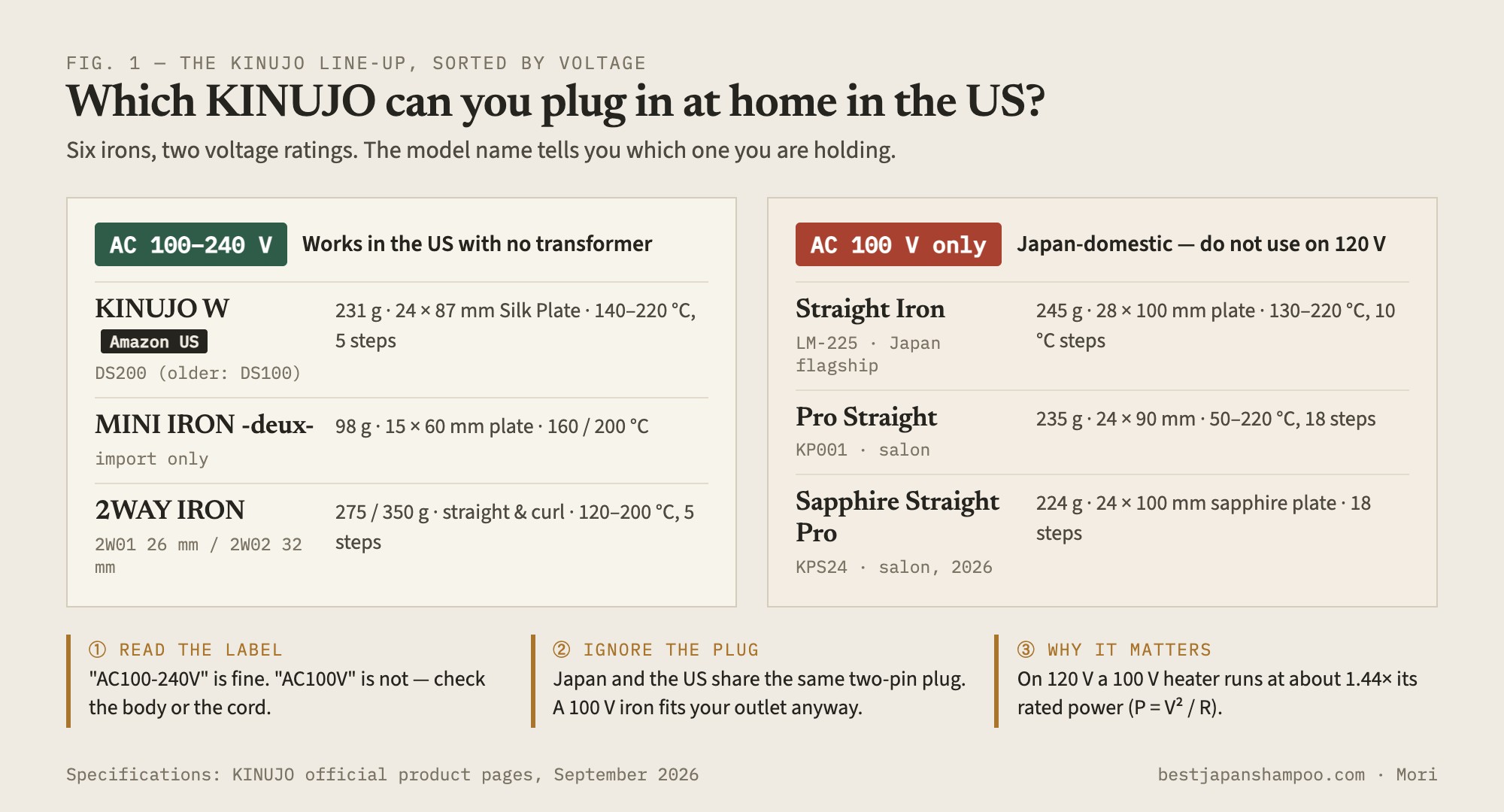
This is the section that saves you money, so it gets its own diagram.
A flat iron draws around 40 to 50 watts, so most Japanese makers build their irons for worldwide voltage — the reason the Japanese flat iron comparison could say every iron in it was 100–240 V. KINUJO is the exception worth knowing about. Its flagship and both professional irons are domestic 100 V models.
Why it matters: a heater rated for 100 V, plugged into 120 V, runs at roughly 44% more than its rated power (power rises with the square of the voltage). The thermostat may hold the plate in range for a while. The electronics were not designed for it, the warranty does not cover it, and a device that overheats in your hand next to your hair is not a risk I would take for a better display.
The check takes ten seconds:
- Read the rating label on the body or the cord. “AC100-240V 50/60Hz” is fine in the US. “AC100V 50/60Hz” is not.
- Check the model number. DS200 and DS100 (the W models), 2W01 and 2W02 (2WAY), and the MINI IRON -deux- are worldwide. LM-225, KP001 (Pro Straight) and KPS24 (Sapphire) are 100 V.
- Ignore the plug. Japan and the US use the same two-pin plug shape, so a domestic iron will slide straight into your wall. The plug tells you nothing.
- Be wary of the words “overseas compatible” in a listing title with no voltage printed. Ask the seller for a photo of the rating label. A good export seller will send one.
What the Silk Plate Actually Does
KINUJO describes the Silk Plate as a proprietary plate material that reduces friction, keeps moisture in the hair and prevents the “steam explosion” — the hiss you hear when a hot plate meets hair that is not completely dry — even around 200 °C. KINUJO does not publish what the plate is made of.
In use, two things are real. The plate glides instead of grabbing the section, so you do not pull the iron through. And it does not sizzle on hair with a trace of moisture left in it.
My professional judgement. The Silk Plate does not make heat harmless. What damages hair under a flat iron is plate temperature × contact time × tension. Research on flat irons published in the Journal of Cosmetic Science (Zhou and colleagues, 2011) found that ironing above 200 °C changes the structure of keratin and increases breakage. A coating does not change that chemistry. What a good plate does is let you get the result at 160–180 °C in one or two passes, so you never reach for 220 °C. That is the real benefit of a KINUJO, and it is worth having if you iron often.
How long the coating lasts, and how to make it last
KINUJO’s own answer is that the Silk Plate is durable but will change over time depending on how often and where it is used, and that owners should contact support if the glide drops off. From the salon side, coated plates wear in three predictable ways:
- Product baked onto the plate. Oils, creams and heavy heat protectants carbonise on a hot plate and turn it tacky. Apply styling product sparingly and let it dry before ironing.
- Abrasive cleaning. Never scrub a coated plate or use a solvent on it. Unplug, let it cool completely, and wipe with a soft cloth dampened with water. Dry it fully before the next use.
- Clamping and storage. Do not store it clamped around a cord or knock the plates together in a drawer. Chips start at the edges.
The sign of a worn plate is not how it looks. It is that it starts to drag and hiss on hair it used to glide through.
KINUJO W (DS200) — The One to Buy in the US
Voltage: 100–240 V · Plate: Silk Plate, 24 × 87 mm · Weight: 231 g · Heat: 140–220 °C, five steps
The KINUJO W is the only KINUJO you can buy on Amazon US, and it is also the one I would choose. It is light enough that the back of the head is not a workout, the plate is standard width, and the five fixed steps are easier to live with than a dial: set it to 160 or 180 and leave it.
One honest note on the listing. As of September 2026 it is sold by a Japanese export seller rather than by KINUJO or Amazon, and the price sits above Japanese retail, which is normal for an imported iron. Check that the listing says worldwide model, DS200 and 100–240 V before you buy, and expect a warranty claim to go through the seller.
Who it is for
- Medium to thick hair straightened several times a week
- Anyone using a titanium iron at 200 °C+ who wants the same finish at a lower setting
- Anyone who travels — one iron for every country, with a plug adapter
Who should skip it
- Fine, bleached or already damaged hair — the Panasonic’s lower ceiling is the safer tool
- Occasional use — the SALONIA does the job at a fraction of the price
- Anyone who wants a US warranty and a simple Amazon return
Pair it with: a sulfate-free wash if your hair is chemically straightened — the shampoo-after-straightening guide explains why the cleanser decides how long the treatment lasts, and why the iron should only touch the new growth.
Delivery note, October 2026: the KINUJO W is in stock on Amazon US. On October 31 it was $168.99 with delivery to New York in under a week, but earlier in the month the same listing quoted two to four weeks, so check the date when you click through. If it has slipped and you need an iron sooner, the Panasonic EH-HS99-K is also 100–240 V and arrives in days.
Is a KINUJO Worth It? KINUJO vs SALONIA vs Panasonic
Here is where I land after years with all three kinds of plate in my hand.
KINUJO W vs SALONIA SL-004S. The SALONIA is the iron in most Japanese bathrooms. Titanium-coated plate, a 120–230 °C dial, 100–240 V, a fraction of the price. Titanium transfers heat aggressively, so it sizzles on damp hair and punishes a high setting. On fully dry hair at 160–180 °C it straightens well. The KINUJO earns its price through the plate — the glide and the lower setting — and that is only worth paying for if you iron three or more times a week. Once a week, buy the SALONIA and keep the dial at 180 °C.
KINUJO W vs Panasonic nanoe EH-HS99-K. The Panasonic is sold on Amazon US by Amazon itself, with a US warranty, and its ceramic plates top out around 200 °C. For fine, coloured or bleached hair that ceiling is the feature: you cannot accidentally set a salon temperature. The rounded edges also curl. On thick hair it needs more passes than the KINUJO, which is why I do not recommend it there.
KINUJO vs ReFa. ReFa’s straight irons are excellent and dual voltage, but like most KINUJOs they are not sold on Amazon US; the flat iron comparison above covers them. If you are comparing the two brands’ dryers rather than irons, the ReFa vs Dyson comparison covers ReFa’s sensor approach.
My professional judgement. A KINUJO is worth it for the person who irons most days and has medium to thick hair. For everyone else, the saving on a SALONIA or the safety ceiling on the Panasonic is the better trade.
Settings That Matter More Than the Model
- Fine, coloured or damaged hair: 140–160 °C
- Medium, healthy hair: 160–180 °C
- Thick, coarse or very curly hair: 180–200 °C, one pass
- 220 °C: a salon speed setting. Not for home use.
Iron only fully dry hair. If your hair has been chemically straightened, keep the iron to the roots and wait the full 72 hours after the treatment before any heat. The article on why straightening damages hair explains why heat on already-treated lengths is the part that breaks them.
If You Still Cannot Decide
You iron most days, medium to thick hair → KINUJO W (DS200).
Fine, coloured, bleached or damaged hair → Panasonic EH-HS99-K.
Once a week, a first iron, or a spare → SALONIA SL-004S.
Fringe and short hair only → KINUJO MINI IRON -deux-, imported.
Someone offers you a KINUJO from Japan as a gift → check the rating label before you plug it in. If it says AC100V, use it on your next trip to Japan, not at home.
If You Live in Japan: Roughly Half Price, and One More Option
Voltage is not the issue with irons, so the Japanese difference is price and what is on the shelf. Prices are Amazon.co.jp in November 2026, tax included, and move quickly — check before you buy.
KINUJO W (DS200) — the same worldwide-voltage model recommended above, ¥16,500 here against $168.99 on Amazon US.
👉 KINUJO DS200 を Amazon.co.jp で見る →
KINUJO 絹女 LM225 (¥24,200) is the 100 V domestic version, and the one most people in Japan actually buy. One thing worth knowing: on 19 October 2026 KINUJO published a notice that some LM225 units (serial 511 00001–512 60600) did not meet part of the Electrical Appliance and Material Safety Act technical standard, covering labelling and an insulation clearance on the internal board. It is not a recall. KINUJO states no accidents or faults have been reported, says the units are safe in normal use and asks owners to keep using them, and has revised the board on units now being sold — so a new purchase is the revised version.
👉 KINUJO 絹女 LM225 を Amazon.co.jp で見る →
ReFa STRAIGHT IRON PRO — ¥23,000. Worth calling out because in the US this is the iron you cannot buy on Amazon at all. In Japan it is simply on the shelf, with a warranty that works.
👉 ReFa STRAIGHT IRON PRO を Amazon.co.jp で見る →
SALONIA SL-004S — ¥2,980, against $42.97 in the US. At this price the budget pick stops being a compromise.
👉 SALONIA SL-004S を Amazon.co.jp で見る →
FAQ
Which KINUJO works in the US?
The KINUJO W (DS200, and the older DS100), the MINI IRON -deux- and the 2WAY IRON are all AC 100–240 V and work in the US with no transformer. The KINUJO Straight Iron (LM-225), the Pro Straight and the Sapphire Straight Pro are AC 100 V only.
Is the KINUJO on Amazon US genuine?
The listing is for the KINUJO W worldwide model and, as of September 2026, is sold by a Japanese export seller rather than by KINUJO directly. Check that the listing names the DS200 and 100–240 V, and look at the seller’s feedback before ordering.
What is the difference between the KINUJO W and the regular KINUJO?
The W is the worldwide model: 100–240 V, a 24 mm plate and five temperature steps. The regular Straight Iron sold in Japan has a wider 28 mm plate, a digital display and 10 °C steps, but it is 100 V only.
Can I use a 100 V KINUJO with a converter?
A step-down transformer rated well above the iron’s wattage will make it safe to power. For a 40–50 W iron that is a small transformer, but it is one more box to carry, and the warranty still will not help you outside Japan. Buying the worldwide model is simpler.
How long does the Silk Plate last?
KINUJO says the plate is durable but changes over time with use. In practice, a coated plate lasts longest when you avoid ironing over oily product, clean it only when it is cool with a damp soft cloth, and never scrub it. When it starts to drag or hiss, it is worn.
Bottom Line
KINUJO makes six irons, and the model name matters more than the brand name. In the US, the KINUJO W (DS200) is the one to buy — 100–240 V, light, and the only KINUJO on Amazon US. The flagship Straight Iron and the professional irons are 100 V, and a Japanese plug will not warn you.
Most people who iron often → KINUJO W (DS200) Fine, coloured or damaged hair → Panasonic EH-HS99-K Occasional use or a budget → SALONIA SL-004S
Whichever you buy: dry hair, 160–180 °C, glide without pulling.
KINUJO makes dryers as well as irons, and none of them reach the US catalogue. KINUJO vs ReFa covers that side of the brand, including the one travel model you can plug into an American outlet.
Prices and availability on Amazon change. Check the live listing before buying.