
Mori · licensed hairdresser, 8 years in Tokyo & Shanghai, specialising in Japanese straightening.
Matching a product to a hair type was the job. That is what this article is.
ReFa and Dyson are the two premium dryers readers ask me to compare more than any others, and on paper they look like the same product: a quiet, expensive dryer with a sensor that is supposed to stop you from cooking your hair. Both brands lead with “heat control.” Both cost as much as a good salon visit.
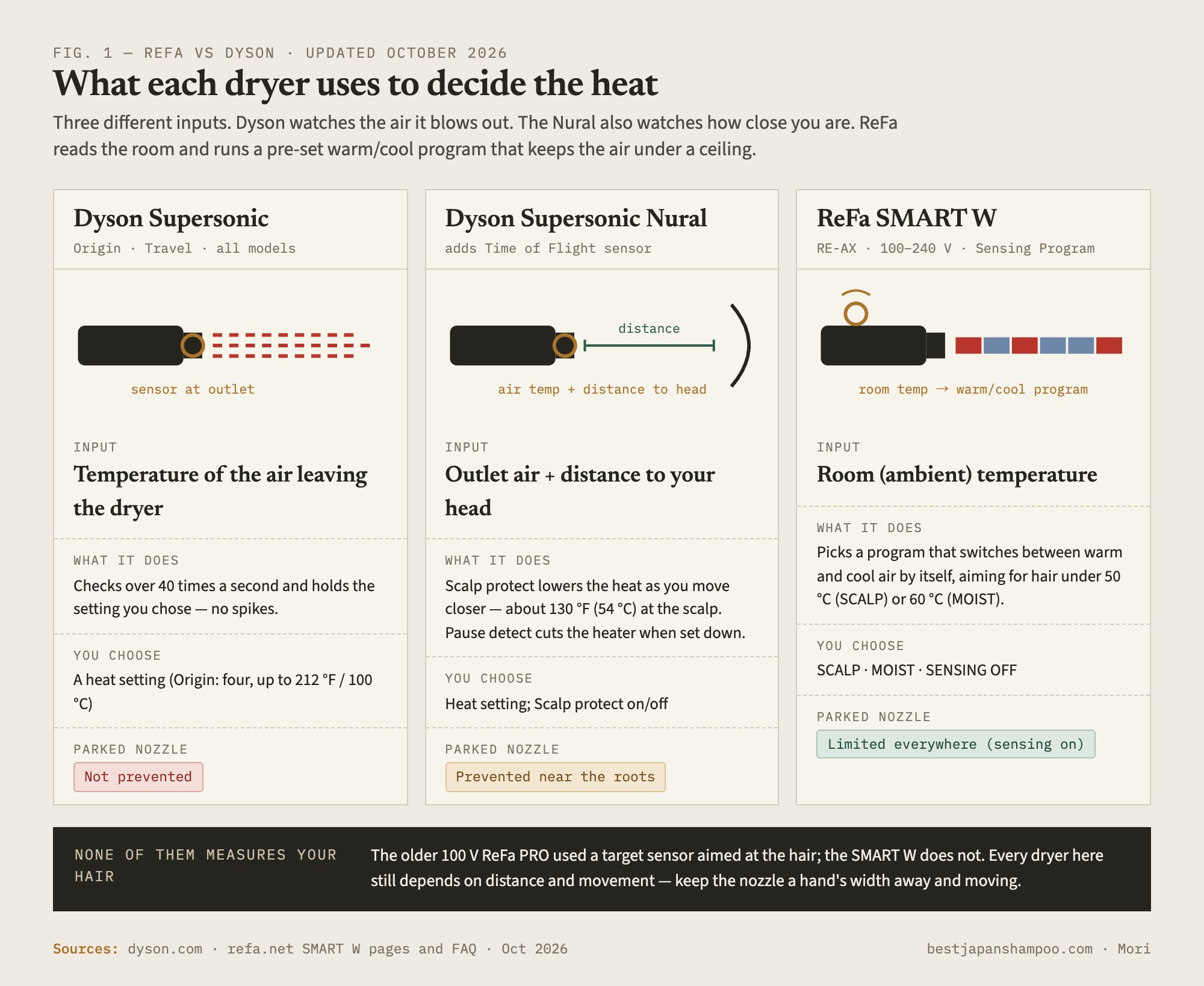
They are not the same product. The two brands measure different things. Dyson measures the air coming out of the nozzle, and the Nural adds a distance sensor. ReFa does not measure your hair at all: it reads the room temperature and runs a preset program that caps the air temperature. That one design decision changes who each dryer suits — and it matters more than the colour of the capsule or the number of attachments in the box.
There is also a practical problem most comparisons skip: Dyson is on Amazon US and plugs straight into a US outlet. ReFa’s dryers are not on Amazon US at all, and only one of them is safe to plug in here. I will cover both questions — how they protect hair, and how you actually get one — and tell you where I land.
⏱️ In a hurry?
Most people in the US → Dyson Supersonic Nural — 120 V, Scalp protect mode, diffuser in the box
Travel, or you want the lighter Dyson → Dyson Supersonic Travel — universal voltage, TSA carry-on friendly
You want the classic Supersonic without sensors → Dyson Supersonic Origin
Sensitive scalp, fine or damaged hair, and you are fine importing → ReFa BEAUTECH DRYER SMART W (100–240 V) — not on Amazon US, details below
You want a Japanese dryer at a fraction of the price → Panasonic nanoe Compact EH-NA27-K

Quick Comparison
| Line | Weight | Voltage | Built for | Price | Where to buy |
|---|---|---|---|---|---|
| Dyson Supersonic Nural | Full-size | US 120 V | Scalp comfort, every hair type, curls (diffuser included) | $$$$ | Check Price on Amazon |
| Dyson Supersonic Origin | Full-size | US 120 V | Fast, controlled drying without the extra sensors | $$$$ | Check Price on Amazon |
| Dyson Supersonic Travel | 25% lighter than Nural | Universal | Travel, short to medium hair | $$$ | Check Price on Amazon |
| ReFa BEAUTECH DRYER SMART W | 520 g, folding | 100–240 V | Sensitive scalp, fine or damaged hair | $$$ | Not on Amazon US — see below |
| Panasonic nanoe Compact EH-NA27-K | Compact, folding | US 120 V | A Japanese dryer on a budget, fine hair | $ | Check Price on Amazon |
Price bands: $ budget · $$$ premium · $$$$ flagship. Dyson runs sales several times a year; check the live listing.
The Real Difference: What Each Sensor Is Watching
This is the part the marketing blurs, so I will go slowly. Manufacturer claims first, then my view.
Dyson measures the air. Every Supersonic has what Dyson calls intelligent heat control. On the Origin, Dyson says the dryer measures the air temperature over 40 times a second and regulates the heater so the air never runs into extreme heat. You choose the target — the Nural and Origin have four heat settings, listed as 212 °F, 176 °F, 140 °F and an 82 °F cool shot — and the dryer holds it precisely.
The Nural adds distance. The Supersonic Nural puts a Time of Flight sensor in the nozzle that measures how far the dryer is from your head. In Scalp protect mode it lowers the air temperature as you move closer, aiming for about 130 °F (roughly 54 °C) at the scalp. It also has Pause detect: put it down and the heater switches off.
ReFa caps the temperature with a program. According to the SMART W manual, ReFa’s Sensing Program uses an ambient (room) temperature sensor plus preset programming to set the warm-air temperature and when to switch between warm and cool air, aiming to keep the scalp under about 50 °C (122 °F) and the ends under about 60 °C (140 °F) — the figures MTG, ReFa’s maker, gives for the SMART W. You do not pick a temperature, but you do have to switch the program on (SCALP or MOIST), and MTG’s figures assume the nozzle is about 10 cm from your head. From there, the program does the work.
My professional judgement. Here is why that difference matters. A dryer set to 212 °F can hold 212 °F perfectly and still overheat your hair — because damage depends on how long the hot air sits on one wet section, not only on how hot the air is. Dyson’s heat control stops the air from spiking; it does not stop you from parking the nozzle on the same spot. The Nural’s Scalp protect closes most of that gap near the roots. ReFa closes it everywhere in a different way: its program keeps the air itself under those limits and keeps switching to cool, so even a parked nozzle is held under those limits while sensing is on — including on the lengths and ends, which are the oldest and weakest part of the fibre.
The trade-off is speed. A dryer that keeps cooling itself down dries more slowly. ReFa is the gentler machine; Dyson is the faster one. Everything below follows from that.
Comparing ReFa with the other big Japanese brand instead? The Panasonic vs ReFa hair dryer comparison covers nanoe, the 100 V trap and which one suits your hair type.
Already decided against importing, and choosing between the two premium brands sold on Amazon US? The Dyson Supersonic vs Panasonic nanoe comparison covers which one your hair needs and whether the Dyson is worth the gap.
Dyson Supersonic Nural — The Best Choice for Most People in the US
Voltage: US 120 V · Style: Full-size · Built for: Every hair type, sensitive scalps, curls
The Supersonic Nural is the Dyson I would buy in the US. It keeps the classic Supersonic motor and heat control, and adds the three sensors that make it closer to ReFa’s philosophy: Scalp protect (distance-based heat), Pause detect (heater off when you put it down), and attachment learning, which remembers your last setting for each attachment.
The attachments are the other reason. The box includes a diffuser — the new Wave+Curl diffuser on current versions — plus a gentle air attachment, a styling concentrator and a flyaway attachment. For curly or coily hair that is decisive. Frizz on curls is decided in the ten minutes after the shower, and a diffuser is the tool that controls it (the curly hair products guide ranks the dryer above the shampoo for exactly this reason). ReFa does not include one.
Who it is for
- Anyone in the US who wants a premium dryer that plugs straight in, with a US warranty
- Curly, wavy or coily hair — the diffuser is in the box
- Thick or long hair that takes a long time to dry
- Sensitive scalps, with Scalp protect switched on
Who should skip it
- Anyone who dries on high heat out of habit and will never turn Scalp protect on — the Origin does the same job for less
- Frequent flyers — it is 120 V only; the Travel is the one for suitcases
Buying tip: buy the listing that says ships from and sold by Amazon.com. Premium dryers attract grey-market and counterfeit sellers, and a third-party seller may not carry Dyson’s warranty.
Dyson Supersonic Origin — The Classic, Without the Extra Sensors
Voltage: US 120 V · Style: Full-size · Built for: Fast, precise drying for people who control their own heat
The Supersonic Origin is the Supersonic design with its core features: the small high-speed motor, Air Multiplier airflow, heat control that checks the air temperature over 40 times a second, and the same four heat settings. What it lacks is the Nural’s sensor network — no Scalp protect, no Pause detect.
That makes it a very good dryer for someone who already dries sensibly: medium heat, nozzle moving, cool shot at the end. It does less to protect someone who does not. Check the listing for which attachments are included; the Origin comes with fewer than the Nural.
Who it is for
- Straight to wavy hair of any thickness, dried on medium heat
- People who want Dyson speed and do not care about the sensors
Who should skip it
- Sensitive scalps — the Nural’s Scalp protect is the feature you would be paying for. Check both live prices; they often sit close together
Dyson Supersonic Travel — The Real Rival to ReFa SMART W
Voltage: Universal, switches automatically · Style: Compact, 25% lighter than Nural · Built for: Travel, short to medium hair
If you are cross-shopping ReFa because it is small and works in every country, the Supersonic Travel is the Dyson that actually answers that brief. Dyson says it is 32% smaller and 25% lighter than the Nural, it adapts to local voltage automatically, and it is TSA carry-on friendly. It has three heat settings and two speeds, and it ships with a travel concentrator — while accepting your other Supersonic attachments.
It keeps Dyson’s heat control but not the Nural’s sensors. So as a protective dryer it sits below ReFa; as a portable dryer you can buy on Amazon US with a US warranty, it is the only one of the two.
Who it is for
- Frequent travellers who want one dryer for every country
- Short to medium hair
Who should skip it
- Long or thick hair as your only dryer at home — it is built for portability
- Curly hair — no diffuser in the box
ReFa BEAUTECH DRYER SMART W — The Gentler Dryer, If You Import It
Voltage: 100–240 V worldwide · Style: Folding, 520 g, 1,150 W, airflow about 1.0 m³/min · Built for: Sensitive scalps, fine or damaged hair
The SMART W is the ReFa I recommend, and the only one I recommend for the US. It has the full Sensing Program (scalp under about 50 °C, ends under about 60 °C), SCALP and MOIST care modes, hydro ions, and a folding body at 520 g including the cord. MTG released it in Japan in February 2024 specifically as the multi-voltage model, so it runs in the US with nothing more than a plug adapter.
In the salon, the hair I worried about most was bleached or chemically straightened hair — hair that has already lost part of its internal structure and overheats faster than healthy hair. For that hair, a dryer that backs off on its own is worth the slower drying. The same logic applies to a scalp that itches or burns after blow-drying.
The trap is the model name. ReFa also sells the BEAUTECH DRYER PRO, which is more powerful — and 100 V only. Export shops list both. The Pro is the one that arrives and cannot be used safely in the US without a heavy step-down transformer (the Nanocare vs US models guide explains why a dryer needs one rated around 3,000 W). Check that the listing says AC100–240V and that the model number starts RE-AX.
Where to buy: as of September 2026, ReFa’s dryers are not listed on Amazon.com — I checked again for this article. The SMART W is sold by ReFa in Japan and by Japanese export retailers, and a warranty claim usually means shipping it back to Japan. No affiliate link, so no button.
Thinking of importing one? My ReFa SMART W review covers the model numbers to check (RE-AX, not the 100 V RE-AN or RE-AJ), what its sensor actually reads, and what owning one in the US is like.
Who it is for
- Sensitive or easily irritated scalps
- Fine, bleached or chemically straightened hair that over-dries easily
- Anyone who has burned their hair with a dryer before and does not trust themselves on high heat
Who should skip it
- Thick, very long or coarse hair — 1,150 W with a temperature ceiling means slow drying
- Curly hair that needs a diffuser — there is not one
- Anyone who wants a US warranty and a simple return
A Japanese Alternative You Can Buy on Amazon: Panasonic nanoe Compact
Voltage: US 120 V · Style: Folding, 1,400 W · Built for: Fine or shoulder-length hair, travel, a smaller budget
If what draws you to ReFa is the Japanese approach — lower heat, moisture-focused, compact — and not the ReFa badge, the Panasonic EH-NA27-K is the Japanese-brand dryer you can plug straight into a US outlet. It has no temperature sensor, so it does not do what ReFa’s Sensing Program does. What it does do is limit you to 1,400 W, which for fine hair is the correct amount of power: it forces you to keep the dryer moving. The full Japanese hair dryer guide compares it with Panasonic’s larger models and with KINUJO.
Who it is for
- Fine, thin or shoulder-length hair
- Anyone who wants a Japanese dryer without importing one
Who should skip it
- Thick, long or curly hair — it is under-powered and has no diffuser
Before You Buy: Four Things to Check
- Voltage, before anything else. Dyson’s US models are 120 V; the Travel is universal. ReFa SMART W is 100–240 V; ReFa PRO is 100 V. A travel adapter changes the plug shape, not the voltage.
- Seller. For Dyson, buy from a listing shipped and sold by Amazon.com or from Dyson. For ReFa, buy from an exporter that states the model number and the voltage in writing.
- Warranty. Dyson gives a two-year limited warranty in the US on machines from authorised sellers. An imported ReFa carries a Japanese warranty, which usually means a return to Japan.
- Your heat habit. No sensor fixes a dryer held still on a wet section. Keep it moving, finish on cool. That habit protects hair more than the difference between these two brands does — the Japanese straightening damage article explains why wet hair is the weak point.
ReFa vs Dyson by Hair Type
Curly, frizzy, thick or long hair → Dyson Supersonic Nural. The diffuser and the airflow decide it; the frizzy hair guide covers the other half of the fix.
Fine hair → ReFa SMART W if you will import; the Panasonic EH-NA27-K if you will not.
Bleached or chemically straightened hair → ReFa SMART W is the gentler machine; the Dyson Nural with Scalp protect on and heat on medium is the close second you can buy here. The shampoo matters as much — see the aftercare guide for straightened hair.
If You Still Cannot Decide
You live in the US and want one premium dryer, bought easily → Dyson Supersonic Nural. It plugs in, it has the diffuser, and Scalp protect brings it close to ReFa at the roots.
You travel a lot → Dyson Supersonic Travel if you want Amazon and a US warranty; ReFa SMART W if gentleness matters more than convenience.
Your scalp is sensitive or your hair is fragile, and importing does not bother you → ReFa SMART W — and only the SMART W.
You want the Japanese approach without the premium price → Panasonic EH-NA27-K.
If You Live in Japan: The Import Argument Disappears
This whole comparison is shaped by one fact — the ReFa is not sold on Amazon US, so buying it means importing, and importing means no usable warranty. In Japan that argument is gone. Both are on Amazon.co.jp with a domestic warranty. Prices are Amazon.co.jp in November 2026, tax included, and move.
ReFa BEAUTECH DRYER SMART W — ¥40,000, 100 V, warranty valid here. The sensing behaviour described above is the same; what changes is that you are no longer paying an importer and accepting a warranty you cannot claim on.
👉 ReFa SMART W を Amazon.co.jp で見る →
Dyson Supersonic Travel (HD19) — ¥42,800. In the US this is the closest rival to the ReFa at $299.99. In Japan the two sit within a few thousand yen of each other, so the choice comes down to the sensor behaviour rather than to price or availability.
👉 Dyson Supersonic Travel を Amazon.co.jp で見る →
And the rest of the ReFa range only exists here. S+ (¥35,640), SE (¥30,000), BX (¥52,470) and the salon-only PRO are Japan-market models that never reach Amazon US at a sane price. If you are choosing in Japan, the honest comparison is wider than ReFa versus Dyson.
FAQ
Is ReFa better than Dyson? For gentleness on fine, damaged or sensitive-scalp hair, ReFa’s Sensing Program is the more protective design, because its program caps the air temperature and cycles to cool air on its own, instead of leaving the heat setting to you. For speed, thick hair, curls and ease of buying in the US, Dyson is the better choice.
Can I buy a ReFa hair dryer on Amazon US? Not as of September 2026. ReFa’s US Amazon presence covers other products, not its dryers. The SMART W is sold by ReFa in Japan and by Japanese export retailers.
Does the ReFa dryer work in the US? The BEAUTECH DRYER SMART W does — it is 100–240 V and needs only a plug adapter. The BEAUTECH DRYER PRO is 100 V only and needs a step-down transformer rated around 3,000 W.
What temperature does the Dyson Supersonic Nural keep at the scalp? In Scalp protect mode Dyson says it aims for about 130 °F (roughly 54 °C) at the scalp, lowering the heat as the dryer gets closer to your head. With Scalp protect off, you choose from four heat settings.
Is the Dyson Supersonic Travel dual voltage? Yes. Dyson describes it as universal voltage that adapts automatically, so it works abroad with a plug adapter. The Nural and Origin sold in the US are 120 V.
Does a sensor dryer stop heat damage completely? No. It reduces the chance of overheating a section. Heat damage still depends on how long hot air stays on wet hair, how often you dry, and what chemical treatments the hair has had.
Bottom Line
ReFa and Dyson both sell “heat control,” but they control different things: Dyson measures the air and lets you choose the heat; ReFa caps the heat for you. ReFa is the gentler dryer and the harder one to buy; Dyson is the faster dryer and the one you can plug in today.
Most people in the US → Dyson Supersonic Nural Travel → Dyson Supersonic Travel Sensitive scalp, fragile hair, happy to import → ReFa BEAUTECH DRYER SMART W (100–240 V) Japanese approach on a budget → Panasonic EH-NA27-K
Prices and availability on Amazon change. Check the live listing before buying.