
Mori · licensed hairdresser, 8 years in Tokyo & Shanghai, specialising in Japanese straightening.
Matching a product to a hair type was the job. That is what this article is.
Ask anyone why Japanese straightening damages hair and you get the same answer: the chemicals are too strong.
That answer is half right, and the missing half is the part you can actually do something about.
I did this treatment for six years in Tokyo. Two clients can walk out of two different salons on the same day, having had the same product applied to the same hair type, and one of them has healthy straight hair while the other has hair that snaps in three months. The chemistry was identical. What differed was the twenty minutes with the iron.
⏱️ Already had it done and just want the short version? You cannot undo what happened at the iron. You can stop adding to it, and the two things that matter most are free: stop rubbing your hair with a towel, and stop brushing it wet. After that, do not strip the cuticle you are trying to protect — a genuinely sulfate-free formula like BOTANIST Botanical (Damage Care) is the safe default — and get it dry faster and cooler with a Panasonic nanoe dryer, because hair is at its most fragile while it is wet. The rest of this article explains why.
First, the chemistry — honestly
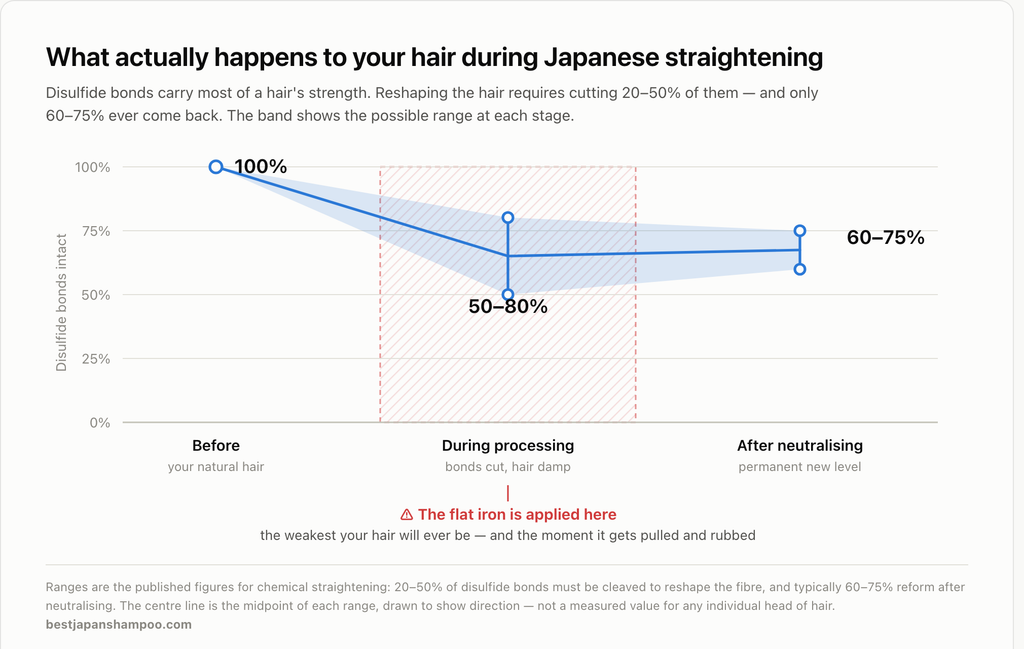
Your hair holds its shape through disulfide bonds: cross-links between protein chains inside the strand. They are also what makes hair strong. Most of a hair’s load-bearing capacity comes from these bonds.
To reshape hair permanently, a reducing agent has to cut them. Not a few of them — between 20% and 50% of the available bonds have to be cleaved before the hair can be reformed into a new shape.
Then the neutraliser reforms them. But not all of them. Typically only 60–75% of the original bonds come back.
So yes: some damage is unavoidable. You cannot restructure hair without paying for it. Anyone who tells you their treatment is damage-free is selling something.
That is the part everyone knows. Here is the part almost nobody says out loud.
The moment your hair is weakest is the moment it gets pulled
Sit with the numbers above for a second.
For the entire middle stretch of the service — after the reducing agent, before the neutraliser — your hair is walking around with up to half of its load-bearing structure deliberately cut open. It is also damp, which weakens it further. Chemically and mechanically, this is the weakest your hair will ever be in its life.
And that is precisely the moment a stylist clamps a hot iron onto it and pulls.
That is not a subtle point. Applying maximum mechanical stress at the exact moment the fibre has minimum ability to resist it is, mechanically, the worst thing you can do to a hair. Everything the chemistry did was reversible-ish and accounted for. What happens under tension in that window is not.
Where I am stating fact, and where I am giving you my judgement
I want to be straight with you, because a lot of hair content blurs this line.
Established: straightening requires cleaving 20–50% of disulfide bonds; those bonds carry most of hair’s strength; only 60–75% reform; wet hair is weaker than dry hair; friction abrades the cuticle.
My professional judgement: that the tension and friction applied during the ironing stage is the largest avoidable cause of damage in this treatment — larger than the difference between one brand of solution and another.
I have not found a controlled study ranking these causes against each other, and I am not going to pretend one exists. What I have is the mechanism above, and six years of seeing which clients’ hair survived and which did not. Make of that what you will — but ask your stylist about it and watch their face.
What a careful stylist does differently
Here is the thing that took me years to fully trust: you do not need tension to straighten hair that is chemically reduced.
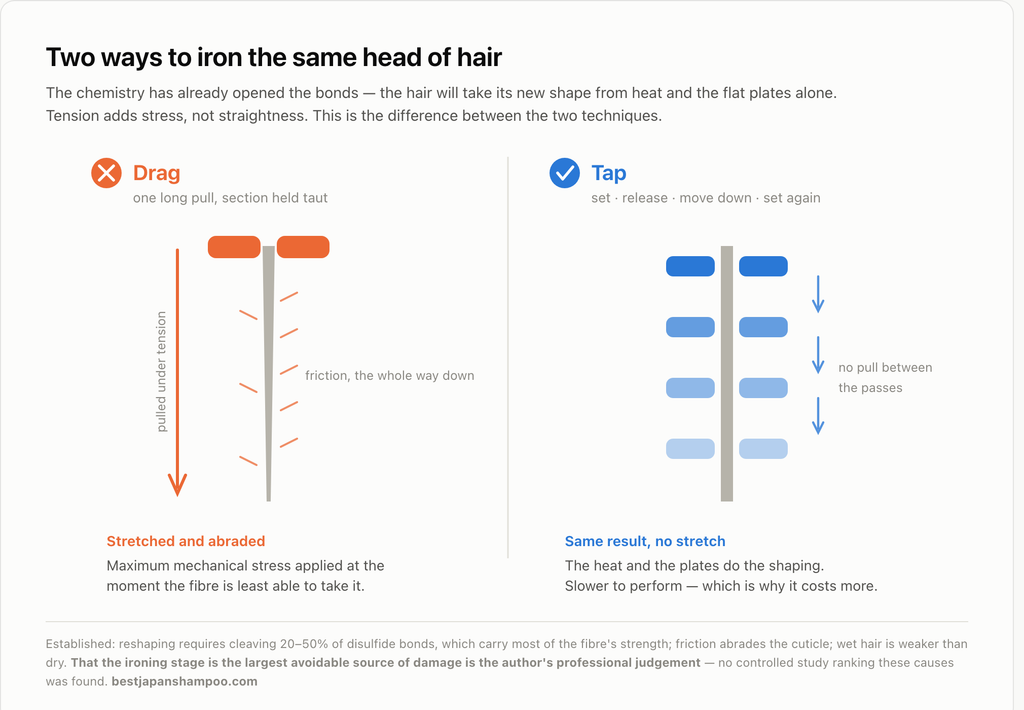
The bonds are already open. The hair is soft and ready to take a new shape. Heat plus the flat surface of the plates is enough. Pulling adds nothing to the result — it only adds stress to a fibre that currently cannot handle it.
So the technique is not one long hard pull down the length. It is a series of light, repeated closures:
Set the iron. Release. Move down. Set again. Tap, don’t drag.
The same rule applies to the iron you use at home. The Japanese flat iron comparison covers why the plate matters less than the temperature and the pull — and which of the KINUJO, Panasonic and ReFa irons are actually sold in the US.
The hair still comes out straight. It comes out straight because the chemistry did the work, not because someone stretched it.
Why doesn’t every salon do this? Because it takes longer. A hard pull down a section is fast. Tapping down the same section, section by section, over a full head, adds real time to a service that is already four to eight hours. That time has to be paid for by someone.
That is the honest economics of it, and it is why the same treatment costs $300 at one place and $800 at another.
Friction is the other half
Tension is the force pulling the fibre apart. Friction is what happens to the surface.
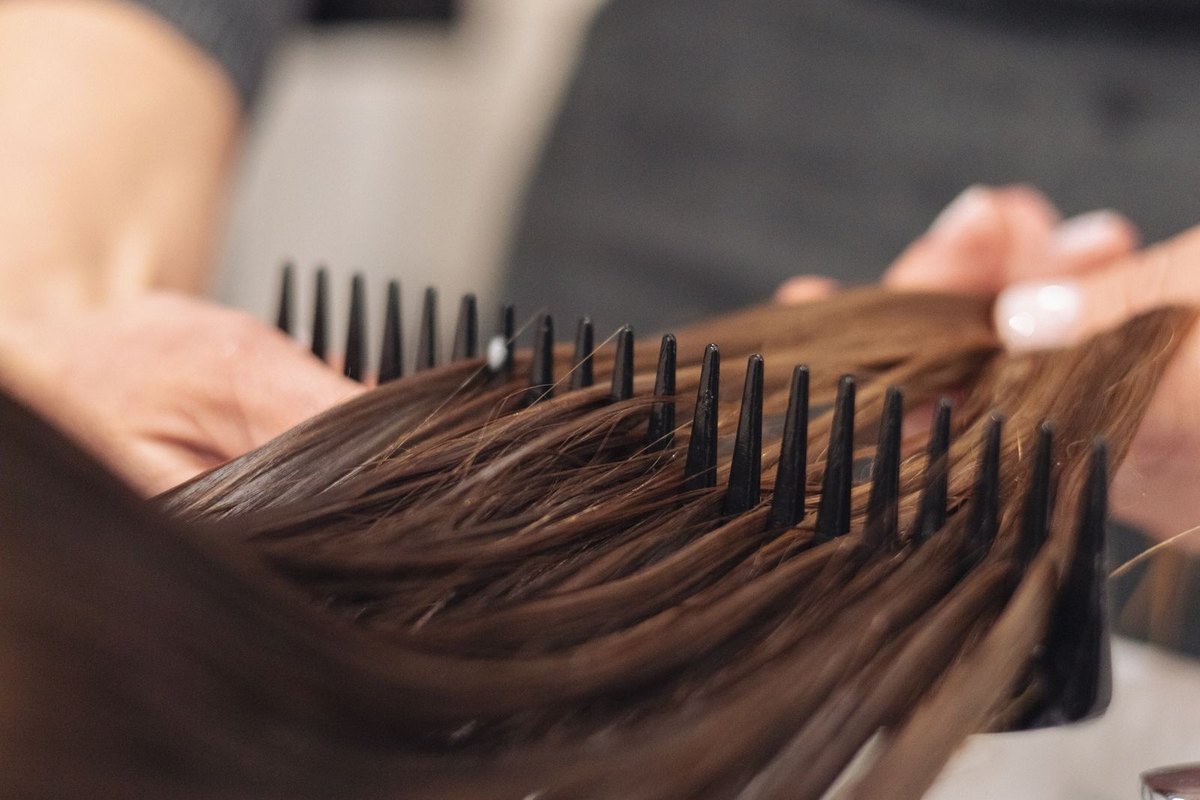
The cuticle — the overlapping scales on the outside of each strand — is swollen and softened during processing. Every drag of a hot plate across it, every comb pulled through under pressure, abrades it. Each friction event removes a little of the protective layer, and unlike the internal bonds, those scales do not grow back.
This is why some straightened hair looks glassy and some looks straight but dull. Dullness is surface damage. It is light scattering off a cuticle that has been sanded.
A stylist who is conscious of this combs gently, uses the comb to guide rather than to tension, and does not scrub the plates back and forth over the same section to “get it smoother.”
What to ask before you book
You cannot watch the technique before you pay. But you can ask, and the answer tells you a lot.
“When you iron, do you pull the section taut, or do you work down it in short passes?”
“Short passes / light tension” — good. A stylist who thinks about this will have an immediate, specific answer, and will often be pleased you asked.
“We pull it firm to get it really straight” — that is the answer that produces snapped ends at month three. Straightness comes from the chemistry, not the pull.
A blank look — they have never thought about it. That is its own answer.
Combine this with the question in our touch-up guide — whether they apply to new growth only — and two questions will tell you more about a salon than any review.
If yours was already done badly
You cannot undo it, and I am not going to sell you a product that claims otherwise.
What you have is hair with an abraded cuticle and fewer intact internal bonds than it started with. That hair is more porous, loses moisture faster, tangles more, and snaps more easily than undamaged hair. It will behave that way until it is cut off.
What you can do is stop adding to it. Which brings us to the part that actually matters day to day.
You are doing the same thing to your hair every day
Here is what struck me most when I stopped working behind the chair and started paying attention to how people treat their hair at home.
The salon does it once. You do it every single day.
The exact two forces I have spent this article warning about — tension and friction — are what most people apply to their own hair every morning and night:
- Rubbing it dry with a towel. Vigorous rubbing against a swollen, wet cuticle is abrasion, straightforwardly. Squeeze and blot instead. A microfibre towel or even a cotton T-shirt is gentler than a terry towel
- Brushing it wet. Wet hair is weaker and stretches more easily. Dragging a brush through it applies tension exactly when the fibre is least able to take it. Detangle dry, or with a wide-tooth comb from the ends upward
- Tying it tight while damp. Same force, applied for hours
- Your own flat iron. Same principle as the salon — light passes, not hard pulls
- Stripping it in the shower. Sulfates lift and swell the cuticle further, which makes every subsequent friction event more damaging
That last one is where product choice actually earns its place. Not because a shampoo repairs anything — it does not — but because a stripping shampoo makes your hair more vulnerable to everything else on this list.
What to use
The requirement is simple: do not swell and strip the cuticle you are trying to protect. Every shampoo here is genuinely sulfate-free, which is the entry condition rather than a feature. Corrected September 2026: Milbon Moisture Replenishing used to head this list. Sodium laureth sulfate is the third ingredient on its panel, so it no longer belongs in a sulfate-free list — it is still a good salon repair shampoo, just not for the weeks right after a chemical service.
| Product | Best for | Price | Where to buy |
|---|---|---|---|
| BOTANIST Botanical (Damage Care) | The safe default after any chemical service — taurate cleanser, no sulfates | $$ | Check Price on Amazon |
| Margaret Josefin Hotel Shampoo | The in-stock fallback when BOTANIST is overpriced or weeks out — amino-acid cleanser, no sulfates | $$$ | Check Price on Amazon |
| &Honey Deep Moist | Hair that already feels rough and porous | $$$ | Check Price on Amazon |
| ONSENSOU Scalp Care Shampoo | A tight, sensitive scalp after treatment | $$ | Check Price on Amazon |
Price bands: $$ mid-range · $$$ premium · $$$$ salon tier. Amazon pricing moves — check the live listing.
If you buy one thing, make it BOTANIST Damage Care. It is usually cheap, it is genuinely sulfate-free, and against the cost of the treatment the difference is rounding.
👉 Check BOTANIST Damage Care on Amazon →
Availability note, September 2026: The word “usually” above is doing work. Japanese shampoo on Amazon US is mostly grey-market, and BOTANIST has been listed anywhere between $20 and $90 depending on who is selling it that week — as of late September the only listing is around $90 with delivery three to five weeks out. If that is what you see when you click through, buy Margaret Josefin instead: an amino-acid cleanser (cocoyl glutamate and a betaine, no sulfates anywhere on the panel) that ships in days and does the same job here.
Do not reach for a clarifying shampoo. Ichikami and similar formulas are good products doing exactly the wrong job here — they exist to strip the shaft. See the sulfate-free guide for gentler options, and the full aftercare guide for the whole routine.
Your dryer matters more than you think
This follows directly from everything above, and it is the piece most people skip.
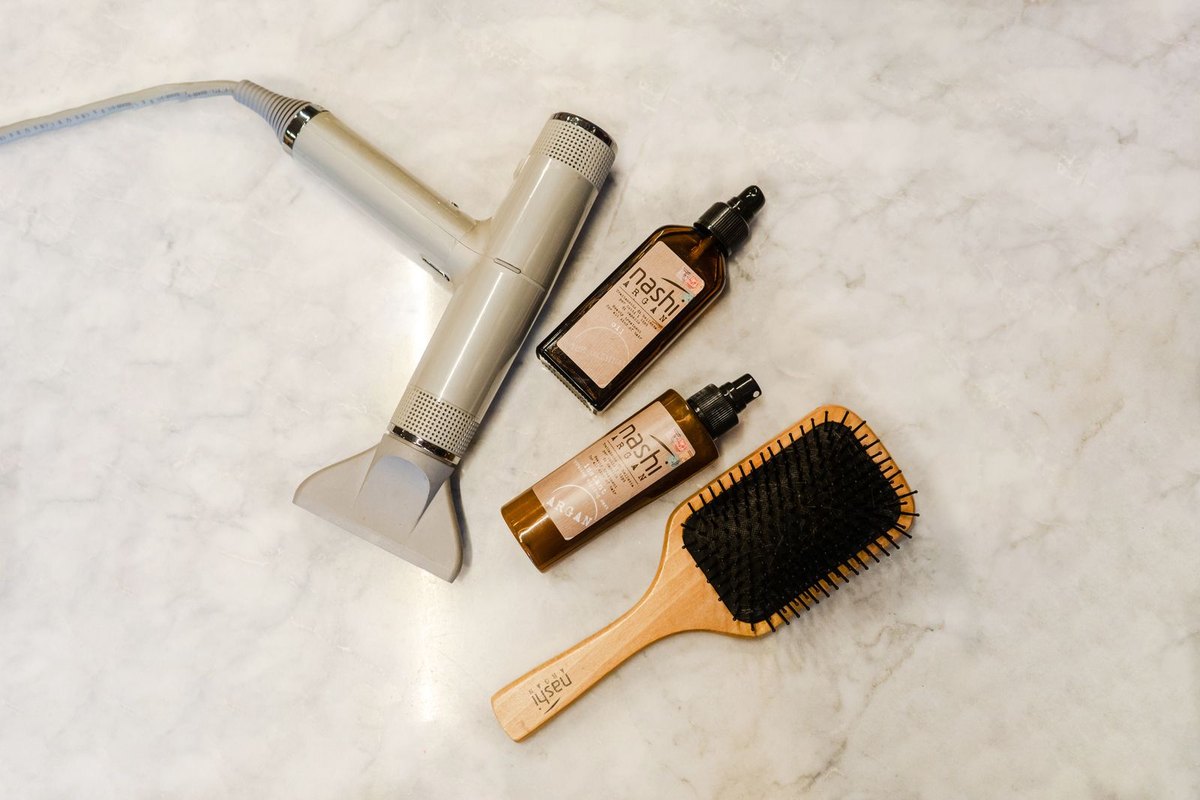
Hair is at its most fragile while it is wet. Every minute it spends damp is a minute it is weak, and every minute you spend working on it damp is mechanical stress applied at the worst possible time.
A dryer that gets hair dry faster and at a lower temperature shortens that window twice over — less time vulnerable, less heat delivered. On straightened hair that you will be blow-drying several times a week for years, that difference compounds in a way a single bottle of shampoo never will.
The Panasonic nanoe range is built around exactly this, and it is what most Japanese salons use:
- Panasonic EH-NA67 Nanoe — the sensible all-rounder
- Panasonic EH-NA0J Nanocare — the flagship
- Panasonic EH-NA27-K — compact, good for fine hair and travel
⚠️ Check the voltage before you order. Japanese domestic models run on 100V and the US runs 120V — our dryer guide covers which models are safe to use abroad and when a transformer is and is not worth it.
👉 Check Panasonic EH-NA67 on Amazon →
FAQ
Is Japanese straightening damaging? Yes, unavoidably to a degree — it requires cleaving 20–50% of the disulfide bonds that give hair its strength, and only 60–75% reform. But how damaging varies enormously between salons, and in my experience that variance is mostly technique, not chemistry.
So the chemicals aren’t the problem? They are a problem, and a known one. My argument is that the tension and friction applied while the hair is in its reduced state is the largest avoidable cause — the part that separates a good result from a bad one.
Can I tell if my treatment was done badly? Not immediately. Straight is straight on day one. The tell shows up at two to three months: snapping mid-length, split ends appearing fast, and hair that looks straight but dull rather than glossy.
Does a gentler technique give a less straight result? No. The straightening comes from the chemistry, not the pull. That is the whole point.
Will a repair product fix mechanically damaged hair? No. Abraded cuticle does not grow back and unreformed bonds do not reform later. Products can smooth, moisturise and prevent further damage. Nothing rebuilds it.
What is the single biggest thing I can change at home? Stop rubbing your hair with a towel and stop brushing it wet. Both apply the exact forces described above, daily, for free.
How soon after the treatment does this matter? Immediately — the first 72 hours have their own strict rules, covered in The First 72 Hours.
The Bottom Line
- The chemistry is unavoidable: 20–50% of bonds cut, only 60–75% reform
- The avoidable damage happens at the iron, when your hair is at its weakest and gets pulled and rubbed
- Straightness comes from the chemistry. Tension adds stress, not results
- Ask your salon whether they pull sections taut or work down in short passes
- At home, you apply the same two forces every day — towel rubbing and wet brushing are the biggest offenders
- Sulfate-free so you are not swelling the cuticle you are protecting: BOTANIST Damage Care
- Dry it faster and cooler so it spends less time fragile: Panasonic nanoe
If you are choosing between treatments in the first place, start with Japanese Straightening vs Keratin instead.
About the author
Mori spent eight years as a licensed hairdresser — two in Shanghai at the Isetan salon, six in Tokyo — specialising in Japanese hair straightening (shukumo kyosei). He no longer works behind a chair but still holds the licence, and lives in Japan.
This article is based on professional knowledge of hair and formulation, plus aggregated customer reviews. It does not claim personal testing of every product. Where a claim is professional judgement rather than established research, it is labelled as such in the text. More about how this site works →