
Mori · licensed hairdresser, 8 years in Tokyo & Shanghai, specialising in Japanese straightening.
Matching a product to a hair type was the job. That is what this article is.
KINUJO and ReFa are the two Japanese dryer brands people argue about in Tokyo salons. They sit in the same price bracket, they both promise hair that looks like it has just been blown out professionally, and they are both sold in every big electronics store here. So the comparison looks like it should come down to taste.
It does not. Two facts settle it before you get to the styling. Neither brand sells a hair dryer on Amazon.com — I re-checked both catalogues on 13 November 2026, and the only KINUJO appliance in the US store is a flat iron. And inside each range, exactly one dryer can be plugged into a US outlet at all. Everything else is built for Japanese 100 V and stays here.
Once you know which two models those are, the choice between the brands becomes a clean one, because KINUJO and ReFa are not selling you the same thing.
⏱️ In a hurry?
Thick, long or slow-drying hair, and you can get to Japan → KINUJO Hair Dryer Voyage HW001 — 290 g, 100–240 V, import only
Fine, bleached or chemically straightened hair → ReFa BEAUTECH DRYER SE W — holds the air under 60 °C, 100–240 V, import only
You want a dryer this week, in the US, with the same low-heat idea → Panasonic EH-NA67 nanoe
Fine hair, small bathroom, smallest spend → Panasonic EH-NA2C nanoe Compact
One dryer for every country, bought locally → Dyson Supersonic Travel
The one KINUJO you can buy in the US today → KINUJO W flat iron
Quick Comparison: Every Current Dryer in Both Ranges
| Model | Voltage | Weight (body) | Airflow | List price, tax incl. | Can you use it in the US? |
|---|---|---|---|---|---|
| KINUJO Hair Dryer Voyage HW001 | AC100–240 V, 1,000 W | 290 g | 2.1 m³/min | ¥35,200 | Yes — import |
| KINUJO Hair Dryer KH301 / KH302 | AC100 V, 1,250 W | 348 g | 2.2 m³/min | ¥35,200 | No — Japan only |
| KINUJO Silk Premium Dryer HP001 | AC100 V, 1,250 W | 392 g | 2.7 m³/min | ¥49,500 | No — Japan only |
| ReFa BEAUTECH DRYER SE W | AC100–240 V, 1,200 W | 330 g | Not published | ¥36,300 | Yes — import |
| ReFa BEAUTECH DRYER SE | AC100 V, 1,100 W | 280 g | Not published | ¥33,000 | No — Japan only |
| ReFa BEAUTECH DRYER SMART W | AC100–240 V, 1,150 W | 520 g with cord | Not published | ¥40,000 | Yes — import |
| ReFa BEAUTECH DRYER S+ | AC100 V, 1,200 W | 495 g with cord | Not published | ¥39,600 | No — Japan only |
| ReFa BEAUTECH DRYER BX | AC100 V, 1,200 W | 740 g with cord | Not published | ¥58,300 | No — Japan only |
| ReFa BEAUTECH DRYER BX W | AC100–240 V, 1,200 W | 775 g with cord | Not published | ¥74,800 | Yes — import |
Figures are from the makers’ own spec pages, read on 13 November 2026. Note the two brands do not even weigh their dryers the same way: KINUJO quotes the body alone, ReFa quotes the body with the cord on its heavier models, so I have marked which is which rather than pretending the column is level.
The Number Each Brand Will Not Print
Read both spec sheets next to each other and you notice something odd. KINUJO leads with airflow and never states a temperature. Every model gets a cubic-metres-per-minute figure — 2.1 for the Voyage, 2.2 for the standard dryer, 2.7 for the Silk Premium — and the heat is described only as far-infrared warmth delivered from three points, with a three-step temperature switch and a SWING mode that alternates hot and cold air by itself.
ReFa does the exact opposite. There is no airflow figure on any ReFa dryer page — not one model, not one number. What ReFa publishes instead is behaviour: a sensing program that reads the room temperature and switches between hot and cold air to hold the air that reaches your hair under 60 °C, winter or summer, with the MOIST mode selected.
That is worth being precise about, because ReFa’s marketing is easy to misread and I have corrected myself on it before. On the SE W and the SMART W, the sensor reads ambient temperature and picks a program; it is not measuring your hair. The only ReFa dryer with a sensor aimed at the hair itself is the older PRO (RE-AJ), which is 100 V and Japan-only — I worked through that distinction in my review of the SMART W.
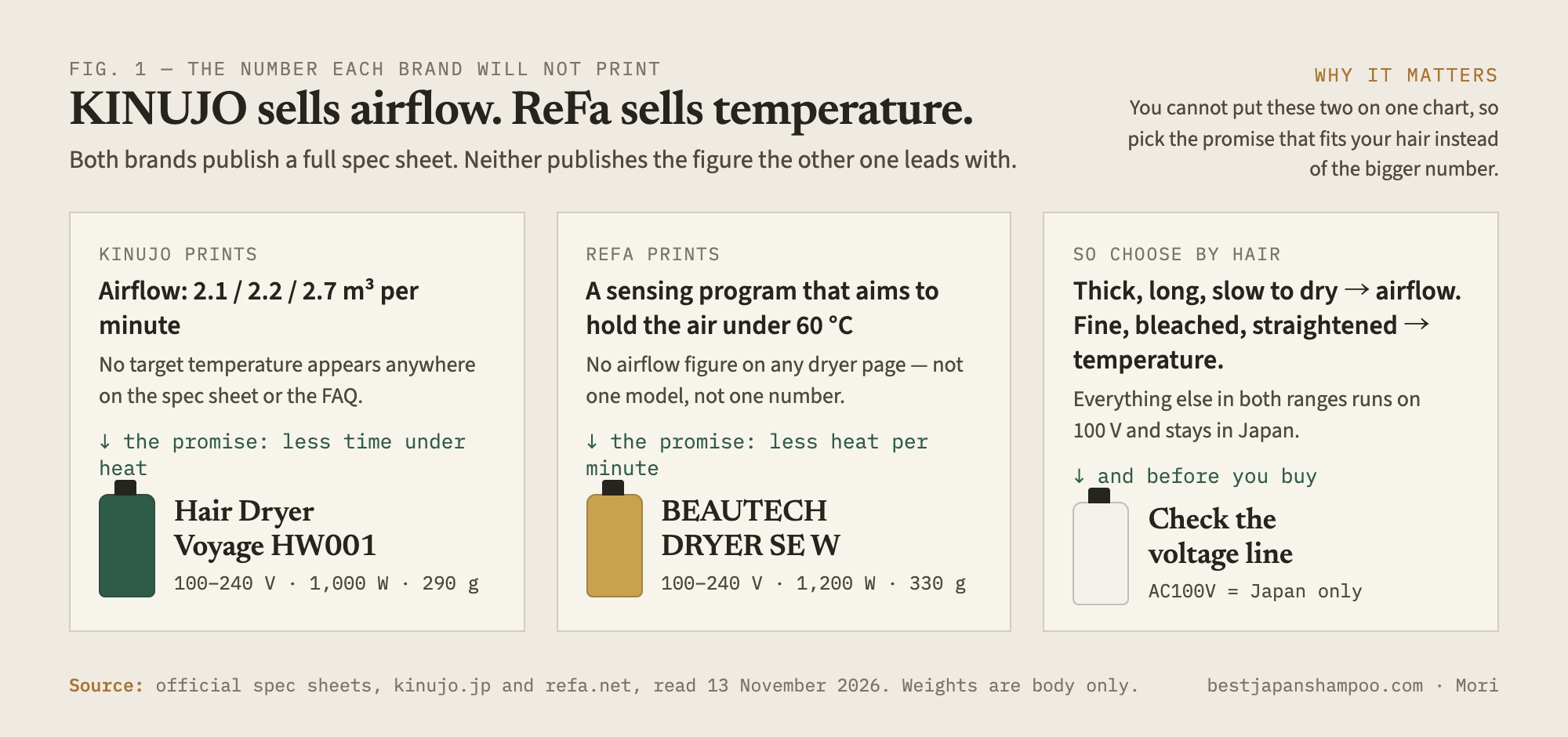
My professional judgement. Heat damage is a product of temperature and time, and the two brands have each picked one of those to attack. More airflow means the water leaves sooner, so the cuticle spends less time hot and swollen — that is the real argument for KINUJO, and on thick or long hair it is the one that shows. Lower air temperature protects the sections that are already fragile, which is why I reach for the ReFa idea on bleached hair and on hair that has been chemically straightened, where the fibre has already been softened once. Neither approach is marketing nonsense. They just suit different heads.
One caution on the numbers themselves: airflow figures are self-measured by the maker, and ReFa’s under-60 °C claim is a target the program aims at, not a guarantee at your scalp. Treat both as the brand’s design intent, which is what they are.
Only One Model From Each Brand Runs on US Power
This is the part that decides most purchases, and it is simple once you see it. Japan runs on 100 V. The US runs on 120 V. A dryer stamped AC100 V is built for Japan and nothing else — KINUJO says so outright in its FAQ for the KH301 and KH302, in two words: domestic only. Run one on 120 V and you are feeding a heating element and a motor twenty per cent more than they were designed for.
A dryer stamped AC100–240 V is a different animal, and here is the detail that surprises people: you do not need a plug adapter in the US. Japanese plugs are the same flat two-pin Type A as American ones, so a Japanese multi-voltage dryer goes straight into a US socket. KINUJO’s own note about needing a conversion plug applies to the rest of the world, not to North America.
So the honest shortlist for anyone outside Japan is three machines: the KINUJO Hair Dryer Voyage HW001, the ReFa BEAUTECH DRYER SE W, and — if money is genuinely not the question — the ReFa BEAUTECH DRYER BX W. The step-down transformer route exists for the Japan-only models and I have written about what that actually costs and weighs, but for a dryer I would not bother. Buy the model that was designed to travel.
KINUJO Hair Dryer Voyage HW001
KINUJO’s travel model is the lightest serious dryer in this comparison at 290 g for the body — about the weight of a small bottle of water — in a case that fits in a hand. It runs 100–240 V, 1,000 W, with three airflow steps, three temperature steps and a cold-shot button, and it moves 2.1 m³ of air a minute. Note that it costs the same ¥35,200 as the full-size Japanese KH301, and that the power and airflow are both slightly lower. At KINUJO, portability is not a premium; it is a trade.
Who it is for. Anyone with thick or long hair who wants a Japanese dryer they can actually use at home in the US, and anyone who travels enough that a 290 g dryer in the case is worth real money. The far-infrared heating is gentle in the way KINUJO claims — in an independent test by the Japanese review site my-best, the standard KINUJO dryer left no hot spots on a thermal camera after drying.
Who should skip it. People who want the quietest possible machine. The same my-best test measured the standard KINUJO dryer at 87.1 dB and took 6 minutes 12 seconds to dry a medium-length mannequin — fast, but not a dryer you use at 6 a.m. in a thin-walled apartment. Skip it too if you want a dryer that manages heat for you; the Voyage gives you switches, not sensors.
Pair it with. A heat protectant and the rough-dry-then-tension technique, not a diffuser — there is no diffuser in the box. If your hair is curly, the airflow is strong enough that you need the hand to control it; my curly-hair routine covers how.
ReFa BEAUTECH DRYER SE W
ReFa’s answer, released on 16 September 2026, is the newest dryer in this comparison and the one I would hand to a client with damaged hair. It is 330 g for the body (470 g once you count the cord), 1,200 W, 100–240 V, and the whole machine is built around the sensing program: pick MOIST and it reads the room and swaps between warm and cool air to keep the stream under 60 °C. It costs ¥36,300.
Who it is for. Fine hair, bleached hair, hair that has had a Japanese straightening treatment, and anyone who over-dries without noticing — which is most people. The SE W takes the decision away from you, and that is its value. It is also the model to pick if you want a ReFa you can use abroad without paying the flagship premium.
Who should skip it. Anyone with a lot of hair who is impatient. ReFa does not publish an airflow figure for any dryer it makes, and when a brand leads with heat control rather than speed, that tells you where its engineering went. If your hair takes twenty minutes to dry, buy airflow. Skip it too if you want a diffuser in the box — you get a styling nozzle.
Pair it with. A lightweight leave-in rather than an oil; the SE W’s cooler air does not drive heavy product in, it just dries around it. If you are already in the ReFa world, my ReFa versus Dyson comparison explains how ReFa’s approach to heat differs from Dyson’s, which measures the air itself over forty times a second.
The Flagships Both Brands Keep at Home
The best dryer each brand makes is one you cannot use outside Japan, and it is worth knowing what you are missing so you can stop wondering.
KINUJO Silk Premium Dryer HP001 (April 2026, ¥49,500) is the airflow argument taken to its end: 2.7 m³ a minute, the most of anything in this article, at 392 g, with a sensing feature that reads the distance between the dryer and your hair and adjusts the airflow by itself. The spec sheet says AC100 V, domestic use only, in plain words.
ReFa BEAUTECH DRYER BX (¥58,300) is the opposite kind of flagship: 740 g with the cord, salon-shaped, priced like a professional tool. ReFa does sell a multi-voltage version, the BX W, but at ¥74,800 it carries a ¥16,500 premium over the Japanese BX purely for the voltage range. Compare that with KINUJO, where the travel model costs exactly the same as the home model. The two brands charge for portability in completely different ways, and if you are importing, that difference is worth more than any feature on either spec sheet.
What to Buy in the US Instead
If importing is not worth it to you — and for most readers it is not — here is what gets you closest to each brand’s idea from a dryer that arrives this week with a US warranty.
Closest to ReFa’s low-heat idea: Panasonic EH-NA67 nanoe. No temperature sensor, but an oscillating nozzle that sweeps the airflow so no single section takes the hot air for long, plus nanoe moisture particles. It is the dryer I recommend most often to people with thick hair, and the diffuser is in the box.
Closest to the Voyage’s size: Panasonic EH-NA2C nanoe Compact. Folding, light, the same nanoe output, and the cheapest way into Japanese dryer technology that you can buy without importing anything. Fine to medium hair only — it does not have the power for a thick head.
If what you actually wanted was one dryer for every country: Dyson Supersonic Travel. Universal voltage, folds, and bought locally with local support — the one thing an imported Japanese dryer can never give you.
If the sensor is the reason you were looking at ReFa: Dyson Supersonic Nural. It is the only dryer in the US catalogue that measures the distance to your head and drops the heat as you come closer — the machine that actually does what people think ReFa does. I compare the two directly in ReFa vs Dyson, and against Panasonic in Dyson vs Panasonic.
Price bands used on this site: $ budget · $$ mid-range · $$$ premium · $$$$ flagship. The Panasonic Compact is $, the EH-NA67 is $$, the Dyson Travel is $$$ and the Nural is $$$$. Amazon pricing moves — check the live listing. The full line-up, including the Panasonic models sold only in Japan, is in my guide to Japanese hair dryers, and the Panasonic-versus-ReFa question has its own article.
The One KINUJO You Can Buy on Amazon US
KINUJO’s dryers are not in the US catalogue, but its flat iron is, and it is the product that made the brand’s name. The KINUJO W worldwide model runs 100–240 V, goes up to 220 °C, and uses the silicone-coated plates that let you work on slightly damp hair without the hiss you get from ceramic. If you came here for the KINUJO feel and the dryer is out of reach, this is the one to buy.
Which model to pick, and whether the plates earn their price, is covered in my KINUJO straightener guide; it is measured against Panasonic and SALONIA in Japanese flat irons.
If You Are in Japan: The Whole Problem Disappears
Everything above is written for someone buying from outside Japan, which is why two thirds of both ranges had to be ruled out. From a Japanese address none of that applies: the 100 V models are the better machines, and they are the ones to buy. Prices are Amazon.co.jp in November 2026, tax included, and they move — check before you buy.
🔴 If you live here, do not buy a travel model. The Voyage and the SE W exist to solve a voltage problem you do not have, and you pay for it — in airflow at KINUJO, in weight and price at ReFa.
KINUJO Silk Premium Dryer HP001 — ¥49,500. 2.7 m³/min, 392 g, three nozzles and a stand in the box. Long or thick hair, dried every night: this is the one in this article I would buy with my own money.
👉 KINUJO シルクプレミアムドライヤー HP001 を Amazon.co.jp で見る →
KINUJO Hair Dryer KH302 — ¥35,200. 2.2 m³/min, 348 g, folds flat. The sensible KINUJO: nearly the airflow of the Premium for ¥14,300 less.
👉 KINUJO ヘアドライヤー KH302 を Amazon.co.jp で見る →
ReFa BEAUTECH DRYER SE — ¥33,000. 280 g, the lightest dryer either brand makes, with the same under-60 °C sensing program as the SE W for ¥3,300 less. For fine or coloured hair in a Japanese bathroom, this is the value pick of the nine machines in the table.
👉 リファビューテックドライヤー SE を Amazon.co.jp で見る →
ReFa BEAUTECH DRYER BX — ¥58,300. The salon-shaped flagship. Heavy at 740 g with the cord, and worth it only if you blow-dry properly with a brush rather than waving the dryer around.
👉 リファビューテックドライヤー BX を Amazon.co.jp で見る →
If you are buying here anyway, compare Yodobashi and Bic Camera with points included before you order — on a ¥50,000 dryer, ten per cent back in points is real money, and the previous generation usually drops in price in autumn when the new models land.
If You Still Cannot Decide
Answer one question: how long does your hair take to dry?
- More than fifteen minutes — buy airflow. KINUJO, in the biggest version you can legally plug in where you live.
- Under ten minutes, and your hair is coloured, bleached or chemically straightened — buy temperature control. ReFa.
- Under ten minutes and your hair is healthy — neither of these is worth importing. A Panasonic nanoe Compact does everything you need.
- You are in Japan — ignore the travel models entirely and use the section above.
FAQ
Can I use a KINUJO or ReFa hair dryer in the United States?
Only the multi-voltage models. The KINUJO Hair Dryer Voyage HW001, the ReFa BEAUTECH DRYER SE W, the SMART W and the BX W are all AC100–240 V and will run on US power as they are. Every other dryer either brand sells is stamped AC100 V and is built for Japan only — KINUJO states this in its own FAQ for the KH301 and KH302.
Do I need a plug adapter?
Not in the United States or Canada. Japanese plugs are the same flat two-pin Type A, so a Japanese multi-voltage dryer goes straight into the wall. Elsewhere you will need an adapter, and KINUJO notes that not every country and region is covered by the 100–240 V range.
Which is better for frizzy or chemically straightened hair?
ReFa, on the logic of the design. Straightened hair has already been through one heat-and-chemistry cycle, and a program that holds the air under 60 °C is doing exactly the right thing for it. The aftercare that matters more than the dryer is in what to wash straightened hair with.
Is KINUJO loud?
The Japanese review site my-best measured the standard KINUJO Hair Dryer at 87.1 dB and dried a medium-length mannequin in 6 minutes 12 seconds in the same test. That is fast and loud, which is the honest summary of the brand. I have not found a matched measurement of a ReFa dryer under the same protocol and in the same round, so I will not give you a number for the comparison — noise figures from different test rounds are not comparable.
Is the Silk Premium worth ¥14,300 more than the standard KINUJO?
If you have long or thick hair and you dry it daily, yes: 2.7 against 2.2 m³ a minute is the biggest airflow step in either range, and the automatic airflow adjustment is genuinely useful. If your hair is short or fine, no — you will use the lowest setting anyway, and you will be carrying 44 g more.
What happened to the ReFa SMART W?
It is still sold, at ¥40,000, and it is still multi-voltage. The SE W that came out in September 2026 is lighter and cheaper with the same sensing idea, which makes the SMART W hard to recommend now unless you want the larger body. My full review of it is here. Ignore any listing labelled 終売 — that is the discontinued first version.
What about the warranty if I import one?
KINUJO gives one year, and both brands service their products in Japan. When I checked ReFa’s FAQ in October 2026 it stated that faults caused by use outside the country of purchase are chargeable even inside the warranty period. Terms change, so read the current wording before you spend the money — and assume that an imported dryer is, in practice, unsupported where you live.
Bottom Line
KINUJO sells airflow. ReFa sells temperature. Thick, long, slow-drying hair wants the first. Fine, coloured, bleached or chemically straightened hair wants the second. That is the whole comparison, and it survives every model change either brand makes.
The second half of the answer is less romantic. Neither brand sells a dryer on Amazon.com, so from the US this is an import decision, and only one model in each range — the Voyage HW001 at 290 g and the SE W at 330 g — is built to run on your power at all. If that is more effort than you want, the dryer that gets you closest to the Japanese idea with a US warranty is the Panasonic EH-NA67 nanoe, and the one that does what people assume ReFa does is the Dyson Supersonic Nural.
And if you are reading this in Japan: buy the 100 V model. The travel versions solve a problem you do not have.
Specifications and list prices are from kinujo.jp and refa.net, read on 13 November 2026. Prices and availability on Amazon change — check the live listing before buying.