
Mori · licensed hairdresser, 8 years in Tokyo & Shanghai, specialising in Japanese straightening.
Matching a product to a hair type was the job. That is what this article is.
Panasonic and ReFa are the two Japanese dryer brands my Tokyo clients asked about most. Both promise the same thing: dry hair faster, at a lower temperature, and leave more moisture in it.
They get there in different ways. Panasonic’s selling point is what it adds to the air — its nanoe particles. ReFa’s selling point is how it limits the heat — a sensor-driven program that keeps the air below set temperatures. That difference decides which one suits your hair.
For readers in the US there is a second difference, and it often matters more: Panasonic makes dryers for the US market that you can buy on Amazon and plug straight in. ReFa does not. No ReFa dryer is listed on Amazon US (I checked again in October 2026), and two of ReFa’s current models are 100 V only. I will cover both questions — how they treat hair, and how you actually get one — and tell you where I land.

⏱️ In a hurry?
Most people in the US → Panasonic EH-NA67 nanoe — 120 V, oscillating nozzle, diffuser in the box
Travel or fine hair, and you want the oscillating nozzle → Panasonic EH-NA2C nanoe Compact
Smallest budget → Panasonic EH-NA27-K nanoe Compact
Fine, bleached or straightened hair, and you are happy to import → ReFa BEAUTECH DRYER SMART W (100–240 V) — not on Amazon US
Avoid unless you own a transformer → ReFa PRO, ReFa SE and Panasonic’s Japan-only nanocare models (100 V)
Quick Comparison
| Line | Weight | Built for | Price | Check Price on Amazon |
|---|---|---|---|---|
| Panasonic EH-NA67 nanoe · US 120 V | Full-size, 1,875 W | Thick, long or curly hair; everyday family dryer | $$ | Check Price on Amazon |
| Panasonic EH-NA2C nanoe Compact · US 120 V | Folding, 1,400 W | Fine to medium hair, travel, small bathrooms | $ | Check Price on Amazon |
| Panasonic EH-NA27-K nanoe Compact · US 120 V | Folding, 1,400 W | Fine or short hair on the smallest budget | $ | Check Price on Amazon |
| ReFa BEAUTECH DRYER SMART W · 100–240 V | 520 g with cord, 1,150 W | Fine, bleached or chemically straightened hair; sensitive scalps | $$$ | Not on Amazon US — see below |
| ReFa BEAUTECH DRYER BX W · 100–240 V | 625 g body, 1,200 W | ReFa’s newest flagship, for people who want the most sensing | $$$$ | Not on Amazon US — see below |
| Panasonic EH-NA0J nanocare · 100 V Japan | Full-size, 1,200 W | Only for people who already own a step-down transformer | $$$$ | Check Price on Amazon |
Price bands: $ budget · $$ mid-range · $$$ premium · $$$$ flagship or import. Check the live listing for today’s price.
The Real Difference: Moisture in the Air vs a Ceiling on the Heat
The marketing for both brands blurs this, so I will separate the manufacturers’ claims from my own view.
Panasonic adds nanoe. Panasonic’s dryers draw moisture from the air and turn it into extremely fine, electrically charged water particles. Panasonic says each nanoe particle carries about 1,000 times more moisture than an ordinary negative ion, and that the particles are small enough to reach into the hair. On the US models, heat is managed mechanically rather than by a sensor: the EH-NA67 and EH-NA2C have an oscillating QuickDry nozzle that sweeps the airflow back and forth so no single spot keeps taking the hot air, and the EH-NA27-K’s QuickDry nozzle alternates strong and soft airflow. Panasonic’s Japan-only nanocare models go further — the EH-NA0J has an air-temperature sensor and a room-temperature sensor, and a Scalp mode that runs at about 60 °C.
ReFa caps the temperature. ReFa’s maker, MTG, describes the SMART W this way: a built-in sensor reads the room temperature, and the dryer chooses a program that adjusts the air temperature automatically, aiming for under 50 °C at the scalp and under 60 °C at the ends. The program runs only when you switch it on (SCALP or MOIST), and the manual notes that its figures assume the nozzle is about 10 cm from your head. The dryer also produces what ReFa calls hydro ions. The newer BX W (released in Japan on 8 October 2025) adds a second layer — MTG says it uses separate sensors for the scalp and the hair and analyses the scalp, the hair and the air in real time.
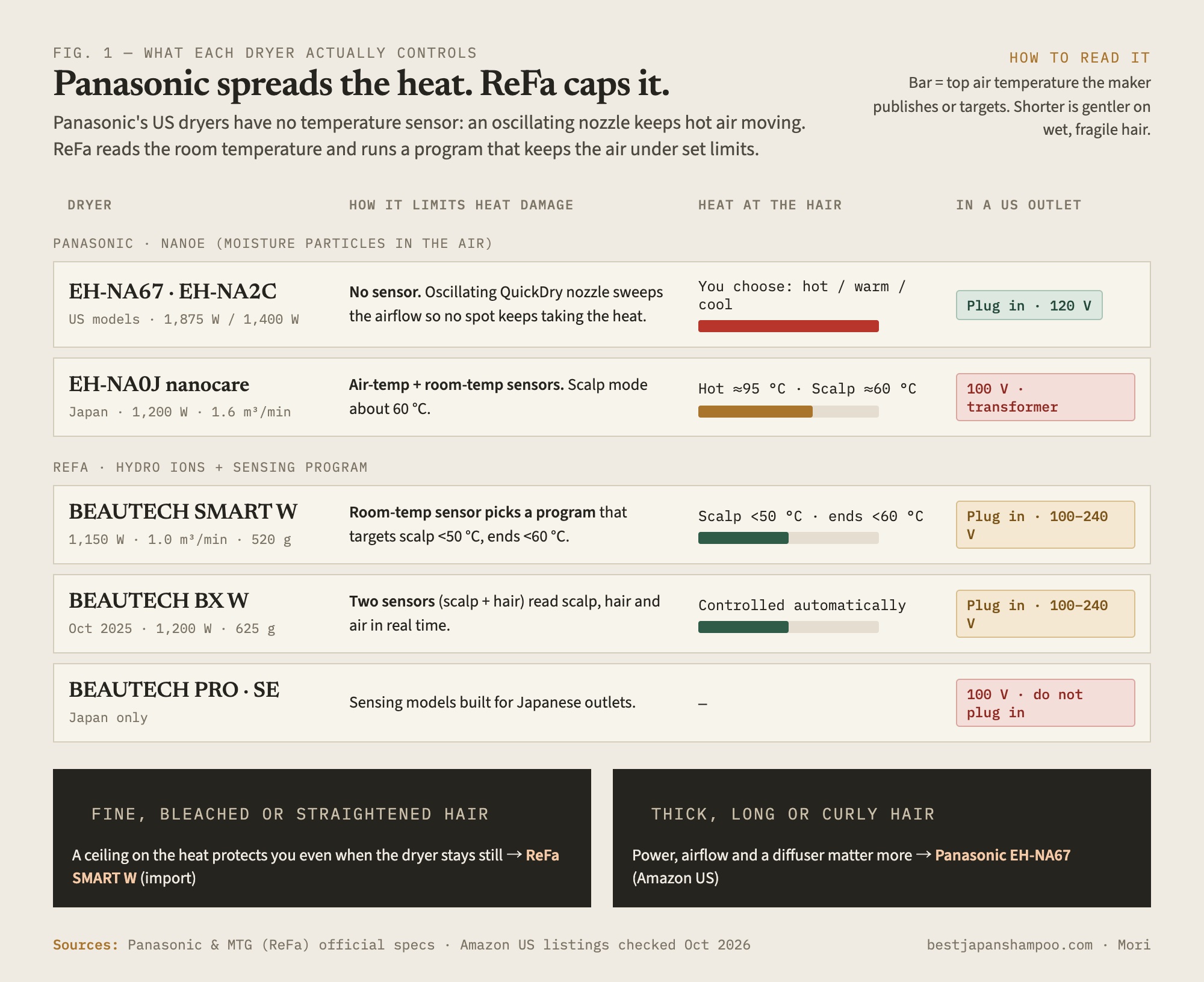
My professional judgement. Heat damage during drying comes from temperature multiplied by time on wet hair. Wet hair is at its weakest — the straightening damage article explains why — so the question is what stops one wet section from sitting under hot air for too long.
ReFa answers that with a ceiling: whatever you do with your hands, the air is kept below a temperature at which hair is unlikely to be harmed. That protects the person who holds the dryer still. Panasonic’s US models answer it with movement: the oscillating nozzle spreads the heat, but the top setting is still hot, and if you park the dryer on one section the nozzle cannot fully save you.
The nanoe particles are the part I value least. Hair dried with nanoe does feel smoother and less static to me, and that is real. But what saves bleached or straightened hair is keeping the temperature down, not adding particles — so for fragile hair, ReFa’s approach is the more protective one. For healthy, thick or curly hair, Panasonic’s more powerful airflow and diffuser matter more than a heat ceiling.
Panasonic EH-NA67 nanoe — The Best Choice for Most People in the US
Voltage: US 120 V · Style: Full-size, 1,875 W · Built for: Every hair type, especially thick, long or curly
The EH-NA67 is Panasonic’s full-size nanoe dryer for the US market, sold by Amazon.com. It has three heat settings, two speeds and a cool shot, and three attachments: the oscillating QuickDry nozzle, a concentrator, and a full-size diffuser.
The diffuser is the reason I recommend it over any ReFa for curly hair. Frizz on curls is decided in the minutes after the shower, and a diffuser is the tool that controls it (see the curly hair products guide). No ReFa dryer includes one.
Who it is for
- Anyone in the US who wants a Japanese dryer that plugs straight in, with a US warranty
- Thick, long or coarse hair that takes a long time to dry
- Curly, wavy or coily hair that needs a diffuser
Who should skip it
- People who always dry on the highest heat and hold the dryer still — it has no temperature sensor
- Frequent flyers — it is 120 V only and full-size
Pair it with a heat-aware routine: towel-dry well, medium heat, finish on cool. For straightened hair, the shampoo matters as much as the dryer — see the aftercare guide for straightened hair.
Panasonic EH-NA2C nanoe Compact — The Small One With the Oscillating Nozzle
Voltage: US 120 V · Style: Folding, 1,400 W · Built for: Fine to medium hair, travel, small spaces
The EH-NA2C is the compact nanoe dryer that keeps the EH-NA67’s best feature: the oscillating QuickDry nozzle. It folds, it has high, medium and cool settings, and it fits in a carry-on bag.
At 1,400 W it has less raw power than the EH-NA67. For fine hair I see that as an advantage: lower wattage with a moving nozzle means it is genuinely hard to overheat a section. Of everything in this article that you can buy on Amazon US, it comes closest to ReFa’s gentle approach.
Who it is for
- Fine, thin or shoulder-length hair
- Travel within the US, dorm rooms, small bathrooms
- Anyone who likes the idea of ReFa’s gentleness but wants to buy a dryer here
Who should skip it
- Thick, long or curly hair — it is under-powered for that, and there is no diffuser
- International travel — it is 120 V only
Panasonic EH-NA27-K nanoe Compact — The Budget Pick
Voltage: US 120 V · Style: Folding, 1,400 W · Built for: Fine or short hair, smallest budget
The EH-NA27-K is the older compact model. It has nanoe, 1,400 W, high, medium and cool settings, a folding handle and an easy-clean filter. Its QuickDry nozzle alternates strong and soft airflow rather than oscillating. If the EH-NA2C costs about the same on the day, take that one.
Who it is for
- Fine or short hair
- A first Japanese dryer, or a second one for the gym bag
Who should skip it
- Thick, long or curly hair
- Anyone who wants the oscillating nozzle — that is the EH-NA2C
ReFa BEAUTECH DRYER SMART W — The Gentler Dryer, If You Import It
Voltage: 100–240 V worldwide · Style: 520 g including cord, 1,150 W, about 1.0 m³/min · Built for: Fine, bleached or straightened hair; sensitive scalps
The SMART W is the ReFa I recommend for the US. It runs on 100–240 V, and because Japan and the US use the same two-pin plug shape, it plugs straight into a US outlet with no adapter or transformer. It has the temperature-capping program (scalp under about 50 °C, ends under about 60 °C), SCALP and MOIST modes, and hydro ions. Model numbers start RE-AX.
In the salon, the hair I worried about most was bleached or chemically straightened hair, which has lost part of its internal structure. For that hair — and for a scalp that burns after blow-drying — a dryer that limits its own temperature is worth the slower drying.
The cost of that gentleness is speed. At 1,150 W and about 1.0 m³/min, it dries thick or long hair slowly, and it comes with a styling nozzle but no diffuser.
Where to buy: ReFa’s dryers are not listed on Amazon.com as of October 2026. The SMART W is sold by ReFa in Japan and by Japanese export retailers, and a warranty claim usually means sending it back to Japan. No affiliate link, so no button.
For the full picture before importing — the RE-AX model number, how its room-temperature sensing works, and the warranty catch — see my ReFa SMART W review.
Who it is for
- Fine, bleached or chemically straightened hair
- Sensitive or easily irritated scalps
- Anyone who has burned their hair with a dryer before
Who should skip it
- Thick, very long, coarse or curly hair
- Anyone who wants a US warranty and an easy return
ReFa BEAUTECH DRYER BX W — ReFa’s Newest Flagship (Import Only)
Voltage: 100–240 V worldwide · Style: 625 g body, 1,200 W · Built for: People who want ReFa’s most advanced sensing and do not mind the price
Released in Japan on 8 October 2025, the BX W has two sensors — one for the scalp, one for the hair — plus a new double-ion system, according to MTG. It is multi-voltage, so it works in a US outlet as is.
My professional judgement: it is heavier than the SMART W and costs far more, and the SMART W already gives fragile hair the protection that matters — a temperature ceiling. Not on Amazon US either.
The 100 V Trap: Three Models That Do Not Belong in a US Bathroom
Both brands sell some of their most famous dryers in Japan at 100 V only. Here is the danger: Japanese plugs have the same shape as US plugs, so these dryers fit a US outlet — but at 120 V they run over-voltage, and you risk ruining the dryer or worse.
- ReFa BEAUTECH DRYER PRO — the most powerful ReFa (1,200 W, about 1.4 m³/min). 100 V.
- ReFa BEAUTECH DRYER SE — ReFa’s smallest dryer (280 g, released October 2025). ReFa’s own FAQ says it is for use in Japan only.
- Panasonic EH-NA0J and EH-NA0K nanocare — the Japanese flagships. The EH-NA0J is on Amazon US through a third-party seller, still at 100 V.
The only safe way to use them is with a step-down transformer rated around 3,000 W, because dryers draw far more than their rated wattage at start-up. The 100 V problem guide walks through the arithmetic. If you already own a transformer, the EH-NA0J is Panasonic’s best dryer and a 3,000 W step-down transformer is what it needs. Most people should not go down this route.
Panasonic vs ReFa by Hair Type
Thick, long or curly hair → Panasonic EH-NA67. Airflow and the diffuser decide it.
Fine or thin hair → ReFa SMART W if you will import; the Panasonic EH-NA2C if you will not.
Bleached or chemically straightened hair → ReFa SMART W is the gentler machine. The EH-NA2C on medium heat is the closest option you can buy here. If you also straighten with irons, the Japanese flat iron comparison covers the other heat tool.
Sensitive scalp → ReFa SMART W in SCALP mode.
If You Still Cannot Decide
You live in the US and want one Japanese dryer, bought easily → Panasonic EH-NA67.
Your hair is fine or fragile and you will not import → Panasonic EH-NA2C.
Your hair is fragile and importing does not bother you → ReFa SMART W.
You are considering ReFa because of the price tier, not the Japanese approach → also look at Dyson. The ReFa vs Dyson comparison covers that choice, and the full Japanese dryer guide adds KINUJO.
Choosing between Panasonic and Dyson instead? Both plug straight into a US outlet — the Dyson Supersonic vs Panasonic nanoe comparison explains how each one protects hair and who should pay for the Dyson.
If You Live in Japan: Skip the Transformer Entirely
The transformer section above exists because the EH-NA0J is a 100 V machine being sold to 120 V households. In Japan that whole problem does not exist, and it changes the recommendation. Prices are Amazon.co.jp in November 2026, tax included, and move quickly — check before you buy.
Panasonic nanocare EH-NA0K — about ¥34,200. This is the current flagship that replaced the EH-NA0J. No transformer, no export seller, full warranty. For most people in Japan this is the end of the decision.
👉 Panasonic EH-NA0K を Amazon.co.jp で見る →
nanocare ULTIMATE (EH-NC50) — about ¥55,000, Panasonic’s top tier.
👉 nanocare ULTIMATE を Amazon.co.jp で見る →
ReFa BEAUTECH DRYER SMART W — about ¥40,000. In the US this comparison is lopsided because the ReFa has to be imported. In Japan the two sit within a few thousand yen of each other, so the choice comes down to the sensing behaviour rather than to price or availability.
👉 ReFa SMART W を Amazon.co.jp で見る →
FAQ
Is ReFa better than Panasonic? For fine, bleached or straightened hair, ReFa’s temperature-capping program is the more protective design. For thick, long or curly hair, and for buying easily in the US, Panasonic is the better choice.
What is the difference between nanoe and ReFa’s hydro ions? Both are moisture-related particles added to the airflow. Panasonic says nanoe particles carry about 1,000 times more moisture than ordinary negative ions; ReFa does not publish a comparable figure for hydro ions. In my experience the difference you can feel comes more from temperature control than from either ion system.
Can I buy a ReFa hair dryer on Amazon US? Not as of October 2026. The SMART W and BX W are sold by ReFa in Japan and by Japanese export retailers.
Does the ReFa dryer work in the US? The SMART W and BX W do — both are 100–240 V, and the Japanese plug fits a US outlet without an adapter. The PRO and SE are 100 V and should not be plugged into a US outlet without a step-down transformer.
Do Panasonic’s US dryers have a temperature sensor? No. The EH-NA67 and EH-NA2C spread the heat with an oscillating nozzle instead. The temperature sensors are on Panasonic’s Japan-only nanocare models.
Which dryer is best after Japanese straightening? Whichever one keeps the temperature low and stays moving. The ReFa SMART W does this automatically; with a Panasonic, use medium heat and keep the nozzle moving.
Bottom Line
Panasonic and ReFa protect hair in different ways: Panasonic adds moisture to the air and spreads the heat; ReFa caps how hot the air gets. ReFa is the gentler dryer and the harder one to buy. Panasonic is the more powerful one and the one you can plug in today.
Most people in the US → Panasonic EH-NA67 Fine hair, travel, gentle on Amazon → Panasonic EH-NA2C Budget → Panasonic EH-NA27-K Fragile hair, happy to import → ReFa BEAUTECH DRYER SMART W (100–240 V)
The third Japanese pairing readers ask about is the home-grown one: KINUJO vs ReFa compares airflow against temperature control, and explains why neither brand sells a dryer on Amazon.com.
Prices and availability on Amazon change. Check the live listing before buying.